









Can You Tile a Sauna? What Actually Holds Up to Heat
Yes, tile works in a sauna, but only with the right materials and installation method. Skip either one and you’re looking at cracked floors, lifted grout, or a slip-and-fall risk within a season or two.
The single most important action: choose heat-resistant, low-water-absorption tile paired with sauna-rated adhesive, then plan waterproofing and expansion joints before anything gets set. Get that sequence wrong and everything downstream fails with it.
Skip these steps and you’ll likely face:
- Thermal shock cracking from tile that was not rated for rapid heat cycling
- Slippery footing on the wrong finish, especially near water.
- Adhesive failure when standard thinset breaks down near the heater.
- An undersized heater struggling to overcome the added thermal mass
Table of Contents
- Does Tile Work for Every Type of Sauna?
- Which Tile Materials Actually Perform in a Sauna?
- What Does Proper Sauna Tile Installation Require?
- How Slip Resistant Does a Sauna Floor Need to Be?
- Will Tile Change How Much Heater You Need?
- How Do You Maintain a Tiled Sauna Long Term?
- How Sauna Heater Supply Supports a Tiled Sauna Build
- Why the Standard Sauna Tile Advice Falls Short
- Get the Right Heater for Your Tiled Sauna Project
- Sources
Does Tile Work for Every Type of Sauna?
Sauna type dictates the material list more than any other single factor. A traditional Finnish dry sauna, a steam room, and an infrared cabin each punish tile differently, and treating them the same is where most installations go wrong.
Finnish dry saunas swing from room temperature to high temperatures in minutes, then cool again after each session. That cycling is exactly what ISO 10545-9 thermal shock testing is designed to catch, and floors also need real barefoot traction since bathers walk in without shoes on a warm, sometimes damp surface.
Steam rooms and hammams run cooler but stay saturated with moisture for hours at a time. Here, low water absorption and continuous waterproofing matter more than thermal shock resistance, since tile that wicks moisture eventually fails at the grout line or delaminates from the substrate.
Infrared rooms run milder and drier, so they tolerate a wider range of tile without the strict thermal-shock demands of a wood-fired dry sauna.
Transition zones deserve extra attention regardless of sauna type:
- Entryways and shower thresholds see the wettest conditions with the least warning
- These areas need the highest slip rating in the entire installation
- Drainage matters as much here as anywhere inside the sauna itself
Which Tile Materials Actually Perform in a Sauna?
Porcelain in the BIa classification is the default choice for most sauna zones, floors and walls alike. It carries water absorption at or below 0.5 percent and holds up to documented thermal-shock cycling, which is exactly what a floor near a heater needs to survive its first winter.
Large-format rectified porcelain looks sharp as an accent wall, but it demands real joint planning. Skip the near-zero grout lines that look good in a bathroom, because heat-driven expansion needs somewhere to go.
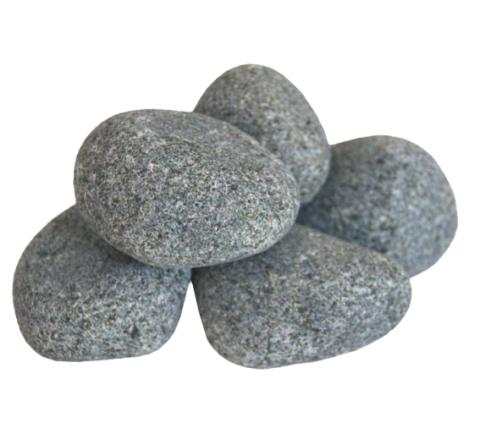
Soapstone earns its reputation around heater surrounds specifically. It stores and releases heat evenly, resists thermal shock better than most stone, and has been a heater-surround standard for decades in stone fabrication circles. It’s also soft compared to granite or quartzite, so it needs to be cut to final dimension before installation and handled carefully to avoid chipped edges in transit.
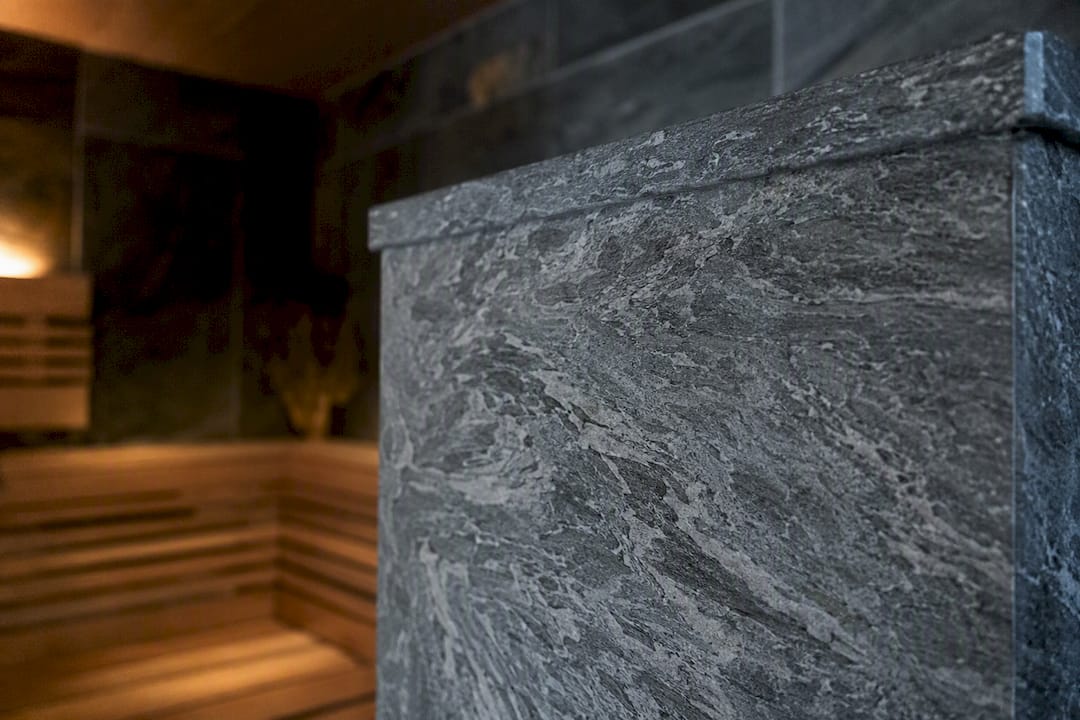
Slate and quartzite both hold up on steam-room floors, provided they get sealed with a steam-rated impregnating sealer before grouting, not after.
Pro Tip: Never install marble, limestone, or travertine in a sauna. These calcite stones etch under acidic cleaning products and can spall or discolor under repeated heat cycling. Peel-and-stick tile products belong on this same do-not-use list, since their adhesive backing was never engineered for sustained heat.
What Does Proper Sauna Tile Installation Require?
Getting tile to survive a sauna’s heat and humidity cycle comes down to five decisions made before a single tile goes down.
- Waterproof the substrate first. A continuous waterproofing membrane applied before tile setting is what protects the structure behind the wall from years of moisture infiltration. Lap every seam and transition carefully. Sauna Heater Supply’s own waterproofing breakdown covers membrane types and where installers most often miss a seam.
- Match adhesive to zone. Near the heater, standard latex-modified thinset isn’t rated for the temperatures involved. Use heat-resistant epoxy or calcium aluminate mortar in that zone instead. In steam-room floors and walls away from direct heater contact, a polymer-modified thinset meeting EN 12004’s C2TE classification handles the humidity load.
- Build in expansion joints everywhere. Skip standard grout in heat zones and use high-temperature silicone instead, particularly around the perimeter and at panel breaks. For soapstone panels, plan a minimum expansion gap, often around 3 millimeters, to prevent buckling during the first full heat cycle.
- Slope the floor toward a drain. Wet-area sauna floors need real pitch, not a flat pour with hope. A removable cedar duckboard over the tile keeps the traditional wood feel underfoot while the tile underneath handles drainage and sanitation.
- Coordinate radiant heat with the manufacturer. If you’re installing electric radiant heating under tile, follow that manufacturer’s spacing and clearance instructions to the letter, and check compatibility with your sauna heater’s own clearance requirements.
Skipping any one of these five steps tends to surface as a problem within the first heating season, not years down the road.
How Slip Resistant Does a Sauna Floor Need to Be?
Barefoot traction on a warm, occasionally damp tile floor isn’t optional. The DIN 51097 barefoot rating system splits surfaces into three classes: A for the lowest slip risk, B for moderate wet-barefoot traffic, and C for the highest-risk wet areas.
Sauna floors themselves should meet at least Class B. Transition zones, showers, and any threshold where standing water is likely need Class C.
- Check the tile’s technical data sheet for its DCOF or COF rating before ordering, not after
- A wet-rated finish beats a polished or high-gloss surface every time in these spaces
- Duckboards and anti-slip strips work as a stopgap over an existing floor that doesn’t meet the rating you need
Will Tile Change How Much Heater You Need?
Tile and stone don’t just sit on a surface, they absorb and hold heat, which means your heater works harder and longer to reach setpoint than it would with a wood-lined room. A heavily tiled or stone-clad sauna can noticeably delay warmup and blunt the perceived heat intensity bathers feel once the room does reach temperature.
A conservative approach: size up a step from what a standard wood-interior calculation suggests whenever you’re adding tile or stone cladding beyond a small heater surround, then confirm the number with the heater manufacturer or a sauna professional before you buy. Heaters like the Harvia Kip45W package or the IKI Pillar 9kW give you headroom that a stone-heavy build will actually use.
- Always follow the heater manufacturer’s minimum clearances around any tile or stone cladding
- Clearance violations create both a fire risk and an uneven heat pattern across the room
How Do You Maintain a Tiled Sauna Long Term?
Natural stone needs sealing before it ever sees a heat cycle, not after problems show up. Seal the back and sides of the stone before installation, then apply a final coat once grouting is finished.
Weekly cleaning stays simple: mild soap and water on porcelain, nothing acidic on soapstone, slate, or quartzite, since acidic cleaners etch calcite-bearing stone over time. Reseal natural stone roughly once a year, or sooner if water stops beading on the surface. Mineral staining from hard water responds to a stone-safe cleaner rather than anything acidic.
Pro Tip: If grout starts crumbling or you see a seal failure spreading across more than a small patch, call a tile professional rather than patching it yourself. A failed membrane behind the tile is far more expensive to fix once it’s spread than it would have been to catch early.
How Sauna Heater Supply Supports a Tiled Sauna Build
Getting the heater size right matters as much as the tile choice itself, and that’s the piece Sauna Heater Supply focuses on. Author Teddy has spent years matching heater output to real-world sauna builds, including stone-heavy and tile-clad rooms where standard sizing charts fall short.
- Browse heater packages built for added thermal mass, including the Saunum Air 7 and the Finnmark Thermo-Aspen FD-7
- Read the heater installation guide for clearance specifics before you finalize your tile layout near the heater
- Review safe water-on-heater practices if you’re planning a combination steam and dry sauna space
- Reach out directly for bespoke product selection when your project mixes tile, stone, and a heater spec that doesn’t fit an off-the-shelf chart
| Point | Details |
|---|---|
| Material comes first | Porcelain BIa or sealed soapstone, slate, and quartzite outperform marble or limestone in heat and moisture. |
| Waterproofing is non-optional | A continuous membrane before tile setting protects the structure from years of moisture damage. |
| Adhesive must match the zone | Epoxy or calcium aluminate mortar near the heater, C2TE polymer-modified thinset elsewhere. |
| Slip rating drives safety | DIN 51097 Class B for sauna floors, Class C for wet transitions and thresholds. |
| Heater sizing shifts with tile mass | Size up a step from a wood-interior calculation and confirm with the heater maker, using packages like those Sauna Heater Supply carries. |
Why the Standard Sauna Tile Advice Falls Short
Most tile guides treat a sauna like any other wet room, borrowing bathroom specs and hoping they hold. They don’t, not once you account for a heater surface pushing past 400 degrees Fahrenheit within a few feet of tile that’s supposed to survive decades of cycling.
The conventional wisdom undersells thermal shock and oversells appearance. A gorgeous large-format porcelain slab with barely visible grout lines photographs beautifully and cracks by the second winter if nobody planned for expansion. The standards exist for a reason: ISO 10545-9 and DIN 51097 aren’t marketing checkboxes, they’re the difference between a floor that lasts fifteen years and one that needs replacing after two.
If you take one thing from this guide, prioritize heater sizing before you fall in love with a tile pattern. A gorgeous soapstone heater surround on an undersized heater just means a beautiful room that never gets hot enough to matter. Get the heat source right first, then build the finish around it.
— Teddy
Get the Right Heater for Your Tiled Sauna Project
Sauna Heater Supply is the resource for readers who don’t want to guess at heater sizing after already committing to tile or stone. Instead of scaling a heater to a generic wood-interior chart, our team helps you account for the actual thermal mass your tile or soapstone surround adds, so the room reaches temperature the way it should.

Whether you’re weighing a compact electric unit like the IKI Pillar 9kW or a larger barrel setup like the Finnmark Cedar Combination FD-6, our catalog covers the sizing range a tiled build actually needs. Round out the space with a SaunaLife bucket, ladle, hygrometer, and thermometer set for practical daily use.
Browse heater packages sized for tile and stone mass, or contact our team with your project specs before you finalize your tile order.
Sources
- Sauna tiles: complete selection guide for 6 zones
- Stone in Sauna and Steam Rooms: Materials, Sealing & Installation – Dynamic Stone Tools
Recommended
- How to Insulate Your Sauna for Maximum Efficiency — Sauna Heater Supply
- Best Sauna Rocks: Top Stone Types for Heat and Safety — Sauna Heater Supply
- Sauna Ceiling Height: Exact Measurements for Builders — Sauna Heater Supply
- Wood burning vs electrical sauna heaters: a comprehensive guide — Sauna Heater Supply