








How to Insulate Your Sauna for Maximum Efficiency

Think of the last time you stepped into your backyard sauna, expecting a wave of soothing heat, only to find the air lukewarm, even after waiting nearly an hour. The heater's working, the temperature's set high, but the warmth isn't there. Does this sound familiar?
At SaunaHeaterSupply, we often hear this during consultations. And more often than not, the problem isn't the heater; it's the insulation.
Poor insulation is a common reason saunas take forever to heat up and struggle to maintain a steady temperature. Heat slips out through unsealed gaps and thin walls, making your sessions less efficient and far more frustrating than they should be.
In this guide, we'll show you exactly how to insulate your sauna (indoors or outdoors) for maximum heat retention and energy efficiency.
Table of Contents
- What You Should Know About Heat Dynamics in Saunas
- R-Value Requirements: Establishing Insulation Benchmarks
- Best Types of Insulation Material For Saunas
- Vapor Barrier Essentials: Moisture Management
- Key Areas in Sauna To Prioritize for Insulation
- Indoor vs Outdoor Sauna Insulation Specifics
- Insulation for Different Sauna Heating Systems
- Common Insulation Mistakes (And How To Avoid Them)
What You Should Know About Heat Dynamics in Saunas
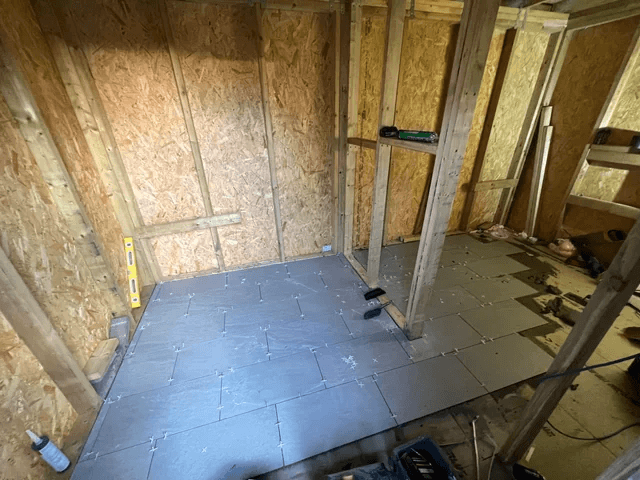
Several heat transfer principles are fundamental to sauna environments. They explain how heat circulates and is transferred from the heater to the body.
Conduction
Conduction occurs when heat moves through solid materials like the walls, floors, and benches. Better insulation ensures less heat loss. Poorly insulated objects absorb heat outward, increasing energy and heat loss.
Convection
Convection is where air is heated and circulated throughout the sauna space, transferring heat to the air and your body. The shape of the room affects the rate of convection.
Radiation
In radiation, long-wave infrared energy is emitted directly into the skin instead of heating the air. This method improves energy efficiency.
Apart from these three dynamics, steam and vapor are also present in a humid sauna. A vapor barrier, usually made of foil or polyethylene, prevents moisture from seeping into the walls and insulation.
This helps prevent moisture build-up, which can degrade insulation, lead to mold growth, and reduce energy efficiency.
Proper installation ensures that the hot air, humid or not, stays inside instead of escaping into the walls.
You can be sure your sauna heaters will be efficient with quality insulation.
Proper insulation reduces heat loss, allowing the heaters to run less and making it easy to maintain the desired temperature.
It also ensures even heat distribution, less heat-up time, and lower energy bills in the long run.
R-Value Requirements: Establishing Insulation Benchmarks
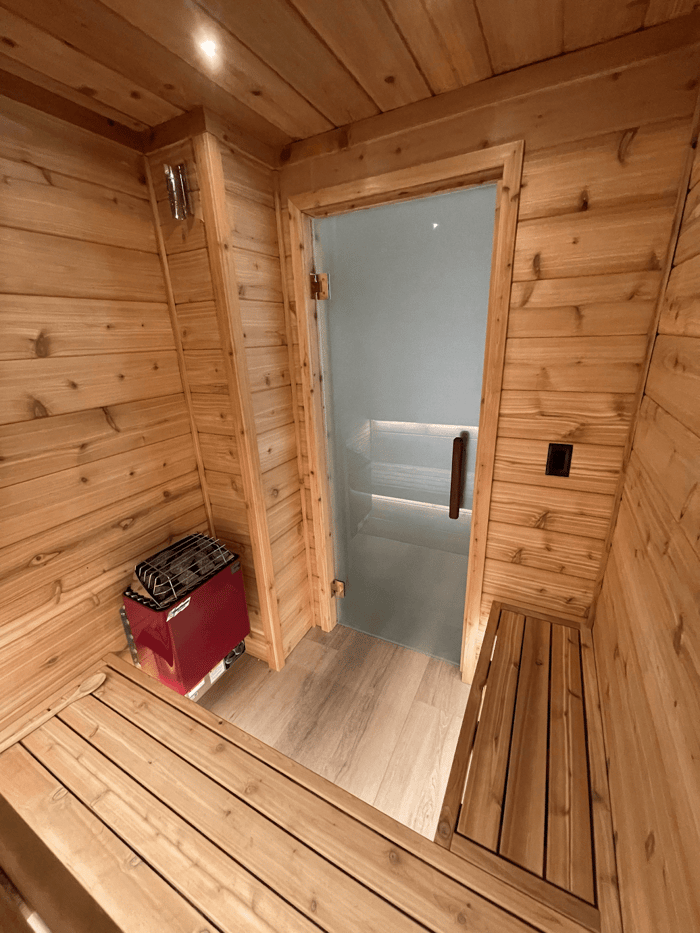
R-value refers to how well a material resists the flow of heat.
That means that a material resists the flow of heat by preventing heat from passing through it, either from inside or outside.
Usually, there is a minimum R-value for every climate.
This means that walls and ceilings of different climates (mild, moderate, and cold) have different R-values to ensure that the sauna works properly, providing energy efficiency.
For mild climates, the walls should be between R-7 and R-11, and the ceilings should be between R-13 and R-19.
For moderate climates, the walls should be R-11 to R-13 and the ceilings R-19 to R-22. The walls should be between R-13 and R-19 for cold climates, and the ceilings should be R-26 and R-30 and above.
| Climate type | Walls | Ceilings |
| Mild | R-7 to R-11 | R-13 to R-19 |
| Moderate | R-11 to R-13 | R-19 to R-22 |
| Cold | R-13 to R-19 | R-26 to R-30+ |
The ceiling has a higher R-value because heat has to rise, and heat loss has great potential during this process. Therefore, it needs thicker insulation with a higher R-value.
While walls lose less heat, they should be insulated with materials like mineral wool that are highly thermally retentive and moisture resistant.
For partitions within the sauna, shared walls can have lower R-values if they are adjacent to warm areas.
That means shared walls can have less R-value if adjacent to walls with high R-values.
These R-values are the minimum values, so walls or ceilings can naturally exceed the stated R-value.
This would help reduce the heat-up time, energy consumption, and humidity control. It would also benefit your heater, as less strain would increase its lifespan.
Best Types of Insulation Material For Saunas
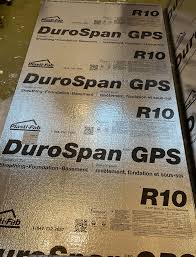
The insulation material used determines the R-value of walls and ceilings.
Different types of insulation materials have various uses, performance, and suitability.
1. Fiberglass insulation
Fiberglass insulation is excellent for indoor saunas or residential walls. Its R-value is R-3.3 to R-3.8 per inch.
Pros
- It is widely available
- Inexpensive
- Easy to install
Cons
- Low fire resistance
- Less efficient when damp
- Not suitable for highly humid areas
2. Mineral wool
Also known as rockwool, it is an excellent option for indoor and outdoor saunas, with an R-value of R-4.0 to R-4.3 per inch.
Unlike fiberglass, it works well in a high-temperature environment, like behind the heater.
Pros
- It is fireproof
- It is mold and water-resistant
- Quality soundproofing
Cons
- More expensive than fiberglass
- Requires precise fitting due to its weight and density
3. Rigid foam board
This is best for strategic implementation and comes in different types.
Depending on the type, it can have an R-value of R-5 to R-7 per inch. It is great for ceilings, outdoor saunas, and roofs.
Pros
- Great for limited space
- Moisture resistant
Cons
- Flammable if not protected with non-combustible surfaces
- Loss of efficiency at very high temperatures
Vapor Barrier Essentials: Moisture Management
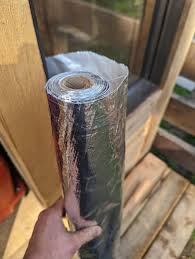
A vapor barrier is a thin layer of material that prevents steam and humidity in the form of vapor from passing through walls, ceilings, and insulation.
It also prevents wood from rotting and mold and mildew from growing.
When installing vapor barriers, keep the following tips in mind. They help you avoid common mistakes many people make when installing vapor barriers:
- Use a reflective foil vapor barrier designed for high heat, and install it with the shiny side inward for heat reflection.
- Seal the seams and edges, including around light fixtures, controls, and sensors, with foil instead of standard duct tape. This will prevent moisture from getting into electrical elements and reduce insulation loss.
- Create an overlap of sheets of at least 2 inches to prevent gaps.
- Install insulation before vapor barriers beneath the wall cladding. This will prevent vapor from passing through the insulation and walls.
For saunas that use steam heaters or are humid most of the time, double the foil sheets to increase the thickness of the vapor barrier.
For outdoor saunas, include a weather-resistant exterior layer to manage steam, humidity, and weather changes outside the sauna.
Key Areas in Sauna To Prioritize for Insulation
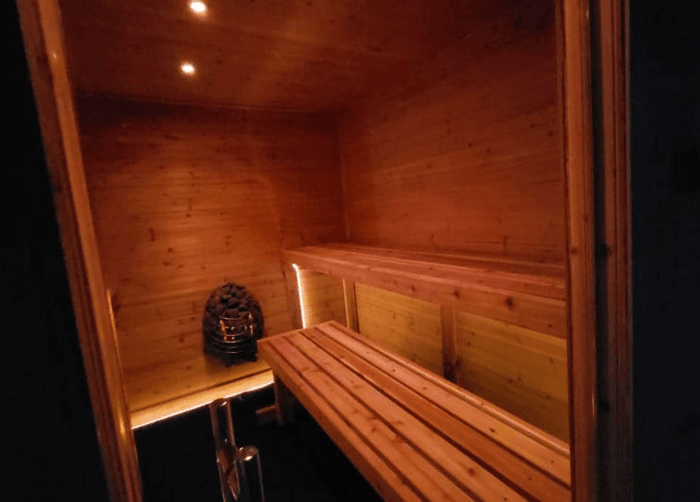
Lack of proper insulation in these areas, or failure to insulate them, can affect heat efficiency and contribute to heat loss.
1. Ceilings
The ceiling is one of the most critical zones for insulation. As much as 80% of the heat in the sauna can be lost through the ceiling as heat rises if it is not adequately insulated.
Use insulation materials with a high R-value (R-26+) and ensure airtight sealing to prevent moisture and mold.
A vapor barrier would also help direct radiant heat downwards and prevent moisture from destroying insulation and growing mold.
2. Walls
Walls do not require as much insulation as a ceiling to retain heat.
However, proper insulation, using materials like fiberglass with an R-value of R-11 to R-19, will reduce heat loss.
Vapor barriers will also help retain heat better and reduce moisture from seeping into walls.
3. Benches and floors
Benches and floors are not always insulated, but they are critical, as benches retain thermal heat and floors prevent cold transfer from below.
For insulation, benches should have non-combustible insulation like mineral wool underneath them.
Floors should be insulated with quality rigid foam board, a vapor barrier, and waterproof flooring. This combination will prevent cold transfer from below and increase longevity.
4. Windows
Windows and doors are the most overlooked, but they are essential. For windows, get quality tempered, sauna-grade glass.
You can also opt for smaller windows. Doors should have metal strips or silicone gaskets for better sealing.
Proper insulation ensures minimal heat loss, maximum energy efficiency, and even heat distribution in the sauna.
Indoor vs Outdoor Sauna Insulation Specifics
Whether you're thinking of installing a sauna in your home or improving the insulation in the one you already have, here are a few ways you can do that:
FOR INDOORS
For already existing saunas, ensure that the walls your sauna shares with your home have their own insulation.
Ensure the walls have double insulation with quality materials like mineral wool or fiberglass.
Ensure that your sauna is well ventilated with passive and exhaust vents that allow air to exchange during and after the session. This helps the room dry and prevents mold growth.
The use of mold-resistant materials in the framing, external walls, and sauna boundaries prevents mold even in the presence of moisture.
FOR OUTDOOR SAUNAS
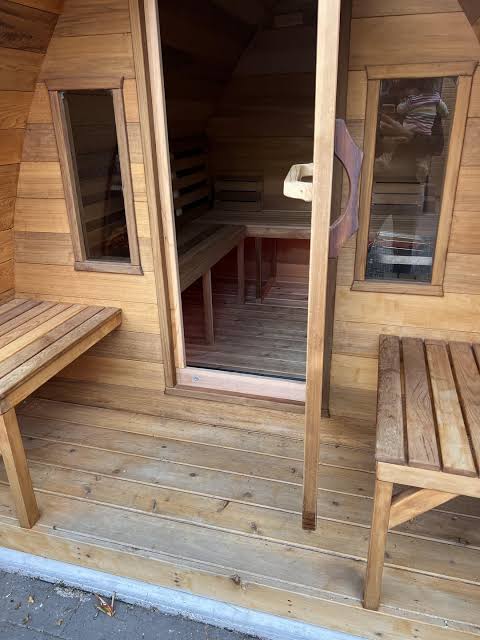
When insulating an outdoor sauna, you must consider the weather.
Install exterior cladding to protect your sauna from rain, snow, and wind.
To manage vapor escape, breathable weather barriers and roof overhangs will prevent water from seeping into the sauna through the seams, joints, and walls.
Freeze-Thaw Cycle Resistance
During extremely high or low temperatures, the sauna can be affected.
One way to prevent damage to your sauna is to use insulation materials like mineral wool, which are unaffected by dramatic temperature fluctuations.
Another way is to use foil tape to seal all interior vapor barriers, preventing moisture from seeping into the sauna's walls.
If you haven't designed your sauna yet or are still setting it up, ensure there are no gaps that would prevent the wood from expanding — this avoids warping, splintering, and cracking.
Foundation Insulation
You have to account for the foundation of your outdoor sauna.
Ensure that you have a rigid foam board around the base of your sauna to prevent cold transfer.
If it is on a raised floor, insulate it with rigid foam board or mineral wool and seal it with moisture barriers.
Also ensure that there is proper drainage around your sauna to prevent flooding, pooling, and freezing of water around it.
Insulation for Different Sauna Heating Systems
While insulation is very important, it differs depending on the type of heating system your sauna uses, regardless of whether it's an indoor or outdoor sauna:
Electric sauna heaters

HUUM DROP 9
$1,751.00 $2,188.75
Inspired by the shape of a water drop, this heater's rounded design softens and complements the angular interior of a classic sauna.
View ProductElectric sauna heaters work by heating the air inside the sauna. In this case, heat loss should be minimized as thermal retention is key:
- Walls and ceilings should be insulated with materials that have a high R-value
- Install foil vapor barriers to direct radiant heat inwards
- Ensure proper ventilation for airflow while maintaining temperature stability.
Wood stoves

HUUM HIVE Flow LS
$3,221.00 $4,026.25
This wood-burning stove with a firebox extension is designed so that most of the heat from the firewood goes directly into your sauna rather than escaping through the chimney.
View ProductThese HUUM wood stoves generally produce intense, convective heat that warms the air and your body simultaneously.
- Use fire-rated insulation that can withstand high-heat zones, like mineral wool.
- Maintain safe clearance between the sauna walls and the stove.
- Heat-retaining materials such as tile or stone should be used on exterior surfaces.
- Insulate the ceiling and walls well to minimize heat loss.
Infrared heaters

Finnmark FD-1 Full-Spectrum Infrared Sauna
$4,695.00 $5,868.75
A compact, 1-person infrared sauna built to turn any space in your home into a personal wellness escape, featuring UL-listed full-spectrum infrared heaters.
View ProductInfrared saunas work by emitting electromagnetic waves that radiate directly into the body:
- Install foil-faced reflective barriers behind panels to bounce infrared waves back into the sauna.
- Ensure vapor protection in humid climates.
- Focus on minimizing drafts to preserve directed warmth.
Understanding the type of heater in your sauna and the heat dynamics it relies on will help you choose the best, most optimal insulation. Doing this will significantly improve your sauna's performance.
Common Insulation Mistakes (And How To Avoid Them)
Here are some common mistakes people make while insulating their sauna.
| Mistake | What It Means | How to Avoid |
| Insufficient vapor barrier | Moisture can leak into walls, damage electrical parts, and lower sauna performance. | Use a proper vapor barrier and seal all edges and joints tightly. |
| Gaps in vapor barrier | Small openings allow steam and humidity to escape into unwanted areas. | Overlap layers and seal every gap with vapor-proof tape. |
| Compressed insulation | Reduces the insulation's effectiveness (lower R-value) and leads to heat loss. | Measure spaces properly and install insulation snugly without squishing or compressing it. |
| Thermal bridging through structural parts | Heat escapes through metal fasteners, doors, or windows if not insulated well. | Use low-conductivity or non-metallic fasteners; install insulated sauna-grade doors and windows. |
| Blocked ventilation | Reduces oxygen flow, traps moisture, causes mold, and leads to uneven heating. | Keep vents clear and ensure air can circulate; don't cover or seal vents during insulation. |
At Sauna Heater Supply, we are the sauna heater experts. Our sole focus is on providing the highest quality sauna heaters from top brands that you can rely on.
Whether you're building a new sauna or upgrading one, we are dedicated to helping you find the perfect heater to create your ultimate relaxation space.