









Best Sauna Rocks: Top Stone Types for Heat and Safety
For most home and commercial saunas, heat-treated olivine diabase and peridotite are the best sauna rocks you can buy. Olivine diabase delivers the best price-to-performance ratio and works with virtually every electric and wood-fired heater on the market. Peridotite ranks highest for long-term structural integrity, making it the right call for high-use commercial installations. For soft, consistent löyly, rounded olivine diabase stones on the top layer are the standard recommendation from manufacturers and independent researchers alike.
- Best all-around: Heat-treated olivine diabase (5–10 cm, electric and wood-fired heaters)
- Best for durability/commercial use: Peridotite (highest survival rating in Saunologia 2026 testing)
- Best for soft steam: Rounded olivine diabase top-layer stones
- Ready to ship in the U.S.: Harvia R-991 round stones and heater+stone packages at Saunaheatersupply
Table of Contents
- Why the right sauna stone changes everything
- The best sauna rock types, ranked by performance
- What size and shape stones should you use?
- How many stones you need and how to arrange them
- Safety: which stones to avoid and why
- How to pour water for consistent steam
- What independent durability testing actually shows
- How to buy: a practical checklist and U.S. product options
- Key Takeaways
- The stone decision most buyers get wrong
- Saunaheatersupply has the stones and heaters to match your setup
- Useful sources and further reading
Why the right sauna stone changes everything
Stone choice directly affects how your sauna feels, how long each session lasts, and how hard your heater works. The physics are straightforward: a denser stone with higher thermal mass absorbs more heat energy per kilogram, releases it slowly, and produces steadier steam when water hits the surface. Porosity and fracture surface area determine whether that steam is soft and enveloping or sharp and harsh.
Practical outcomes that follow from stone selection:
- Longer sessions between water throws: High thermal-mass stones hold heat longer, so you get more steam from each ladle without the temperature dropping sharply.
- Softer vs. hotter löyly: Rounded stones with smooth surfaces produce gentler steam; angular split-face stones vaporize water faster for a more intense hit.
- Heater workload: Dense, well-matched stones distribute heat evenly across elements. Porous or poorly shaped stones create hot spots that stress heating elements over time.
Pro Tip: Before your first session, rinse all new stones under clean water and run the heater through one full heat cycle without pouring water. This clears loose mineral dust and fine particles that can coat elements and reduce efficiency. Peridotite in particular can shed sharp debris as it settles, so this first-use rinse is worth doing carefully.
The best sauna rock types, ranked by performance
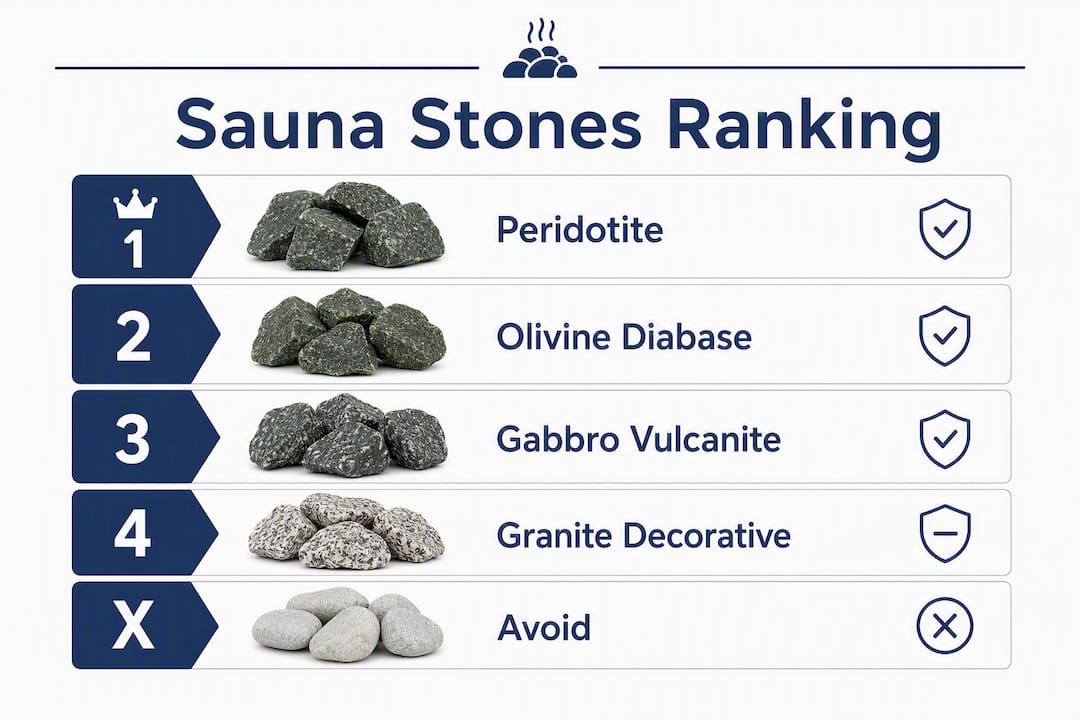
Peridotite
Peridotite is the top performer for structural durability. In Saunologia’s 2026 durability tests, it ranked first among all natural stone types tested, with a survival gap between the best and worst performers. Its density and low porosity mean it resists thermal shock better than most alternatives. The tradeoff: peridotite can break down into sharp-edged debris over time, so the first-use rinse and burn-in protocol matters more here than with other types. Sourcing can also be limited in the U.S. compared to olivine diabase, and per-box pricing tends to run higher.
Best for: High-use commercial saunas, spa facilities, and buyers prioritizing long replacement intervals over upfront cost.
Olivine diabase (olivine basalt)
Olivine diabase is the global market standard for sauna stones, and for good reason. It combines good density, reliable heat storage, and broad compatibility with both electric and wood-fired heaters. Heat-treated variants, processed at approximately 1,000°C, extend service life significantly and are the version worth buying for any installation that sees regular use. Harvia’s Elite Pro Heavy Duty line uses this heat-treatment process and is marketed specifically for public saunas and heavy-use environments. Rounded olivine diabase on the top layer lets water flow down to lower layers, producing the soft, even steam that defines a well-tuned sauna session.
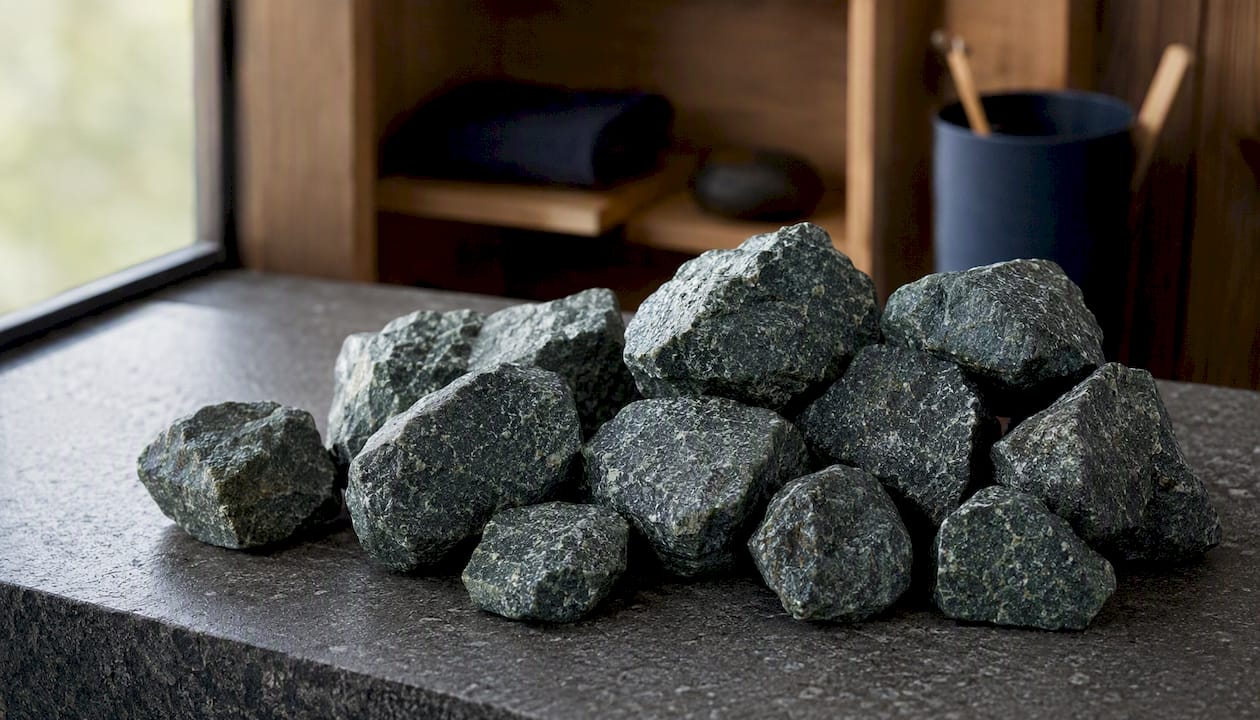
Best for: Home electric heaters, wood-fired heaters, and anyone who wants a widely available, well-tested stone at a fair price.
Gabbro and vulcanite
Gabbro is a coarse-grained igneous rock with good thermal conductivity and a dense, dark appearance that many sauna owners prefer aesthetically. Vulcanite (a fine-grained volcanic equivalent) performs similarly and ranked third in the Saunologia survival tests, behind peridotite and olivine. Both work well in wood stoves where higher temperatures and longer heat cycles are common. Neither is as widely available in the U.S. as olivine diabase, but specialty stone suppliers and some heater retailers carry them.
Best for: Wood-fired heaters, aesthetic preference for dark stone, buyers who want a step up from standard olivine diabase without the sourcing difficulty of peridotite.
Granite and decorative stones
Dense, non-porous granite can produce reliable steam and holds heat reasonably well. Rounded aged granite and non-porous igneous rocks are commonly recommended for top layers by experienced sauna builders. The key qualifier is non-porous: granite with visible voids or a rough, open texture can trap water and crack under heat. Decorative white or red stones, which some heater manufacturers offer, are intended as a single top-layer aesthetic addition only and should never contact heating elements directly.
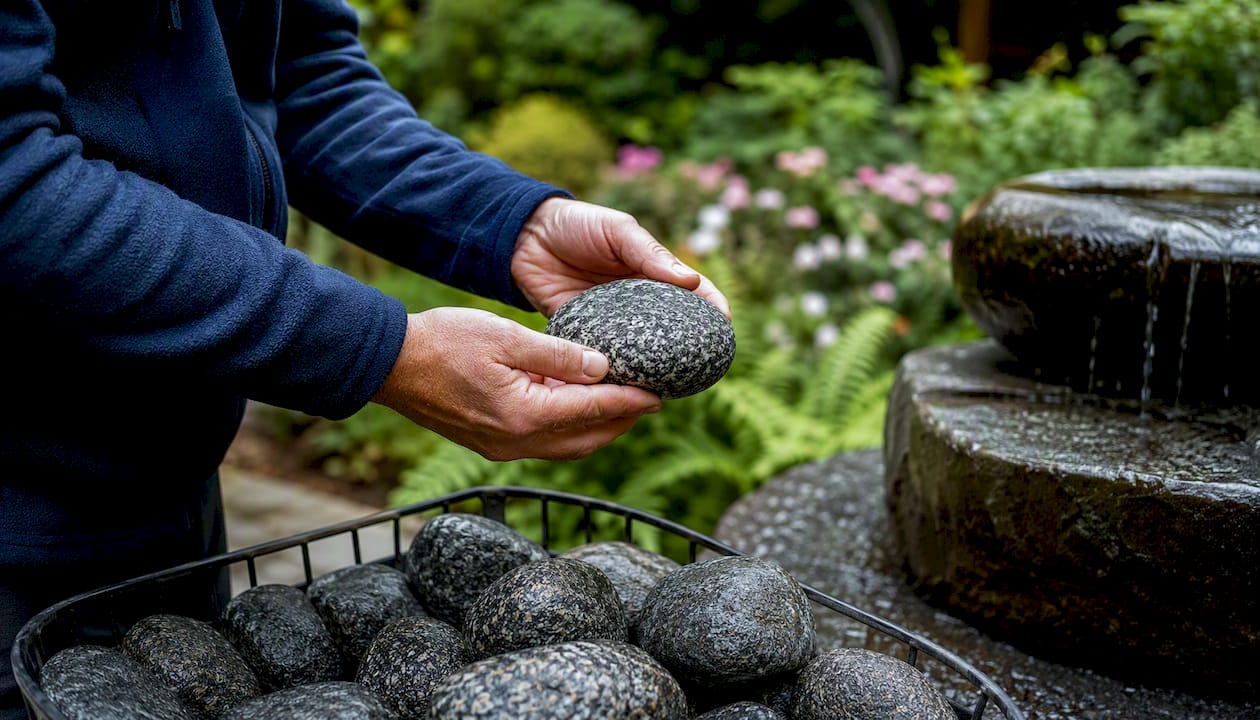
Best for: Top-layer placement, decorative finishing, buyers who source locally and want a non-porous igneous option.
What size and shape stones should you use?
Size and shape affect both steam quality and heater safety. Getting this wrong is one of the most common reasons a sauna underperforms or a heater element fails early.
| Stone Size | Shape | Heater Type | Layer Position |
|---|---|---|---|
| 10–15 cm | Angular, split-face | Electric and wood-fired | Bottom layer |
| 5–10 cm | Mixed angular/rounded | Electric and wood-fired | Middle layer |
| 5–10 cm | Rounded, smooth | Electric and wood-fired | Top layer |
| 10–15 cm | Angular | Wood-fired only | Bottom and mid layers |
Harvia’s stacking guidance recommends larger angular stones at the bottom for stable surface area and airflow voids, mid-size stones to fill gaps without blocking circulation, and smaller rounded stones on top to generate soft steam. This layered approach applies to both electric and wood-fired heaters.
Key size and shape rules:
- Electric heaters: 5–10 cm stones throughout, with the rounded top layer producing the softest steam.
- Wood-fired heaters: 10–15 cm stones at the base give greater thermal mass and handle the longer, hotter heat cycles typical of wood stoves.
- Rounded top stones: Water poured onto rounded surfaces flows down to lower layers rather than vaporizing instantly, which softens the steam and reduces thermal shock to individual stones.
- Angular bottom stones: The irregular surfaces create natural gaps for airflow, which keeps heat distribution even and prevents the heater from overworking.
- Never use flat, plate-shaped stones: They stack too tightly, block airflow, and can trap water between layers.
How many stones you need and how to arrange them
The right quantity depends on your heater’s capacity, not a round number. Always check your heater’s manual first. Most manufacturers specify a stone weight range, and exceeding it stresses the heater frame and elements.
As a general reference:
- Small residential electric heater (3–5 kW): Typically takes 20–30 kg of stones, often covered by one standard 20 kg box plus a small top-layer pack.
- Medium home electric or wood-fired heater (6–9 kW): Usually requires 40–60 kg, meaning two to three boxes depending on stone density and heater design.
- High-use commercial heater (10 kW and above): Stone capacity can exceed 80 kg; check the manufacturer spec sheet and plan for more frequent replacement cycles.
Arrangement matters as much as quantity. Start with the largest angular stones at the bottom, placing them so they interlock without tight gaps. Add mid-size stones to fill the voids without packing them flush. Finish with rounded small stones on top, positioned so they sit stable without wedging against any heating element. The goal is a stable pile with visible air channels running through it.
A few arrangement rules worth following every time:
- Leave a visible gap between the top stone layer and any electric element. Contact between stone and element causes localized overheating and premature element failure.
- Do not stack stones above the manufacturer’s recommended fill line.
- After every major re-stacking, run the heater empty for one cycle before adding water, to let stones settle and any dust burn off.
Safety: which stones to avoid and why
Some stones do not belong in a sauna heater under any circumstances. The risk is hydrofracture: when water trapped inside a porous or cracked stone heats rapidly, it expands and can cause the stone to crack or, in extreme cases, fracture violently. River-smoothed and sea-worn stones look appealing but are particularly risky because their smooth exterior can hide internal fractures and water-saturated pores.
Stones to avoid entirely:
- Pumice: Highly porous, absorbs water freely, and fractures unpredictably under heat.
- Shale and sandstone: Sedimentary rocks that delaminate and crumble when heated repeatedly.
- Marble and limestone: React chemically with water at high temperatures and break down quickly.
- River rocks and beach stones: May look dense but often carry internal cracks and moisture pockets that are invisible until the first heat cycle.
- Porous landscaping rocks: Sold for garden use, not heat cycling; no thermal-shock testing applies to them.
Safety checklist before loading any stones:
- Inspect each stone visually for visible cracks, flaking, or layered structure.
- Tap stones together lightly; a dull thud suggests density, a hollow ring suggests voids.
- Rinse all stones and let them dry before the first heat cycle.
- Run a controlled burn-in cycle before pouring water for the first time.
Replacement signals to watch for:
- Stones crumbling or producing visible dust during sessions.
- Significant cracking or pieces breaking off during normal use.
- Steam quality declining noticeably despite correct pouring technique.
- For commercial saunas, annual inspection is standard practice; home saunas used several times per week typically need a full stone refresh every two to three years.
How to pour water for consistent steam
Technique matters as much as stone quality. Pouring too much water at once, or pouring directly onto a heating element, stresses stones and produces harsh, uneven steam.
Ladle size and frequency:
- A standard sauna ladle holds roughly 1–2 cups (240–480 ml). For most home sessions, one ladle every few minutes is sufficient to maintain steady steam without overloading the stones.
- In a commercial setting with a larger stone bed, slightly larger pours are appropriate, but the principle of waiting between throws still applies.
Pouring technique:
- Aim the ladle at the stone surface, not directly at a heating element. Water should hit stone first and vaporize on contact or flow down through the layers.
- Pour slowly and evenly rather than dumping the ladle in one motion. This distributes the thermal load across more stone surface area.
- Use warm water when possible. Cold water poured onto very hot stones creates a sharper thermal shock, which accelerates stone degradation over time.
Pro Tip: Wait until the sauna has reached its target temperature before the first pour. Stones that have not fully heated through will produce weak, wet steam rather than the dry, enveloping löyly that defines a quality session. A well-calibrated temperature range makes this easier to judge consistently.
What independent durability testing actually shows
The most useful independent data on sauna stone performance comes from Saunologia’s 2026 durability study, which subjected multiple natural stone types to repeated heat-and-cool cycles and measured survival rates. The results showed a nearly 30 percentage-point survival gap between the lowest- and highest-performing natural stones. Peridotite ranked first in Saunologia’s 2026 durability tests, followed by olivine, then vulcanite, with nearly a 30 percentage-point survival gap between the highest and lowest-performing natural stones; olivine diabase ranked lower in long-term survival among non-heat-treated samples.
The practical implication for buyers is straightforward: stone type affects how often you replace stones, which directly affects total ownership cost. For a home sauna used two or three times per week, the difference between a durable and a less durable stone may translate to replacing stones every two years versus every four or five. For a commercial sauna running daily, that gap compounds quickly into real downtime and maintenance cost.
When vetting any stone product, check for these specifications:
- Heat treatment: Processed at approximately 1,000°C significantly extends service life for olivine diabase.
- Size range: Confirm the listed size matches your heater’s recommended range (typically 5–10 cm for electric heaters).
- Pre-washing: Stones sold pre-washed reduce first-use dust and element contamination risk.
- Origin and stone type: Named stone types (peridotite, olivine diabase) from reputable suppliers are more reliable than generic “sauna stones” with no mineralogy listed.
How to buy: a practical checklist and U.S. product options
Before placing an order, confirm these specs against your heater manual:
- Stone type (peridotite, heat-treated olivine diabase, or rounded olivine diabase for top layers)
- Size range (5–10 cm for electric heaters; 10–15 cm for wood-fired bottom layers)
- Heat treatment (yes/no, and at what temperature)
- Pre-washed and ready to use
- Box weight and how many boxes your heater capacity requires
- Shipping weight and carrier options for your location
Matching stones to heater type:
- Residential electric heater (3–9 kW): Heat-treated olivine diabase, 5–10 cm, one to three 20 kg boxes depending on heater capacity. Rounded top-layer stones for soft steam. The Saunum Air 7 Sauna Heater is a good reference point for sizing stone quantities in this range.
- High-use commercial electric heater (10 kW+): Peridotite or heat-treated olivine diabase, larger stone bed, plan for annual inspection and replacement. The Saunum AirSolo 80 is an example of a higher-capacity heater where stone quality and quantity both matter.
- Wood-fired heater: Larger angular stones (10–15 cm) at the base for thermal mass; gabbro or olivine diabase both work well. Rounded olivine diabase on top.
- Decorative top layer only: Non-porous granite or manufacturer-approved decorative stones, one box maximum, never in contact with elements.
For buyers who want a bundled solution, heater+stone packages remove the guesswork on quantity and compatibility. Saunaheatersupply carries several options that pair heaters with matched stone packs, so you receive a tested combination rather than estimating separately.
Key Takeaways
Peridotite and heat-treated olivine diabase are the most durable sauna stone choices available, and matching stone size to heater type is as important as stone material for consistent performance and safety.
| Point | Details |
|---|---|
| Best general-purpose stone | Heat-treated olivine diabase (5–10 cm) works with electric and wood-fired heaters at a fair price. |
| Best for commercial durability | Peridotite ranked first in Saunologia 2026 survival tests, with a nearly 30 percentage-point gap over the lowest-performing natural stones. |
| Size and shape rule | Use angular 10–15 cm stones at the bottom, rounded 5–10 cm stones on top for soft steam and good airflow. |
| Safety: stones to avoid | Never use pumice, shale, marble, river rocks, or porous landscaping stones — hydrofracture risk is real. |
| Saunaheatersupply | Carries heater+stone packages (including Harvia and Saunum bundles) matched to residential and commercial heater capacities, with fast U.S. shipping. |
The stone decision most buyers get wrong
Buyers spend a lot of time comparing heater brands and sauna kit specs, then pick stones almost as an afterthought. That order of priorities is backwards. The stones are the interface between your heater and the steam you actually experience, and a poor stone choice can shorten element life, produce harsh or inconsistent löyly, and require replacement far sooner than the heater itself.
The Saunologia durability data makes this concrete: not all natural stones perform the same, and the gap between the best and worst performers is large enough to matter in real-world replacement cycles. For a home sauna, that might mean replacing stones every two years instead of every five. For a commercial installation, it means maintenance downtime and labor costs that add up quickly.
The other mistake is treating stone type as the only variable. Size, shape, arrangement, and pouring technique all interact. A perfectly selected peridotite stone packed too tightly against an element will still cause problems. Rounded olivine diabase on top of a poorly layered base will produce weak steam regardless of stone quality. Get the full picture right, and the sauna performs the way it should.
Saunaheatersupply has the stones and heaters to match your setup
Choosing the right stone is easier when you can buy the heater and stones together from a single source that has already matched the specs. Saunaheatersupply carries a curated selection of heater+stone packages for residential and commercial installs, including the Harvia Kip45W heater package with stones for home electric setups, the Saunum Air 7 package for mid-range residential use, and the Saunum Air L 15 package for larger or higher-use installations. For buyers building a full sauna from the ground up, the Finnmark Thermo-Aspen Combination Barrel Sauna FD-7 and the Finnmark Cedar Combination Barrel Sauna FD-6 include heater and stone compatibility guidance built into the kit.
Stone packs ship in standard 20 kg boxes. Estimate your total stone weight from your heater manual, then divide by 20 to get your box count. If you are unsure about sizing or compatibility, Saunaheatersupply’s team can help you confirm the right match before you order. Browse the full selection at saunaheatersupply.com or contact the team directly for project-specific guidance.
Useful sources and further reading
- Saunologia 2026 Sauna Stone Durability Test Results — Survival rankings for peridotite, olivine, vulcanite, and olivine diabase; the primary independent durability dataset referenced throughout this article.
- Saunologia Sauna Stone Test Protocol 1.0 — Methodology behind the durability tests; includes first-use rinse and burn-in guidance for peridotite and other stone types.
- Harvia Sauna Heater Stones — Manufacturer stacking guidance, size recommendations, and decorative stone usage rules from one of the leading heater brands.
- Harvia Elite Pro Heavy Duty Stones (5–10 cm, 20 kg) — Product page showing heat-treatment specs (~1,000°C) and recommended use cases for heavy-duty olivine diabase.
- Sauna from Finland: Choosing and Maintaining Sauna Stones — Practical guide covering olivine diabase as the market standard, heat-treated variants, and replacement cadence for home and commercial saunas.
- SaunaTimes: What You Need to Know About Sauna Rocks — Enthusiast-level guidance on granite and non-porous igneous rocks for top layers, and a clear list of rock types to avoid.
Recommended
- 33 lb box Harvia R-991 Round Sauna Stones — Sauna Heater Supply
- Sauna Temperature Range: Safe Zones and Health Benefits — Sauna Heater Supply
- Infrared vs Traditional Sauna: Which Fits Your Health Goals? — Sauna Heater Supply
- Steam Room vs Sauna: What Homeowners & Contractors Should Choose — Sauna Heater Supply