









Sauna Heater Cost: Realistic Installed Budgets for Homeowners
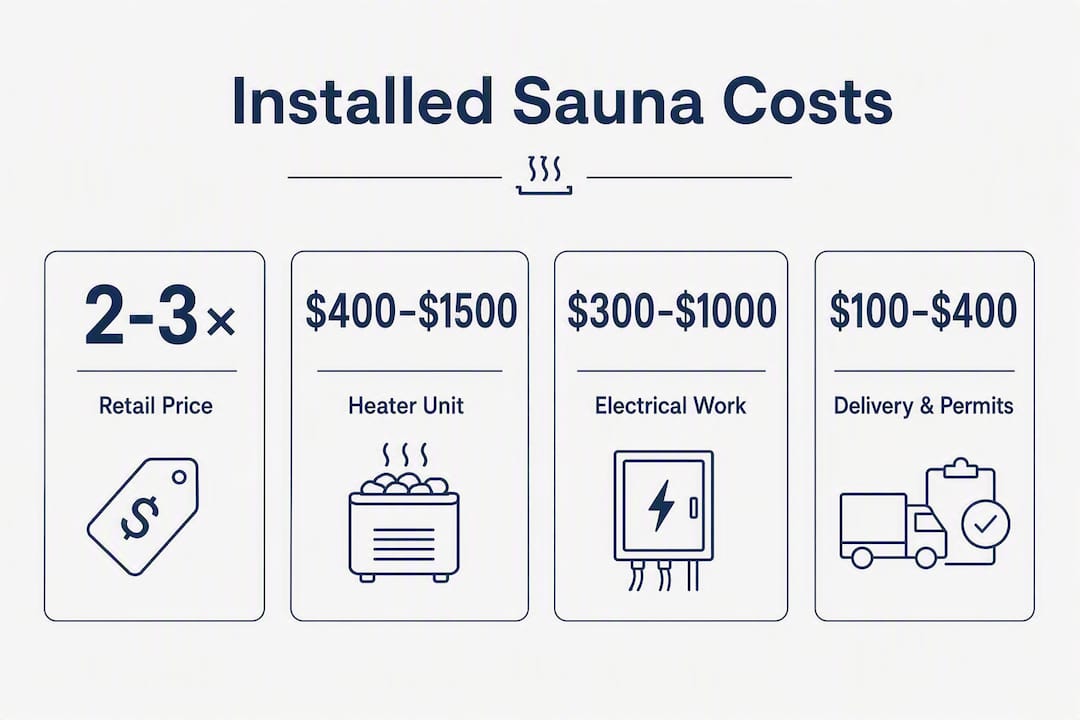
A residential sauna heater typically retails within a range depending on type and size, but the number that actually matters is your installed total. Electric heaters for a standard 2–6 person sauna generally retail in the mid-range; infrared units are usually priced somewhat lower; wood-burning heaters also have a broad price range; gas heaters are less common residentially and tend to start at higher prices. Once you add electrical work, delivery, labor, and permits, a typical home sauna installation can significantly exceed the heater’s retail price, depending on your setup and location.
The three add-ons that most commonly push the total well above the heater’s list price:
- Dedicated electrical circuit and wiring: A dedicated electrical circuit for a standard mid-range heater typically adds a significant cost due to labor, materials, and potentially a panel upgrade when installed by a licensed electrician.
- Delivery and installation labor: Freight shipping for heavy heater units and professional installation fees are rarely included in the retail price and can add hundreds more.
- Permits and inspections: Many jurisdictions require an electrical permit for a new dedicated circuit; outdoor builds may also need a building permit.
Budget based on the installed total cost rather than just the heater’s sticker price. This approach helps avoid common and expensive surprises.
Table of Contents
- What does a sauna heater cost by type?
- What features and materials drive the unit price up?
- What does sauna heater installation actually cost?
- How do you size a sauna heater correctly?
- How much does it cost to run a sauna heater each month?
- What do realistic installed budgets actually look like?
- What should you ask sellers before buying?
- How long do sauna heaters last, and what does maintenance cost?
- Saunaheatersupply makes it easier to budget and buy with confidence
- Key Takeaways
- The real cost of a sauna heater is mostly decided before you buy
- Useful sources and further reading
- Why Saunaheatersupply is the right place to buy your heater
What does a sauna heater cost by type?
The retail price you see online reflects the heater unit alone. Here is how the four main categories break down for common residential sizes, along with what each type delivers in terms of experience.
| Heater Type | Typical kW Range | Retail Price Range | Löyly / Experience Note |
|---|---|---|---|
| Electric (traditional) | 3.6–9 kW | $300–$2,500+ | Best steam quality; stones hold heat well |
| Infrared | 1.5–3 kW | $400–$2,000 | Dry heat; faster warm-up; lower running cost |
| Wood-burning | 8–20 kW | $300–$2,500+ | Authentic experience; no electrical needed |
| Gas | 6–9 kW | $1,000–$3,000+ | Rare residentially; requires gas line |
Electric heaters are the most popular choice for home saunas. Most residential electric models in the 6–9 kW range retail in a mid-range band around $800–$1,600, with premium units above that. Small 3.6–4.5 kW models suited to a 2-person room can be found for $300–$700, while commercial-grade or Wi-Fi-enabled units push past $2,500.
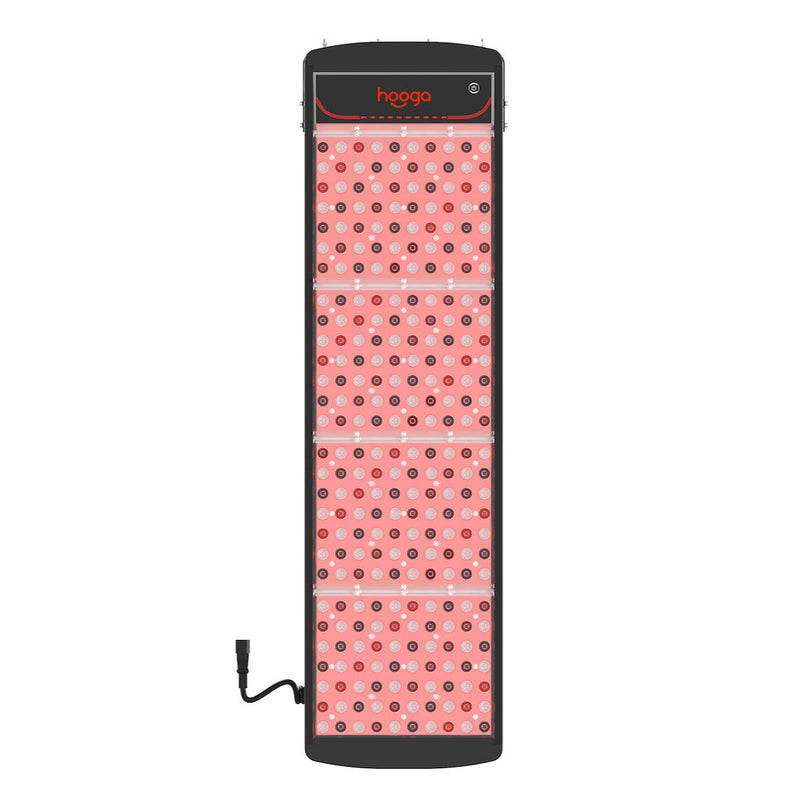
Infrared heaters heat the body directly rather than the air, which means lower wattage and faster warm-up times. They sit at the lower end of operating costs but produce a fundamentally different experience from traditional steam.
Wood-burning heaters deliver the most authentic sauna experience and require no electrical connection to the heater itself, though you will still need proper ventilation and a chimney or flue. Costs vary widely based on stone capacity and build quality.
Gas heaters are uncommon in residential settings and require a dedicated gas line, making them a niche choice best suited to large commercial or outdoor installations.
Model features move units between price tiers within any category. A heater with a built-in mechanical knob controller sits at the low end; add a separate digital controller or a Wi-Fi panel and the same kW class jumps $200–$600 in price.
What features and materials drive the unit price up?
Two heaters with identical kW ratings can differ by $800 or more. Here is what accounts for that gap.
Control type is the single biggest variable. Built-in mechanical knobs are the most affordable option. Separate digital controllers add precision and programmability. Wi-Fi-enabled panels, like those on the Harvia Kip45W heater package, allow remote preheat from a phone app and tend to add the most to the upfront price. That convenience also adds a separate installation consideration: some Wi-Fi controllers require their own wiring run.
Stone capacity matters for steam quality. A heater with a larger stone bed retains heat longer, produces more consistent löyly (steam), and recovers faster between water pours. Heaters with generous stone capacity typically cost more but deliver a noticeably better experience for regular users.
Finish and build materials affect longevity. Stainless steel housings resist corrosion and hold up better in high-humidity environments than painted steel. Commercial-grade heating elements last longer under heavy use. The price premium for stainless is usually $100–$300 and is worth it for a heater that will run several times per week.
Warranty and parts availability are underpriced factors. A heater with a 3-year warranty and readily available replacement elements is a better long-term value than a cheaper unit whose parts are hard to source after two years.
Pro Tip: When comparing two heaters in the same kW class, check whether stones and a controller are included. A heater listed at $700 that requires a $250 separate controller and $80 in stones effectively costs $1,030 installed, which may be more than a $900 package that includes both.
What does sauna heater installation actually cost?
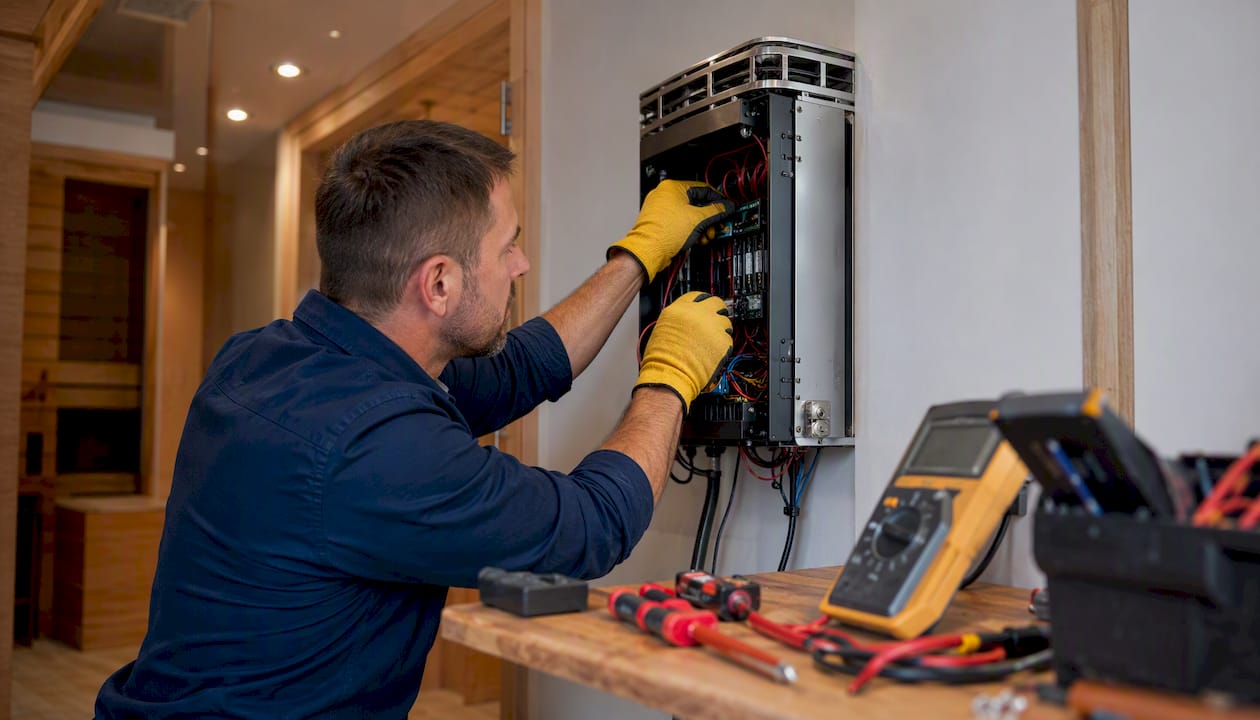
The heater unit is only one component; total installed cost commonly includes electrician work, delivery, permits, and site prep, which often doubles or more the headline unit price. Here is a realistic line-item breakdown.
| Installation Item | Budget Scenario | Mid-Range Scenario | Premium Scenario |
|---|---|---|---|
| Heater unit | $400–$700 | $800–$1,600 | $1,800–$3,500+ |
| Stones (if not included) | $50–$100 | $80–$150 | $150–$300 |
| Controller (if separate) | $0–$150 | $150–$300 | $300–$600 |
| Dedicated 240V circuit | $300–$600 | $600–$1,000 | $900–$2,500+ |
| Delivery and labor | $100–$300 | $300–$700 | $700–$1,500 |
| Permits and inspection | $0–$150 | $100–$300 | $200–$500 |
| Estimated installed total | $900–$1,600 | $2,100–$4,000 | $4,750–$9,300+ |
The electrical line item is where most homeowners get surprised. Real project quotes show the dedicated 240V circuit is often omitted from list prices and commonly costs several hundred to a few thousand dollars depending on panel capacity and distance. A panel upgrade, when needed, adds $1,000–$3,000 on its own.
Key installation cost factors to confirm before you buy:
- Panel capacity: Does your existing panel have an open 40–50A breaker slot, or will you need an upgrade?
- Distance from panel to sauna: Longer runs mean more wire and higher labor cost.
- Indoor vs. outdoor: Outdoor builds require weatherproof conduit, a disconnect switch, and sometimes a concrete pad or foundation.
- Wood-burning or gas: A wood-burning heater needs a proper chimney or flue; a gas heater requires a licensed gas-line connection.
To get an accurate electrician estimate, measure the distance from your main panel to the sauna location, confirm your heater’s required amperage from the spec sheet, and ask the electrician to quote labor and materials as separate line items. For a detailed walkthrough of what to expect, the sauna heater installation guide at Saunaheatersupply covers the full process.
How do you size a sauna heater correctly?
Correct sizing is the most practical thing you can do to control both upfront and operating costs. The standard rule of thumb used across the industry:
1 kW per 45 cubic feet of sauna room volume (for well-insulated rooms with standard 7–8 ft ceilings).
Calculate your room’s cubic footage: length × width × ceiling height. Then divide by 45 to get the minimum kW recommendation.
Worked example 1 — Small 2-person sauna (5 ft × 4 ft × 7 ft = 140 cubic feet): 140 ÷ 45 = 3.1 kW minimum. A 3.6 kW or 4.5 kW heater fits this room and can typically run on a 30A circuit.

Worked example 2 — Medium 4-person sauna (7 ft × 6 ft × 7 ft = 294 cubic feet): 294 ÷ 45 = 6.5 kW minimum. A 6 kW or 8 kW heater is the right range, requiring a 240V/40–50A circuit.
Key caveats to the formula:
- Poor insulation or a vapor barrier gap: Add 10–20% to your kW estimate.
- Ceiling height above 8 ft: Volume increases faster than the formula accounts for; size up.
- Glass walls or doors: Glass loses heat quickly; add at least 0.5–1 kW.
- Outdoor or unheated space: Cold ambient temperatures require a larger heater.
Undersizing a heater means long heat-up times, a room that never reaches target temperature, and a frustrating experience. Oversizing wastes energy and can create installation complexity if it pushes you into a higher amperage circuit. For larger home saunas, the best 9 kW sauna heater guide at Saunaheatersupply walks through model options for rooms in the 300–450 cubic foot range.
How much does it cost to run a sauna heater each month?
Operating cost follows a simple formula: kWh used per session × sessions per week × weeks per month × local electricity rate ($/kWh).
The U.S. average residential electricity rate is approximately $0.16/kWh, though rates vary significantly by state.
Traditional electric heater (6 kW), 3 sessions per week: A 6 kW traditional sauna run 3×/week uses roughly 9–13 kWh per session including heat-up time. At $0.16/kWh, that works out to roughly $1.44–$2.08 per session, or approximately $17–$25 per month.
Infrared heater (1.8 kW), 3 sessions per week: A 1.8 kW infrared unit uses roughly 1.5–2 kWh per session. At $0.16/kWh, that is roughly $0.24–$0.32 per session, or approximately $3–$4 per month.
Monthly running cost at a glance: A traditional 6 kW electric sauna costs roughly $17–$25/month at average U.S. rates (3×/week use). An infrared unit running the same schedule costs roughly $3–$4/month. Over a year, that gap is $150–$250.
The difference compounds for frequent users. For a deeper look at lifetime running costs and how state electricity rates change the math, Saunaheatersupply’s sauna running cost guide provides U.S.-specific calculations. For a side-by-side comparison of the infrared and traditional experience beyond just cost, this infrared vs. traditional sauna breakdown covers the key differences.
What do realistic installed budgets actually look like?
Headline sauna kit prices often omit delivery, permits, and installation labor; buyers frequently pay thousands more than the brochure price. Three itemized scenarios show what homeowners actually pay.
Scenario 1: Budget indoor conversion (existing room, minimal electrical work)
- Heater unit (4.5 kW entry-level electric): $400–$650
- Stones: $60–$100
- Built-in controller: included
- Dedicated circuit (panel has open slot, short run): $300–$500
- Delivery: $100–$200
- Permit: $0–$100
- Total estimate: $860–$1,550
Best for: A homeowner converting a closet or small room with an accessible electrical panel. DIY indoor sauna conversions still require proper insulation, a vapor barrier, and electrical work even when the heater cost is low.
Scenario 2: Mid-range insulated cabin or prefab kit
- Heater unit (6–8 kW, mid-range electric with digital controller): $900–$1,600
- Stones: $100–$150
- Separate digital controller: included or $150–$300
- Dedicated circuit (moderate run, no panel upgrade): $600–$1,000
- Delivery and installation labor: $400–$700
- Permit: $100–$250
- Total estimate: $2,100–$4,000
A package like the Harvia Kip45W heater package with Wi-Fi and stones fits squarely in this scenario, bundling the heater, stones, and Wi-Fi controller in one purchase to reduce the number of separate line items.
Scenario 3: Premium outdoor build
- Heater unit (9 kW premium electric or the Saunum Air L 15 package): $1,800–$3,500+
- Stones: $150–$300
- Wi-Fi controller: included or $300–$500
- Dedicated circuit with panel upgrade and weatherproof outdoor conduit: $1,500–$3,000+
- Delivery, installation labor, and site prep: $800–$1,500
- Permits (electrical + building): $200–$500
- Total estimate: $4,750–$9,300+
The biggest cost driver in the premium scenario is almost always the electrical work, particularly when a panel upgrade is required. Get a licensed electrician’s quote before finalizing your heater selection.
What should you ask sellers before buying?
A short checklist prevents the most common purchasing mistakes.
Questions to ask every seller:
- What kW is correct for my room’s cubic footage, and what circuit does it require?
- Are stones and a controller included, or are those separate purchases?
- What is the warranty period, and are replacement elements stocked domestically?
- What are the exact shipping fees, and does the price include delivery to the installation location?
- Is professional installation available, and what does it cost as a separate line item?
- What is the return policy if the heater arrives damaged or is incompatible?
Red flags to watch for:
- A seller who cannot specify the required circuit amperage or voltage for the heater they are selling.
- A warranty described only as “limited” with no stated duration or parts coverage.
- An unusually low unit price that excludes shipping, stones, and controller in fine print.
- No domestic parts availability or a lead time measured in months for replacement elements.
Always request a written, line-item quote that separates the heater unit cost from stones, controller, shipping, installation labor, and permits. A quote that bundles everything into one number makes it impossible to compare against other sellers or catch hidden markups.
Pro Tip: Ask specifically whether the heater’s controller is sold separately and what circuit it requires. Some digital and Wi-Fi controllers need their own dedicated low-voltage wiring run, which adds to the electrician’s scope and cost.
For a full overview of sauna electrical requirements before you call an electrician, Saunaheatersupply’s guide covers voltage, amperage, and disconnect requirements by heater size.
How long do sauna heaters last, and what does maintenance cost?
A well-maintained residential electric sauna heater typically lasts 15–20 years. The actual lifespan depends heavily on usage frequency, water quality (hard water accelerates element scaling), and whether routine maintenance is performed.
Routine maintenance items and typical intervals:
- Sauna stones: Replace every 1–2 years with regular use. Stones crack and lose heat retention over time. Cost: $50–$200 depending on quantity and stone type.
- Heating elements: Typically last 5–10 years before output degrades noticeably. Replacement cost varies by model: $80–$300 for the element itself, plus labor if you are not replacing it yourself.
- Control unit maintenance: Digital and Wi-Fi controllers occasionally need firmware updates or sensor replacements. Mechanical knob controllers are nearly maintenance-free.
- Interior cleaning: Wipe down the housing and check for mineral deposits around the element annually.
Parts availability is a buying criterion that most homeowners overlook. A budget heater from an obscure brand may cost $400 less upfront but require a 10-week international parts order when an element fails. Over a 15-year lifespan, the cost difference between a budget and premium heater often narrows considerably once you factor in replacement elements, stones, and any service calls. Ask your seller specifically whether replacement elements are stocked in the U.S. and what the typical lead time is.
Saunaheatersupply makes it easier to budget and buy with confidence
Knowing the real sauna heater cost means sizing correctly, planning for electrical work, and choosing a heater whose parts will still be available in year eight. That is the framework that prevents the most common and expensive surprises.
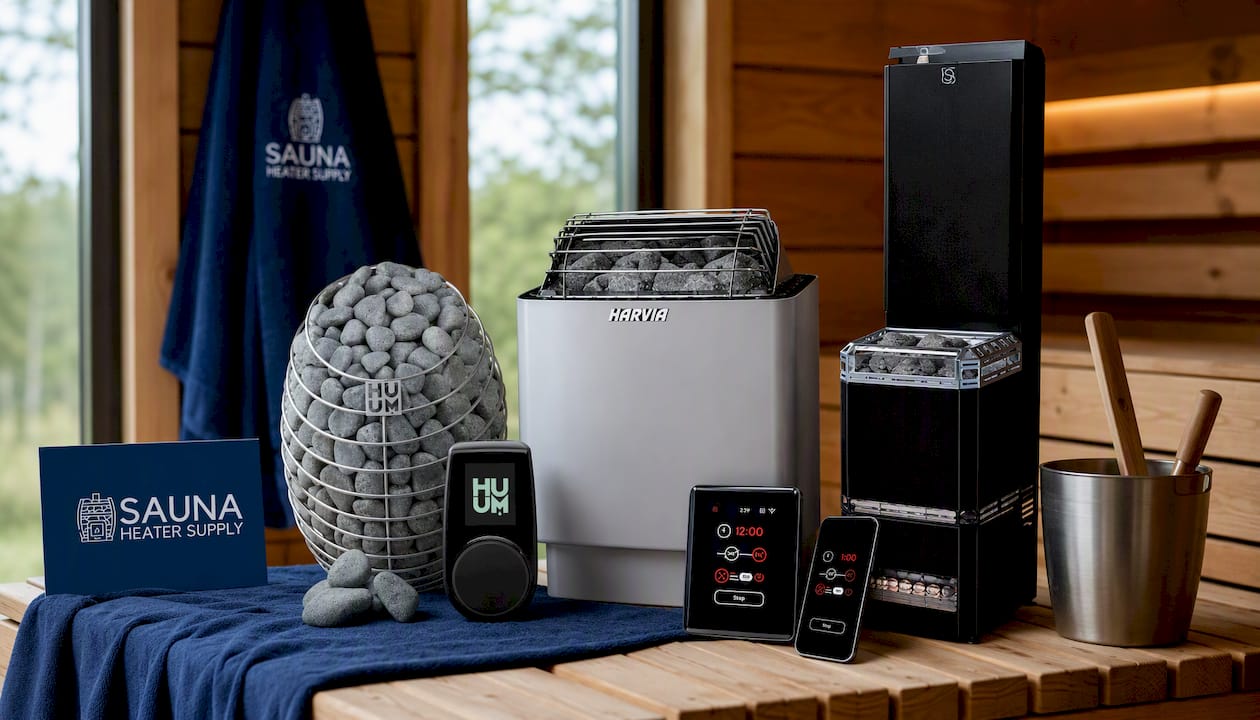
Saunaheatersupply stocks a curated selection of electric, wood-fired, and gas sauna heaters, from entry-level residential units to premium packages like the Saunum Air L 15 package, with expert guidance built into every purchase. The team helps homeowners and contractors match the right kW to their room volume, confirm electrical requirements before ordering, and get fast shipping on in-stock units. A price match guarantee means you are not paying a premium for that support.
Ready to move from research to purchase? Browse the full heater selection at Saunaheatersupply, or pick up a digital gift card (save 5%) if you want to lock in your budget before finalizing your model choice.
Key Takeaways
A realistic installed sauna heater budget is typically 1.5–3× the heater’s retail price once electrical work, delivery, and permits are included.
| Point | Details |
|---|---|
| Budget for the installed total | Electrical work, delivery, and permits commonly double the heater’s retail price. |
| Size by cubic footage | Use 1 kW per 45 cubic feet of sauna volume; adjust up for poor insulation or glass walls. |
| Running costs vary by type | A 6 kW electric heater costs roughly $17–$25/month; a 1.8 kW infrared unit costs roughly $3–$4/month at average U.S. rates. |
| Ask for line-item quotes | Separate heater, stones, controller, electrical, and delivery costs before comparing sellers. |
| Saunaheatersupply | Offers expert sizing guidance, fast shipping, and a price match guarantee on electric, wood-fired, and gas heaters. |
The real cost of a sauna heater is mostly decided before you buy
Most buyers focus on the heater’s list price and treat everything else as a detail to sort out later. That approach is why the electrician’s quote is the most common shock in a sauna project.
The smarter sequence is to measure your room, calculate the kW you need, confirm your panel’s capacity, and get an electrician’s estimate before you choose a model. That order of operations tells you your actual budget ceiling, not just the heater’s price tag. A $900 heater that requires a $2,000 panel upgrade is a $2,900 decision. A $1,600 heater in a room where the panel already has an open 50A slot might cost $2,400 installed total.
The other underestimated factor is parts availability. Heaters from brands with domestic parts distribution and clear warranty terms are worth a price premium over units where replacement elements are a multi-month international order. The upfront savings disappear quickly when a heater sits cold for two months waiting on a $90 element.
Useful sources and further reading
The figures in this guide draw from the following sources. Each is worth bookmarking if you want to verify numbers or go deeper on a specific topic.
| Source | Best For |
|---|---|
| UseSauna: Cost to Run a Sauna | Detailed kWh-per-session data and monthly running-cost math by heater type |
| Sauna Guide: Real Cost of a Home Sauna | Line-by-line installed cost teardown including electrical and permit examples |
| ThermalFinn: Sauna Build Cost Breakdown | DIY and contractor build cost tiers; heater as a variable within a full project |
| HomeInDepth: How Much Does a Sauna Cost? | Hidden add-on costs and real buyer examples |
| Tahoe Sauna Company: Best Electric Sauna Heaters | Model price ranges, kW-to-circuit mapping, and mid-range pricing guidance |
Saunaheatersupply on-site resources:
- Sauna heater installation guide — step-by-step installation workflow
- Sauna running cost guide — U.S.-specific operating cost calculations
- Sauna power requirement and electrical planning — circuit, amperage, and disconnect guidance
- Saunaheatersupply shop — browse heaters, packages, and accessories
Why Saunaheatersupply is the right place to buy your heater
Getting the right heater at the right price means more than finding the lowest unit cost online. It means having someone confirm your kW calculation, verify your electrical requirements, and ship a complete package without hidden freight charges.
Saunaheatersupply serves homeowners, contractors, and wellness professionals with a curated catalog of electric, wood-fired, and gas sauna heaters, full kits, controls, stones, and replacement parts. The Harvia Kip45W heater package with Wi-Fi and stones is a strong mid-range choice for homeowners who want a complete, app-enabled setup without sourcing components separately. For buyers building a premium installation, the Saunum Air L 15 package delivers high-quality löyly with a complete package configuration.
Contact Saunaheatersupply directly for expert product matching, or browse the full catalog at saunaheatersupply.com to find the heater that fits your room, your circuit, and your budget.
Recommended
- Sauna Running Cost: Real Numbers for US Homeowners — Sauna Heater Supply
- Sauna Heater Installation: Step-by-Step Guide for Homeowners — Sauna Heater Supply
- How Much is a Sauna in 2025? Cost and Best Options — Sauna Heater Supply
- Steam Room vs Sauna: What Homeowners & Contractors Should Choose — Sauna Heater Supply