









Best 9 kW Sauna Heater for Home Saunas in 2026
For most home saunas in the 250–450 cubic foot range, the Harvia Virta 9 kW is the best overall pick: reliable 240V/1PH wiring, a compact wall-mount footprint, and strong U.S. availability through Saunaheatersupply. For the softest, steam-rich löyly, the Harvia Cilindro 9 kW floor-standing tower with 80 kg (176 lbs) of stone capacity is the standout. The HUUM Drop 9 kW leads for design-forward builds with Wi-Fi preheat. The Saunum Air L 10 wins for premium even-heat distribution. Budget buyers should look at the Amerec AK Series as a capable, lower-cost entry.
- Best overall: Harvia Virta 9 kW — 240V/1PH, wall-mount, ~$700–$950, balanced heat and compact design; stocked by Saunaheatersupply.
- Best löyly: Harvia Cilindro 9 kW — 80 kg stone capacity, floor-standing tower, ~$900–$1,400; stocked by Saunaheatersupply.
- Best smart control: HUUM Drop 9 kW — wall-mount, 55 kg (132 lbs) stones, UKU Wi-Fi app, ~$1,500–$1,800.
- Best premium/even heat: Saunum Kyrö / Air series — advanced heat distribution, digital controls, available via Saunaheatersupply.
- Best budget: Amerec AK Series — straightforward controls, lower price point, acceptable for occasional use.
All 9 kW heaters require a dedicated 240V circuit; budget $1,500–$3,000 for electrician installation costs depending on panel distance and local permit requirements.
Table of Contents
- How do the best 9 kW sauna heaters compare side by side?
- How do you pick the right 9 kW heater for your home sauna?
- What does a 9 kW heater actually deliver in a real home sauna?
- What are the U.S. electrical requirements for a 9 kW sauna heater?
- Which brand and model is right for your specific needs?
- Why do premium heaters cost more, and do controls actually matter?
- Key Takeaways
- A vendor perspective on choosing the right heater
- Where to buy the right 9 kW heater for your sauna
- The part most buyers get wrong
How do the best 9 kW sauna heaters compare side by side?
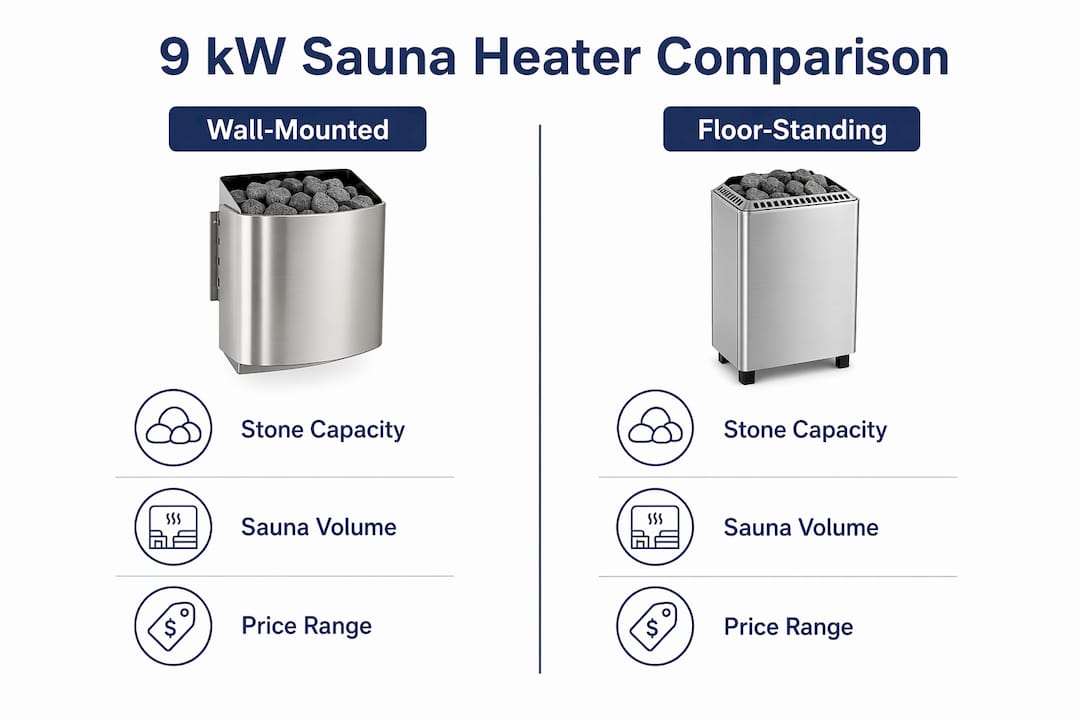
The table below summarizes key features of major models available to U.S. buyers, helping to match your needs and electrical capabilities.
| Model | Mounting | Sauna Volume | Stone Capacity | Controls | Price (USD) | Electrical (US) | Best For |
|---|---|---|---|---|---|---|---|
| Harvia Virta 9 kW | Wall | 250–450 ft³ | 15 kg | Digital panel; optional Wi-Fi | $700–$950 | 240V / 1PH / 40A | Best overall wall-mount |
| Harvia Cilindro 9 kW | Floor/tower | 250–450 ft³ | 176 lbs (80 kg) | Xenio / Griffin (sold sep.) | $900–$1,400 | 240V / 1PH or 3PH | Best löyly / steam |
| Harvia KIP 9 kW | Wall | 250–400 ft³ | 15 kg | Built-in analog/digital | $700–$950 | 240V / 1PH / 40A | Classic dry heat, value |
| Harvia Spirit 9 kW | Wall | 250–400 ft³ | 15 kg | Digital panel | $900–$1,400 | 240V / 1PH / 40A | Mid-range wall-mount |
| Harvia The Wall 9 kW | Wall (recessed) | 250–400 ft³ | — | Digital / Wi-Fi optional | $1,500–$1,800 | 240V / 1PH / 40A | Minimal/design-forward |
| Harvia Trillium 9 kW | Floor/tower | 250–450 ft³ | 50 kg | Digital panel | $900–$1,200 | 240V / 1PH / 40A | Mid-range tower |
| HUUM Drop 9 kW | Wall | 250–450 ft³ | 132 lbs (55 kg) | UKU Wi-Fi app | $1,500–$1,800 | 240V / 1PH / 40A | Design + smart control |
| HUUM Hive 9 kW | Floor/tower | 250–450 ft³ | 75 kg | UKU Wi-Fi app | $1,500–$1,800 | 240V / 1PH / 40A | Max stone mass / löyly |
| HUUM CoreX 9 kW | Wall | 250–450 ft³ | 40 kg | UKU Wi-Fi app | — | 240V / 1PH / 40A | Wall-mount with high stones |
| EOS Mythos 9 kW | Wall | 250–400 ft³ | 40 kg | Digital panel | $900–$1,200 | 240V / 1PH / 40A | Compact design rooms |
| EOS Cubo Avantgarde 9 kW | Wall | 250–400 ft³ | 40 kg | Digital panel | — | 240V / 1PH / 40A | Modern aesthetic |
| EOS Invisio / U Series 9 kW | Under-bench | 250–450 ft³ | 15 kg | Digital panel | $900–$1,200 | 240V / 1PH / 40A | Tight builds / custom layouts |
| Saunum Kyrö / Air 9 kW | Wall | 250–450 ft³ | 40 kg | Digital / Wi-Fi | $1,500–$1,800 | 240V / 1PH / 40A | Even heat / premium |
| Amerec AK Series 9 kW | Wall | 250–400 ft³ | — | Built-in digital | $500–$700 | 240V / 1PH / 40A | Budget / occasional use |
| Finlandia / Finn 9 kW | Wall | 250–400 ft³ | 15 kg | Analog / basic digital | $700–$950 | 240V / 1PH / 40A | Classic Finnish dry heat |
| Tylo 9 kW models | Wall / floor | 250–450 ft³ | 40 kg | Digital / advanced | $1,200–$1,800 | 240V / 1PH / 40A | Luxury / design builds |
| Scandia Stainless 9 kW | Wall | 250–400 ft³ | 15 kg | Basic digital | $700–$950 | 240V / 1PH / 40A | Coastal / high-humidity |
How to read this table: Stone capacity is the most important factor for löyly quality. Wall-mounted heaters with lower stone mass heat up faster but produce drier steam. Floor and tower models with large stone masses deliver soft, enveloping steam favored by experienced sauna users. Price ranges reflect heater only; add $150–$400 for a compatible digital controller where sold separately.
How do you pick the right 9 kW heater for your home sauna?
The sizing decision comes first. A reliable baseline is 1 kW per 50 cubic feet of sauna volume. A standard 6×8×7 ft home sauna measures 336 cubic feet, which puts it squarely in the 6–9 kW range. When in doubt, size up rather than down: an undersized heater runs its elements continuously, shortens element life, and never delivers proper löyly.
Step-by-step sizing checklist:
- Measure your sauna room: length × width × ceiling height = cubic feet.
- Divide cubic feet by 50 to get your baseline kW requirement.
- Add 1–2 kW if the room has exterior walls, large glass panels, or poor insulation.
- Add 1 kW if the ceiling is above 7 feet or the room is in a cold climate.
- Confirm your electrical panel can support a dedicated 240V circuit at the required amperage.
Questions to ask before you buy:
- Do you want soft, steam-rich löyly (choose higher stone mass) or fast, dry heat (wall-mount with lower stone mass)?
- How often will you use the sauna? Daily users benefit from premium models with better thermal controls and parts availability.
- Do you want remote preheat? Wi-Fi controls like the HUUM UKU system eliminate the 45–60 minute manual warm-up wait.
- Is the heater UL or ETL listed? This is non-negotiable for U.S. residential installations.
- What warranty and parts support does the supplier offer?
Red flags when shopping:
- No UL/ETL certification listed on the product page.
- Vague or absent warranty terms (less than 2 years residential coverage is a warning sign).
- No documented replacement parts availability — budget heaters often perform well short-term but leave owners stranded when elements fail.
- Undersized electrical circuit recommendations from the seller.
Pro Tip: Daily users should prioritize stone capacity over price. A heater with 50+ kg of stones delivers noticeably better steam recovery after repeated water throws and holds temperature more consistently through a full session.
What does a 9 kW heater actually deliver in a real home sauna?
A properly matched 9 kW heater in a well-insulated 250–450 ft³ sauna typically reaches 185–194°F (85–90°C) within 30–50 minutes. The 200 rule is the standard design target: the heater should bring the room to approximately 200°F (93°C) within 45–60 minutes. Undersizing forces the elements to run continuously, which shortens their lifespan and produces harsh, dry heat rather than soft löyly.
Room size to kW and stone mass reference:
| Sauna Volume (ft³) | Sauna Volume (m³) | Recommended kW | Recommended Stone Mass |
|---|---|---|---|
| 150–200 | — | 4–5 kW | — |
| 250–450 | — | 5–7 kW | 30–50 lbs (14–23 kg) |
| 300–450 | 8.5–12.7 | 7–9 kW | 50–130 lbs (23–60 kg) |
| 450–600 | 12.7–17 | 9–12 kW | 100–175 lbs (45–80 kg) |
Wall-mounted vs. floor/tower heat character:
Wall-mounted heaters with lower stone mass heat the air quickly and produce a drier, more intense heat. Floor-standing and tower models with large stone masses — like the Harvia Cilindro’s 80 kg — radiate heat from all sides and deliver the soft, enveloping steam that defines a traditional Finnish sauna experience. Higher stone mass also means better steam recovery after repeated water throws, which matters for users who perform multiple rounds.
A practical example: a 6×8×7 ft sauna (336 ft³) needs roughly 6.7 kW by the baseline formula. A 9 kW unit in that space is intentionally oversized, which shortens warm-up time and gives you more thermal headroom. Some community reports suggest that a 9 kW heater in a small, well-insulated sauna may reach high temperatures quickly under ideal conditions, though manufacturer specs and insulation quality vary significantly.
What are the U.S. electrical requirements for a 9 kW sauna heater?
Every 9 kW electric sauna heater in the U.S. requires a dedicated 240V circuit. Running one on a shared circuit is a code violation and a fire risk. The typical setup is a 40A double-pole breaker with 8 AWG copper wire, though some models specify a 50A breaker — always follow the manufacturer’s nameplate and your local NEC-based code.
Installation checklist:
- Dedicated 240V circuit with a double-pole breaker (typically 40A–50A).
- Correct wire gauge: 8 AWG for 40A circuits; 6 AWG for 50A circuits (confirm with your electrician).
- A local disconnect switch within sight of the heater, per NEC Article 430.
- Proper clearances: minimum 4 inches from the heater to combustible materials (check manufacturer specs for exact clearances).
- Heater must carry UL or ETL listing for U.S. residential use.
- Control panel mounted outside the sauna room or in a location rated for high-humidity environments.
- Permit pulled from your local building department before work begins.
Cost reality check: Electrician costs for installing a dedicated 240V sauna circuit can vary widely depending on distance, panel upgrades, and local labor rates. Permit fees vary by municipality but commonly run $50–$200.
Hire a licensed electrician for all sauna heater wiring. This article provides general guidance only; confirm all requirements with your local building department and a qualified electrical contractor before installation.
Which brand and model is right for your specific needs?
Wall-mounted models
Harvia KIP and Harvia Spirit are the workhorses of the Harvia lineup. The KIP is the more affordable entry with a built-in analog or basic digital control, suited to classic dry-heat sessions in 250–400 ft³ rooms. The Spirit steps up with a cleaner digital panel and slightly more refined thermal tuning. Neither carries a large stone load, so expect faster heat-up and drier steam.
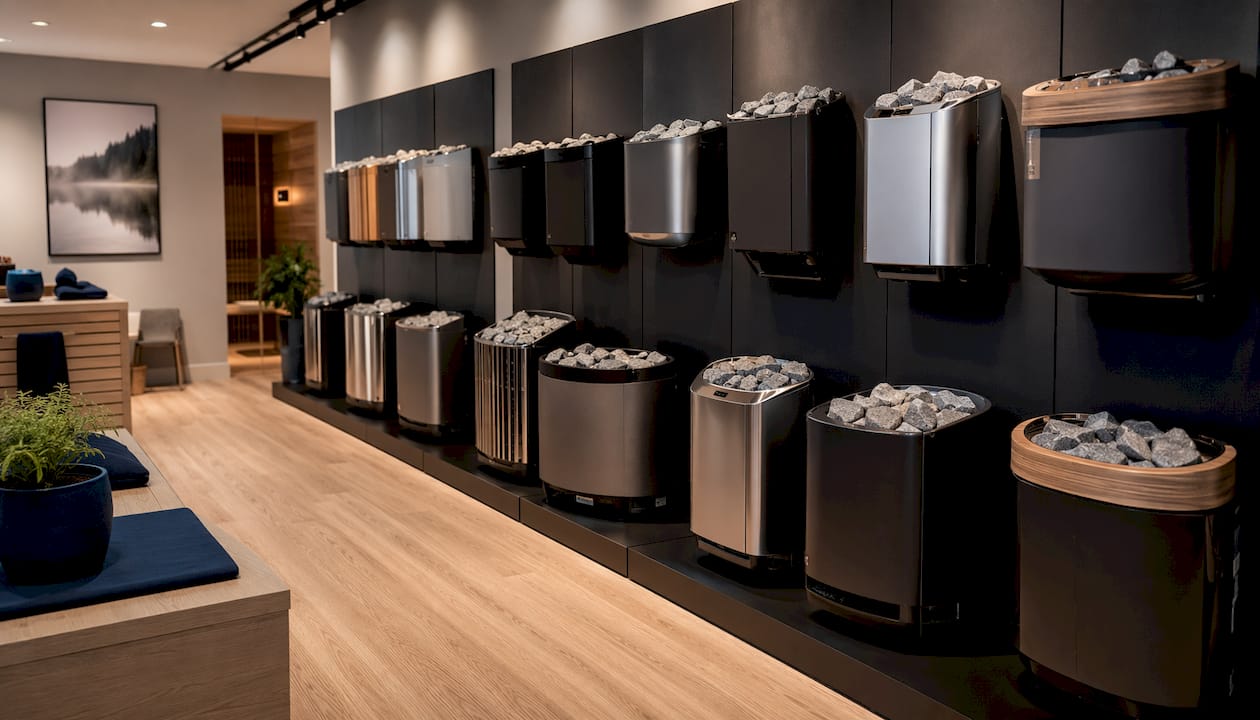
Harvia Virta is the model Saunaheatersupply stocks as its primary Harvia 9 kW recommendation. The stainless design is compact, the 240V/1PH wiring fits most U.S. residential panels without modification, and the balance between rock capacity and footprint makes it the practical choice for most homeowners.
Harvia The Wall takes a different approach entirely: a recessed, flush-mount design that disappears into the wall. Stone capacity is lower than the Cilindro or HUUM Hive, but for design-conscious builds where visual minimalism matters, nothing else in the Harvia range competes.
HUUM Drop is the aesthetic benchmark in the wall-mount category. Its water-drop silhouette has won design awards, and its 55 kg (132 lbs) of stone capacity is unusually high for a wall-mounted unit. Paired with the UKU Wi-Fi controller, it lets you preheat remotely, which removes the 45–60 minute manual warm-up entirely.
HUUM CoreX sits between the Drop and the Hive: wall-mounted with approximately 40 kg of stones, a strong middle ground for buyers who want more stone mass than a typical wall unit without committing to a floor-standing tower.
EOS Mythos and EOS Cubo Avantgarde are German-engineered wall-mount options with a focus on consistent, even heat in compact rooms. Stone capacity is moderate, but the build quality and design finish are strong. The Cubo Avantgarde adds a more architectural aesthetic for modern sauna interiors.
EOS Invisio and EOS U Series solve a specific problem: saunas where wall space is limited or where the heater needs to disappear entirely. The under-bench form factor preserves usable bench and floor space, making these the right call for tight custom builds.
Saunum Kyrö and Air series stand apart through their patented air-mixing technology, which circulates air more evenly through the room and reduces the temperature stratification common in standard heaters. The result is a noticeably more even heat from floor to ceiling. Saunaheatersupply carries the Saunum Air L 10 and larger models for buyers who prioritize heat quality over price.
Amerec AK Series is the straightforward budget option. Controls are simple, performance is adequate for occasional use, and the price point is accessible. The trade-off is a thinner warranty and less refined thermal behavior compared to HUUM or Harvia premium lines.
Finlandia Finn and Scandia Stainless both target buyers who want proven, no-frills performance. The Finlandia Finn is tuned for classic Finnish dry heat with conservative thermal settings. Scandia’s stainless construction makes it the better choice for coastal homes or high-humidity environments where corrosion resistance is a practical concern.
Tylo rounds out the wall-mount category with premium German and Swedish engineering, advanced control options, and high-end fittings. Tylo models suit luxury builds where the heater is part of the room’s design statement.
Floor-standing and tower models
Harvia Cilindro is the strongest floor-standing choice at the 9 kW tier. Its open-grid cylindrical cage exposes stones on all sides, producing 360-degree radiant heat and measurably more even heat distribution than enclosed units. The 80 kg stone capacity delivers sustained löyly through extended sessions. Factor in the separately purchased controller (Xenio or Griffin compatible) when budgeting.
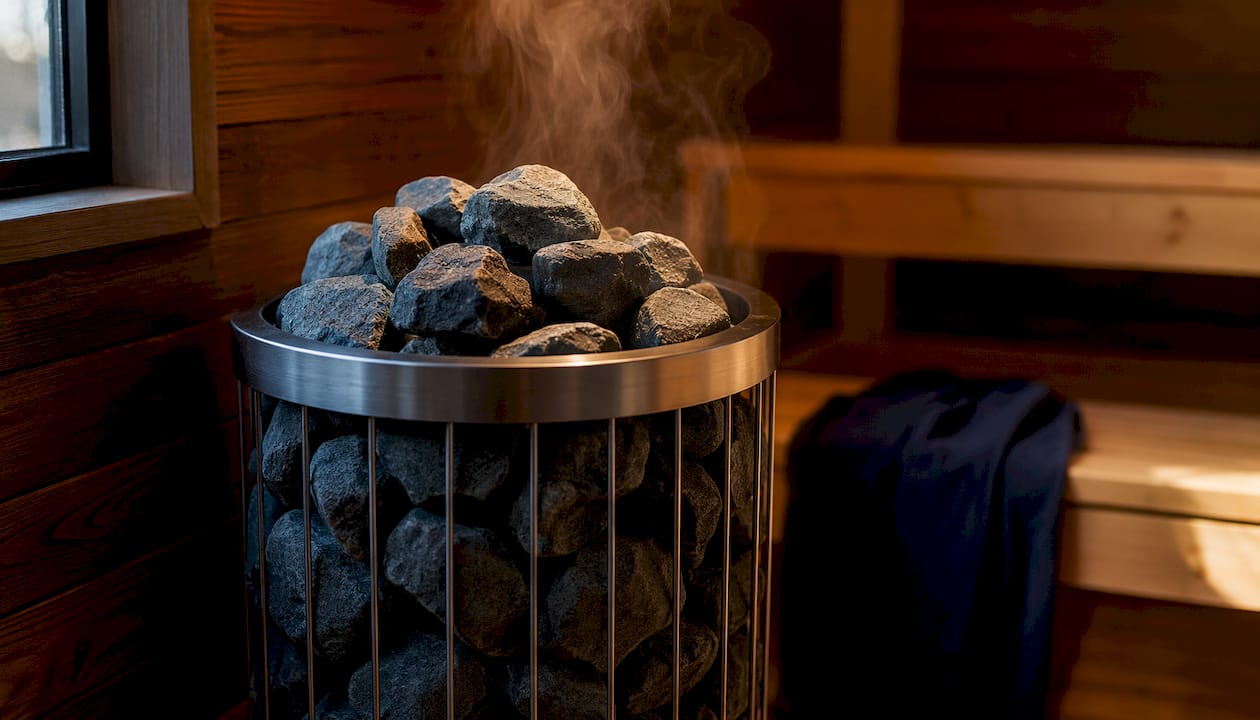
HUUM Hive is the tower model for daily users who want maximum stone mass and the softest possible steam. With approximately 75 kg of stones and the full UKU Wi-Fi ecosystem, it combines thermal performance with smart-home convenience. It is the most premium floor-standing option in this comparison.
Harvia Trillium occupies the mid-range tower position: more stone mass than a wall-mount, a lower price than the Hive, and a clean stainless design that works in most sauna interiors.
Why do premium heaters cost more, and do controls actually matter?
The price gap between a $500 Amerec AK and a $1,800 HUUM Hive is not arbitrary. Three factors drive it: thermal design quality, stone mass engineering, and the controller ecosystem.
“The ‘best’ 9 kW heater depends more on matching thermal characteristics to usage than on brand alone. Choose wall-mounted vs. floor/tower by the heat style you want, not by price alone.” — Tahoe Sauna Company, sauna heater comparison guide
Why controls change the experience: Wi-Fi-enabled systems like the HUUM UKU and Harvia’s Xenio platform let you schedule preheat from your phone. That means the sauna is ready when you are, not 45–60 minutes after you decide you want one. For homeowners who use the sauna daily, this convenience directly affects how often the sauna actually gets used.
Always-ready vs. cold-start designs: Some premium heaters hold a large stone mass at low standby power, cutting ramp-to-temperature from roughly an hour to under 12 minutes. The trade-off is steady standby consumption of 0.8–1.2 kW on average. For daily users, that trade-off is usually worth it. For occasional users, a cold-start model with a Wi-Fi preheat timer achieves a similar result without the standby draw.
Long-term reliability signals to look for:
- Documented replacement parts availability (heating elements, control boards, stone guards).
- Clear warranty terms: 3-year residential is the benchmark for premium brands.
- A supplier with actual service support, not just a drop-ship operation.
Long-term reliability depends heavily on controller quality and the ease of sourcing replacement parts. Premium models often justify their higher upfront cost for daily users precisely because the total cost of ownership over five to ten years is lower.
Key Takeaways
For a 250–450 ft³ home sauna, a 9 kW heater is the right size class — and the Harvia Virta 9 kW wall-mount is the most practical starting point for most U.S. homeowners, with the Harvia Cilindro and HUUM Hive as the clear upgrades for löyly-focused buyers.
| Point | Details |
|---|---|
| Sizing rule | Plan 1 kW per 50 ft³; a 6×8×7 ft sauna (336 ft³) needs 6–9 kW. |
| Stone mass matters most | Floor/tower models with 75–80 kg of stones deliver softer löyly and better steam recovery than wall-mounts. |
| Electrical requirement | All 9 kW heaters need a dedicated 240V circuit; electrician costs typically run $1,500–$3,000. |
| Controls upgrade usability | Wi-Fi preheat (HUUM UKU, Harvia Xenio) eliminates the 45–60 minute manual warm-up wait. |
| Saunaheatersupply recommendation | Saunaheatersupply stocks the Harvia Virta 9 kW, Harvia Cilindro 9 kW, and Saunum Air L 10 for U.S. buyers with expert support and a price match guarantee. |
A vendor perspective on choosing the right heater
Saunaheatersupply curates its electric heater inventory specifically for U.S. residential buyers, which means every model it stocks is confirmed for 240V/1PH compatibility and carries a warranty backed by supplier support. The team’s approach is straightforward: match the heater to the room and the usage pattern, not to a price point. That means recommending the Harvia Virta for most standard home builds, the Cilindro for buyers who want serious löyly, and the Saunum Air series for those who want premium even-heat distribution with smart controls.
Beyond the initial sale, Saunaheatersupply provides guidance on replacement parts, compatible controllers, and installation resources, helping you to transform your bedroom into a luxurious spa sanctuary that complements your sauna experience. The price match guarantee means buyers can order with confidence that they are getting a competitive price on a product that will be supported after delivery.
Where to buy the right 9 kW heater for your sauna
Saunaheatersupply offers the most direct path from this comparison to an actual purchase. The curated selection covers the full range of 9 kW options discussed here, from the practical Harvia Virta wall-mount to the premium Saunum Air series, all with U.S.-compatible electrical specs and expert pre-sale support.
Key product pages to bookmark:
- Harvia Virta 9 kW — best overall wall-mount for most home saunas; 240V/1PH, stainless steel, compact footprint.
- Harvia Cilindro 9 kW — floor-standing tower with 80 kg stone capacity for serious löyly.
- Saunum Air L 10 — premium even-heat distribution with advanced controls; ideal for upscale home builds.
- Saunum Air L 15 — for larger rooms or buyers sizing up beyond the standard 9 kW range.
For personalized help matching a heater to your room dimensions and electrical setup, visit the Saunaheatersupply shop or contact the team directly. Expert support, warranty handling, and a price match guarantee are included with every order.
Useful sources and spec references
- Tahoe Sauna Company — Best Electric Sauna Heaters: Sizing heuristics, brand comparisons, and installation cost estimates for U.S. buyers.
- SaunaTimes — Electric Sauna Heater Review by a Professional Electrical Engineer: The 200 rule explained, ceiling-height adjustments, and long-term reliability guidance from an engineering perspective.
- ThermalFinn — Harvia Cilindro Review: Detailed 11-month test of the Cilindro PC90E with stone mass data, heat distribution analysis, and pricing.
- ThermalFinn — Harvia Forte AF9 Review: Always-ready heater standby consumption data (0.8–1.2 kW) and steam recovery test results.
- The Movement Review — HUUM Drop 9 kW Review: Real-world assessment of the UKU Wi-Fi control system and remote preheat experience.
- Rosenberry Rooms — VEVOR 9 kW Sauna Heater Review: Honest budget heater assessment with caveats on long-term reliability and parts availability.
- Sauna Society: U.S.-based sauna culture and safety standards reference.
- Saunaheatersupply — Main Shop: Primary source for purchasing 9 kW heaters with U.S. electrical compatibility confirmed.
The part most buyers get wrong
The most common mistake in buying a 9 kW sauna heater is treating it as a commodity purchase. Buyers compare wattage and price, pick the cheaper unit, and then wonder why the sauna never feels right. The real decision is about thermal character, not kilowatts.
A 9 kW wall-mount with 15 kg of stones and a 9 kW floor tower with 80 kg of stones are technically the same output. The experience they deliver is completely different. The wall-mount heats fast and dry. The tower produces the kind of soft, enveloping steam that makes you want to stay in the sauna for an hour. Neither is wrong — they serve different preferences. But choosing the wrong one for your style is a $1,000 mistake that no amount of stone rearranging will fix.
The second mistake is underestimating installation costs. A $700 heater with a $2,500 electrical upgrade is a $3,200 project. That changes the budget math considerably and often makes a $1,200 premium model with better long-term reliability the smarter total investment.
Buy for the experience you want, not the spec sheet that looks most impressive.
Recommended
- Sauna Heater Supply- Shop Premium Sauna Heaters
- Harvia Virta Combi Series 9.0kW Sauna Heater at 240V 1PH — Sauna Heater Supply
- Harvia Virta Series 9kW Stainless Steel Sauna Heater at 240V 1PH — Sauna Heater Supply
- Harvia Virta Series 8kW Stainless Steel Sauna Heater at 240V 1PH — Sauna Heater Supply