









Sauna Running Cost: Real Numbers for US Homeowners
Running a home sauna costs far less than most buyers expect. Per session, a typical electric/traditional sauna runs a moderate amount, an infrared cabin is generally less expensive, a steam unit costs somewhat more, and a wood-fired stove costs roughly a few dollars in firewood. Monthly, that translates to varied costs depending on sauna type and usage frequency.
These figures assume a US average residential electricity rate of approximately $0.15/kWh, a 60-minute session (including preheat), and a duty-cycle factor of 0.60, meaning the heater draws full power only about 60% of the time. Your actual sauna running cost will shift based on local utility rates, room insulation, heater sizing, and how often you use it. States like Hawaii and California can push rates above $0.30/kWh, while parts of the South and Midwest sit closer to $0.09/kWh — a difference that nearly triples monthly bills for daily users.
Table of Contents
- How is sauna running cost calculated?
- What wattage and kWh should you expect by sauna type?
- What do monthly costs look like at different usage levels?
- What does installation actually cost?
- What should you budget for maintenance and repairs?
- How do insulation, sizing, and behavior cut your monthly bill?
- What do industry experts say about duty cycle and repair risks?
- Key Takeaways
- The numbers are realistic — here is what that means for your decision
- Find the right heater for your budget and room size
- Useful sources and further reading
How is sauna running cost calculated?
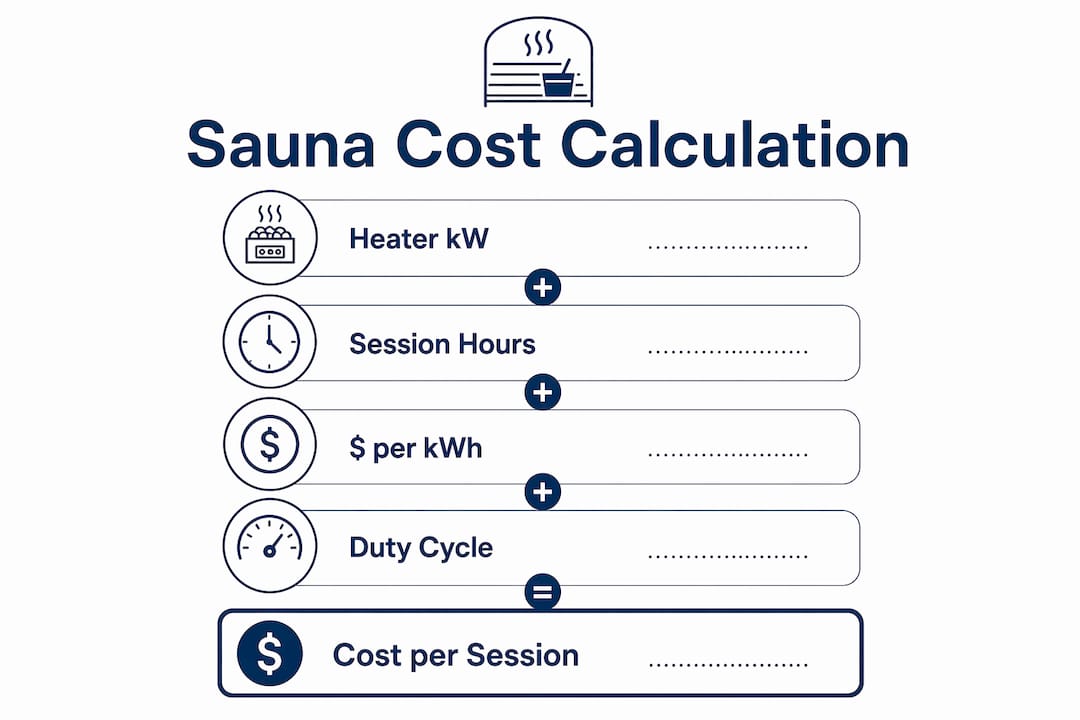
The formula is straightforward:
Cost per session = Heater kW × Session hours × $/kWh × Duty-cycle factor
The duty-cycle factor accounts for the fact that heaters draw full power during heat-up then cycle on and off to hold temperature. Across a full session, average draw is typically 50–65% of rated kW. Using 0.60 as a middle value is standard for planning purposes.
Step-by-step worked examples
-
6 kW traditional electric heater, 1-hour session, $0.15/kWh: 6 kW × 1 hr × $0.15 × 0.60 = $0.54 per session At 3 sessions/week: $0.54 × 12 sessions = $8–$18 per month
-
2 kW infrared cabin, 45-minute session, $0.15/kWh: 2 kW × 0.75 hr × $0.15 × 1.00 = $0.23 per session (Infrared heaters run continuously without cycling, so duty cycle = 1.0) At 3 sessions/week: $0.23 × 12 = about $3 per month
Note that preheat is included in session time for traditional heaters. A 6 kW heater typically takes 30–45 minutes to reach temperature, and that preheat phase is when the heater draws hardest. Infrared cabins warm up in 10–15 minutes and are often counted from the moment you step in.
Assumptions table
| Variable | Low | US Average | High |
|---|---|---|---|
| Electricity rate ($/kWh) | $0.09 | $0.15 | $0.30 |
| Session length (minutes) | 45 | 60 | 90 |
| Duty-cycle factor | — | 0.60 | — |
| Heater kW (electric) | 3.5 | 6.0 | 9.0 |
What wattage and kWh should you expect by sauna type?
Heater size and operating behavior vary significantly across sauna types, and those differences drive real cost gaps.
Infrared cabins
- Typical draw: 1.6–2.8 kW for 1–2 person units; up to 4.5 kW for 3–4 person cabins
- Session kWh: 0.8–2.0 kWh (no duty cycling; heater runs continuously)
- Heat-up time: 10–15 minutes
- Infrared heaters warm the body directly rather than the air, so session lengths tend to run 40–45 minutes at lower temperatures (120–140°F vs. 160–195°F for traditional)
Electric/traditional (hot-rock) heaters
- Typical draw: 3.5–9.0 kW for residential units; commercial models reach 12+ kW
- Session kWh: 4.5–6.0 kWh for a standard 60-minute session including preheat
- Heat-up time: 30–45 minutes; preheat accounts for roughly 50–65% of session energy
- Larger rooms (5+ persons), glass walls, or poor insulation push kWh toward the high end
Steam/combination units
- Typical draw: 5.0–10.5 kW depending on generator size and room volume
- Session kWh: 4.0–8.0 kWh; steam generators cycle more frequently than dry-heat heaters
- Heat-up time: 20–35 minutes; humidity adds thermal load
- The Harvia Virta Combi 10.5kW is a representative combination unit at 240V/1PH
Wood-fired stoves
- No grid electricity draw (beyond any ventilation fan)
- Fuel: approximately 10–15 lbs of seasoned hardwood per session
- Per-session fuel cost: roughly $1–$3 depending on local wood prices and species
- Heat-up time: 45–90 minutes; requires active fire management
- Additional costs: chimney maintenance, wood storage, and ash disposal
Size and glass effects: A 1–2 person sauna with solid cedar walls and proper insulation sits at the low end of every range above. Add a glass wall panel, jump to 3–4 persons, or skip the vapor barrier, and you can add 20–30% to session kWh across all electric types.
What do monthly costs look like at different usage levels?
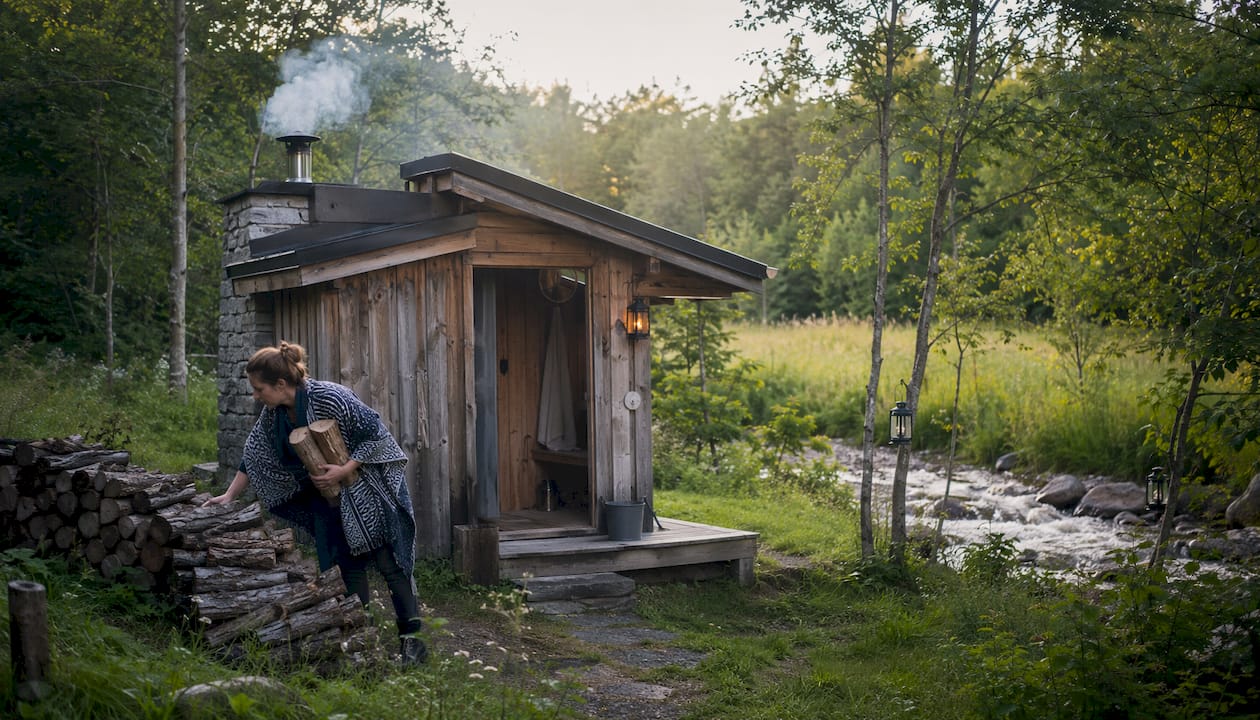
The table below shows per-session and monthly costs for the three most common electric sauna types at light, moderate, and heavy use, across three electricity price tiers. Wood-fired costs are shown separately as a firewood range.
Monthly costs vary widely depending on sauna type, usage frequency, and electricity price, with wood-fired sauna fuel costs depending on local firewood prices.
Every $0.05/kWh increase in your electricity rate adds roughly $1.30–$3.50 per month to a 6 kW electric sauna used three times per week. For daily users in high-rate states, regional electricity price variation can mean a $60–$80 monthly swing compared with low-rate states.
Wood-fired saunas look cheap per session but carry higher upfront installation costs (chimney, hearth pad) and require consistent wood sourcing. In rural areas with access to cord wood, the per-session cost can drop below $1.00. In urban markets, bagged hardwood can push it above $4.00.
What does installation actually cost?
The one-time electrical hookup often costs more than years of electricity bills combined. Budget for these items before you buy a heater.
- Dedicated 240V circuit: $600–$2,500 depending on panel capacity, run length, and conduit requirements
- Panel upgrade (if your existing panel lacks capacity): $1,000–$3,500
- Electrician labor: typically $75–$150/hour; a straightforward run from panel to sauna room takes 3–6 hours
- Chimney kit and installation for wood stoves: $500–$1,500 for a single-wall or insulated chimney kit plus labor; the HUUM barrel sauna chimney kit is one example of a purpose-built option
- Building permits: $50–$300 in most jurisdictions; required in many states for new 240V circuits
Electrician checklist before installation
- Confirm breaker size matches heater amperage (a 6 kW/240V heater draws 25A; a 9 kW draws 37.5A).
- Measure circuit distance from panel to sauna location; runs over 50 feet may require heavier gauge wire.
- Specify conduit type (EMT or PVC) per local code.
- Confirm GFCI protection and proper grounding per NEC requirements.
- Pull the required permit and schedule inspection before covering walls.
- For wood stoves: schedule a chimney inspection and confirm clearance distances meet local fire code.
Get at least two electrician quotes. Older homes with 100A panels, long runs to detached garages or outbuildings, and aluminum wiring all push costs toward the high end of the range.
Pro Tip: Ask your electrician to install a dedicated sub-panel near the sauna room if you plan to add other high-draw accessories later (lighting, ventilation fans, audio). The marginal cost at install time is far lower than a return visit.
What should you budget for maintenance and repairs?
Sauna upkeep is genuinely low compared with hot tubs or pools, but skipping a few key tasks creates expensive problems fast.
Routine annual maintenance tasks:
- Bench sanding with 80–120 grit sandpaper (removes surface grime and opens wood grain)
- Wood oiling or treatment for exterior surfaces exposed to moisture
- Sauna stone inspection and replacement (stones crack over time; replace every 1–3 years)
- Light cleaning with a sauna-safe cleaner; avoid harsh chemicals on cedar or spruce
- Visual check of heater elements, wiring connections, and thermostat function
Annual maintenance costs typically run $150–$350, with most homeowners landing around $250 when factoring in stones, sandpaper, and occasional wood treatment. Most of these tasks are DIY-friendly.
Non-routine repair cost ranges
| Repair Type | Typical Cost Range | Trigger |
|---|---|---|
| Heating element replacement | $500–$1,500 | Element failure; usually after 5–10 years |
| Full heater replacement | $1,000–$3,500 | Heater beyond repair or obsolete |
| Moisture damage / rot repair | $1,000–$5,000+ | Chronic poor ventilation or missed maintenance |
| Chimney relining (wood stoves) | $600–$2,500 | Creosote buildup or liner damage |
| Control board / thermostat | — | Electrical fault or age |
Moisture damage is the most expensive non-routine repair homeowners face, and it is almost entirely preventable.
Pro Tip: Practice the “bake-and-breathe” routine after every session: run the heater for 10–15 minutes after your last use with the door cracked open. This dries residual moisture from the wood before it can penetrate the grain. Skipping this step consistently is the primary cause of rot that leads to $1,000–$5,000+ remediation bills.
How do insulation, sizing, and behavior cut your monthly bill?
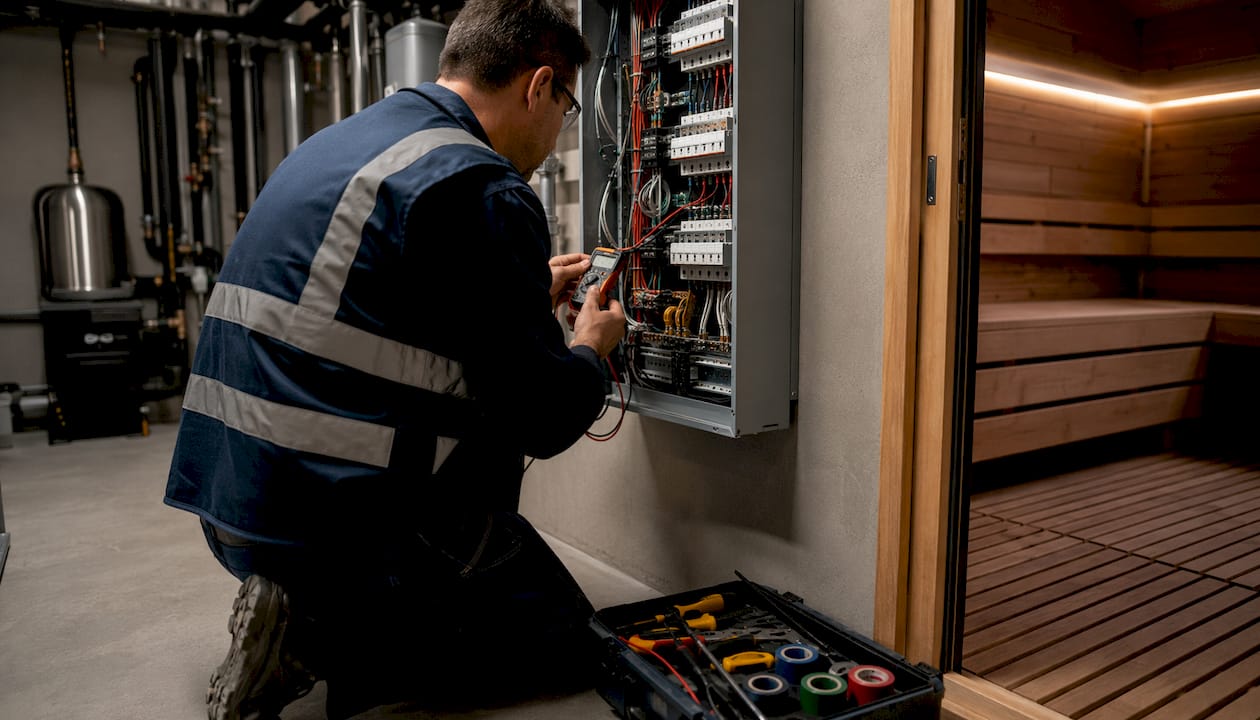
Correct heater sizing and proper insulation deliver more lifetime savings than any other factor. Practitioners consistently point to these two levers first.
Highest-impact efficiency steps:
- Match heater kW to room volume. The standard rule of thumb is 1 kW per 45–50 cubic feet of sauna room for electric heaters. Oversizing by even 2 kW means the heater cycles less efficiently and draws more energy during heat-up.
- Insulate to R-19+ in walls and R-25+ in the ceiling. Proper insulation can reduce session energy consumption by 15–25%, and adding a reflective foil vapor barrier cuts heat-up losses by another 10–15%.
- Minimize glass area. Glass panels transfer heat 5–10x faster than insulated cedar walls. Every square foot of glass adds measurable kWh per session.
- Use a timer or Wi-Fi controller. Preheat only as long as needed. A heater left running 30 minutes longer than necessary on a 6 kW unit costs an extra $0.16–$0.27 per session at average rates.
- Batch sessions. Running two sessions back-to-back uses significantly less energy than two cold starts, since the room is already at temperature.
Insulation and ventilation checklist
- Check for gaps around the door frame and threshold; even small air leaks extend heat-up time.
- Confirm the vapor barrier is continuous and lapped correctly at seams.
- Verify the ventilation vent is sized correctly (typically 4–6 inches) and positioned low on the wall opposite the heater.
- Inspect ceiling insulation depth annually; settling reduces effective R-value over time.
An energy monitor plugged into the heater’s circuit gives you actual kWh per session rather than estimates. The real number is almost always lower than buyers expect once duty-cycle behavior is measured directly.
What do industry experts say about duty cycle and repair risks?
The duty-cycle reality is one of the most misunderstood aspects of sauna electricity costs. Here is the core insight from practitioners:
Sauna heaters do not draw their rated wattage for the entire session. During heat-up they run at full power, then cycle on and off to hold temperature. Measured across a full session, average draw is typically 50–65% of the nameplate kW rating. Using 100% continuous draw in any cost estimate overstates actual electricity use by 35–50%.
This is why a 9 kW heater does not cost twice as much to run as a 6 kW unit in practice. The larger heater reaches temperature faster, then cycles less frequently. The net kWh difference per session is smaller than the nameplate gap suggests.
Recommended heater families and their efficiency profiles:
- Saunum AirSolo 70 and AirSolo 80: Saunum’s AirSolo line uses air-mixing technology to distribute heat evenly, reducing the temperature differential between floor and ceiling. More even heat distribution means the heater cycles less aggressively, which can lower effective duty cycle and per-session kWh.
- Saunum Air L series (Air L 10 and Air L 13): Larger-capacity models suited to 3–5 person rooms; the air-circulation design maintains consistent temperature with fewer full-power cycles.
- Harvia Virta series: Available in 8 kW and 10.5 kW configurations, the Virta line is a widely used electric heater with a proven element lifespan and straightforward replacement parts availability. The Virta Combi variant adds steam capability.
Recommended inspection cadence:
- Annual visual check: heater elements, stone condition, wood surfaces, door seal
- Bench sanding: once per year for moderate use; twice per year for heavy use
- Electrical check: every 3–5 years by a licensed electrician; includes connection tightness and element resistance test
- Chimney inspection (wood stoves): annually before the heating season
Key Takeaways
A typical electric sauna costs about $0.68–$0.83 per session at the US average electricity rate, with monthly totals of $8–$18 for three sessions per week — and the one-time electrical hookup usually costs more than the first two years of electricity combined.
| Point | Details |
|---|---|
| Per-session cost range | Infrared: about $0.15–$0.45; electric/traditional: about $0.68–$0.83; steam: $0.72–$1.44; wood-fired: $1–$3 in firewood |
| Biggest one-time cost | Dedicated 240V circuit runs $600–$2,500; budget this before purchasing a heater |
| Duty cycle cuts real costs | Heaters average 50–65% of rated kW across a session, so actual bills are lower than nameplate math suggests |
| Insulation pays off | R-19+ walls and R-25+ ceilings reduce session energy by 15–25%; a foil vapor barrier adds another 10–15% |
| Saunaheatersupply heater selection | Saunaheatersupply carries the Saunum AirSolo, Air L, and Harvia Virta lines with specs and sizing guidance for every room size |
The numbers are realistic — here is what that means for your decision
The cost figures in this article are not best-case scenarios. They reflect real heater behavior, real duty cycles, and real US electricity rates. What they do not account for is a poorly insulated room, an oversized heater, or a preheat habit that runs 45 minutes longer than necessary. Those three factors together can double a monthly electricity bill without changing the heater at all.
The homeowners who get the most out of a sauna investment are the ones who size the heater correctly for their room, insulate properly before the first session, and treat the bake-and-breathe routine as non-negotiable. The electricity cost is genuinely manageable. The repair cost from skipped maintenance is not.
If you are unsure which heater fits your room or how to estimate your installation costs, Saunaheatersupply’s team can help you work through the numbers before you buy.
Find the right heater for your budget and room size
Knowing your per-session cost is useful. Knowing you have the right heater for your room is what actually keeps that cost where it belongs.

Saunaheatersupply carries a curated selection of electric, infrared, and wood-fired heaters matched to room size, usage frequency, and installation requirements. Whether you are planning a compact 1–2 person infrared cabin or a full-size traditional sauna for a family, the product lineup includes options at every capacity level, from the Saunum AirSolo series to the Harvia Virta 8 kW and 10.5 kW models. Every heater listing includes wattage, voltage, and room-volume specs so you can run the cost formula before you order.
Browse the full sauna heater catalog at Saunaheatersupply, or go directly to the Harvia Virta 10.5kW or Saunum Air L 10 product pages for specs and pricing. Contact the team for sizing help or a price match on any model.
Useful sources and further reading
- EIA Residential Electricity Rates — check current average rates by state to plug into your own cost formula
- ThermalFinn: Sauna Energy Consumption and kWh Reduction — detailed breakdown of session kWh, insulation savings, and efficiency levers
- Sauna Monthly: Real Per-Session Cost Calculator — duty-cycle explanation, formula walkthrough, and installation cost context
- Angi: Sauna Maintenance Cost Data — annual maintenance ranges and repair cost benchmarks
- Tahoe Sauna Company: Annual Maintenance Costs — moisture/rot risk detail and routine upkeep guidance
- Epic Hot Tubs: Sauna Running Cost Guide — infrared wattage data and per-session cost comparisons
- Saunaheatersupply Product Pages — heater specs, wattage, and voltage for all models referenced in this article
To get your actual per-session cost: check your most recent utility bill for your $/kWh rate, measure your sauna room’s cubic footage, confirm your heater’s rated kW, and run the formula: kW × hours × $/kWh × 0.60. For the most precise figure, plug a dedicated energy monitor into your heater’s circuit for one month of real sessions.