








Homeowners and Installers: Steam Generator Sizing with Brand Multipliers
Sauna Heater Supply and manufacturer sizing charts from brands like Kohler and Delta all follow this same three-step logic. The next section walks through the measurements and conversions in order.
TL;DR:
- Manufacturers base sizing on cubic volume, which requires accurate interior measurements, including benches and niches, after finishing work is complete.
- Material type significantly alters the required generator size, with dense stone doubling the baseline, glass or tile adding approximately 35%, and acrylic or fiberglass needing less adjustment.
- Ceiling height and exposure to unconditioned or cold exterior walls can increase the necessary kilowatt capacity by up to 30% or more, especially in rooms with extensive glass surfaces.
- Correct placement of the generator within specified distances minimizes heat loss and simplifies maintenance, while water quality issues like hard water can cause scale buildup that reduces heating efficiency over time.
- Proper sizing reduces long-term maintenance, preventing premature component failure caused by short-cycling or inadequate heat, and ensures consistent, reliable performance in residential and commercial steam rooms.
Table of Contents
- How Do You Measure Cubic Volume for Steam Generator Sizing?
- Which Material Multipliers Matter Most for Sizing?
- What Adjustments Do Ceiling Height and Glass Require?
- What Inputs Do Online Steam Generator Calculators Need?
- What Electrical Setup Does Your Steam Generator kW Need?
- How Do You Know If a Steam Generator Is Undersized or Oversized?
- Which Controls Pair With Each Steam Generator Sizing Band?
- How Does Ventilation Affect Steam Generator Sizing?
- Where Should You Place the Steam Generator for Best Results?
- Does Water Quality Affect Steam Generator Performance?
- How Does Sizing Affect Long-Term Maintenance?
- An Installer’s Take on Getting Sizing Right the First Time
- Shop Steam Shower Controls That Match Your Sized Generator
- Sources
How Do You Measure Cubic Volume for Steam Generator Sizing?
Cubic volume, not floor area, is the number every manufacturer chart runs on. Measure the finished interior dimensions of the steam enclosure, from wall to wall, floor to ceiling, after tile or panel installation, not the rough framing.
- Measure length and width along the interior finished walls, in feet.
- Measure ceiling height at the lowest point if the ceiling slopes or has a soffit.
- Multiply length × width × height to get cubic feet.
- Include volume taken up by benches, niches, and step platforms since they still hold air the generator must heat, even though a bench eats some of that space back.
- Exclude any plumbing chase, closet, or mechanical space sealed outside the steam envelope.
If you prefer metric, convert feet to meters by multiplying by 0.3048, then cube the result for cubic meters, or just divide your cubic-foot total by 35.3 to get cubic meters directly. Most manufacturer tables assume an 8 ft ceiling as the baseline. Once you go above that, height starts changing the math meaningfully, which the next section covers.
Which Material Multipliers Matter Most for Sizing?
Surface material determines how much heat the room’s walls absorb and radiate away before steam ever reaches you, and manufacturers build specific multipliers around that behavior. Delta’s SimpleSteam sizing guide publishes some of the clearest reference numbers in the industry.
- Ceramic or porcelain tile: multiply adjusted volume by roughly 1.35× for standard tile on drywall or cement board.
- Glass or glass block: also carries a 1.35× multiplier per Delta’s guidance, reflecting how quickly glass sheds heat.
- Natural stone or marble: doubles the requirement at roughly 2.0×, since dense stone soaks up far more thermal energy before the room stabilizes.
- Acrylic or fiberglass: typically needs less compensation than tile or stone, since these low-mass surfaces heat up fast and hold little residual cold.
Built-in benches and thick mortar beds add thermal mass beyond what the base multiplier assumes, so Mr. Steam’s sizing guidance recommends bumping up an extra size when a room combines heavy stone with a full bench system. When your specific brand publishes its own multiplier table, defer to that over any general rule.
What Adjustments Do Ceiling Height and Glass Require?
Height and exterior exposure change the math almost as much as material does, and glass is the adjustment most people skip entirely.
- Start with your material-adjusted cubic volume from the previous step.
- Add roughly 15% for a 9 ft ceiling, and closer to 30% for a 10 ft ceiling, since taller rooms trap more rising steam before it reaches the sensor.
- Add a further percentage, generally 10 to 15%, for each exterior wall exposed to unconditioned space or cold climate, since exterior walls bleed heat outward faster than interior partitions.
- Compensate for glass doors and partitions. Many installers add capacity for each square meter of glass surface, treating this as a working estimate rather than a fixed manufacturer standard.
- Convert the fully adjusted cubic volume to kW using your manufacturer’s chart, then round up to the next available SKU.
Worked example: A 6 ft × 4 ft × 8 ft shower with tile walls gives a raw volume of 192 cubic feet. Apply the 1.35× tile multiplier for 259 cubic feet. Add 15% for a 9 ft ceiling upgrade, landing at roughly 298 cubic feet. Kohler’s sizing table maps 240 cubic feet to a 9 kW unit, so this room rounds up to a 9 kW or the next available step above it. Expected warm-up on a correctly sized 9 kW unit runs 5 to 15 minutes for a residential room this size, a useful benchmark once the unit is installed.
What Inputs Do Online Steam Generator Calculators Need?
Interactive calculators speed up the math, but only when you feed them the right numbers. Give the calculator your finished interior dimensions in feet, exact ceiling height, primary wall material, total glass area in square feet, and whether any wall borders unconditioned exterior space.
- Entering floor area instead of full cubic volume is the single most common input error and produces an undersized recommendation almost every time.
- Skipping bench and niche volume makes the room appear smaller than it actually is.
- Leaving glass area at zero, even for a single glass door, quietly erases a real heat-loss factor from the result.
- Forgetting to flag exterior walls understates the load in cold climates or unconditioned spaces.
Once you get a number, cross-check it against a printed manufacturer kW-to-volume chart. If the calculator and the chart land more than one size apart, contact the manufacturer’s support line before ordering. That gap usually means one of your inputs got entered wrong, not that the chart is out of date.
What Electrical Setup Does Your Steam Generator kW Need?
Kilowatt selection dictates the electrical work behind the wall, so loop in an electrician before you finalize a model.
- A 5 kW generator typically runs on a 20 to 25 amp single-phase circuit, which fits most residential panels without a service upgrade.
- Larger units frequently need three-phase power or multiple dedicated circuits, common in commercial spas, gyms, and multi-unit steam rooms.
- Larger commercial installations sometimes split the load across two generators feeding one steam room rather than one oversized unit, which also builds in redundancy if one unit needs service.
- Long conductor runs from the panel to the generator can cause voltage drop that undermines performance even on a correctly sized unit.
A licensed electrician should confirm your panel has capacity for the added load and verify wire gauge for the run length. This step matters as much as the volume math. For a closer look at breaker sizing by kW band, Sauna Heater Supply’s electrical planning guide walks through the specifics.
How Do You Know If a Steam Generator Is Undersized or Oversized?
A generator that never seems to catch up, or one that shuts off almost as soon as it starts, is telling you something about its sizing.
- Undersized signs: warm-up stretches past 15 minutes in a residential room, the unit runs at maximum output continuously, or steam output feels weak even after 20 minutes.
- Oversized signs: the generator short-cycles, hitting temperature and shutting off within a couple of minutes, then restarting almost immediately.
- Target warm-up: residential rooms should reach steam temperature in 5 to 15 minutes; commercial rooms run 15 to 30 minutes given their larger volume.
- Short-term fix: check door seals and glass gaskets first, since a leaking envelope mimics undersizing on a correctly rated unit.
- Long-term fix: if sealing is solid and warm-up still lags, the room needs a larger generator or a second unit running in parallel.
Pro Tip: Before blaming the generator, run a smoke-pencil or incense-stick check around the door seal. A surprising number of “undersized” complaints turn out to be a $20 gasket problem. For a full diagnostic walkthrough, see Sauna Heater Supply’s troubleshooting guide.
Which Controls Pair With Each Steam Generator Sizing Band?
Once you land on a kW figure, the control panel and steamhead you choose affect the daily experience, not the sizing math itself. Sauna Heater Supply carries three control options built for different room scales and installer preferences.
The iSteamX Steam Shower Control and Steamhead suits mid-size residential rooms where the homeowner wants full digital control over temperature, timing, and aromatherapy injection alongside a properly matched generator. The TempoTouch Steam Shower Control and Steamhead works as a strong alternative for installers who want a simplified touch interface without sacrificing programmability. The compact iTempo Round Steam Shower Control and Steamhead fits smaller enclosures or tight wall space where a full-size panel won’t work cleanly.
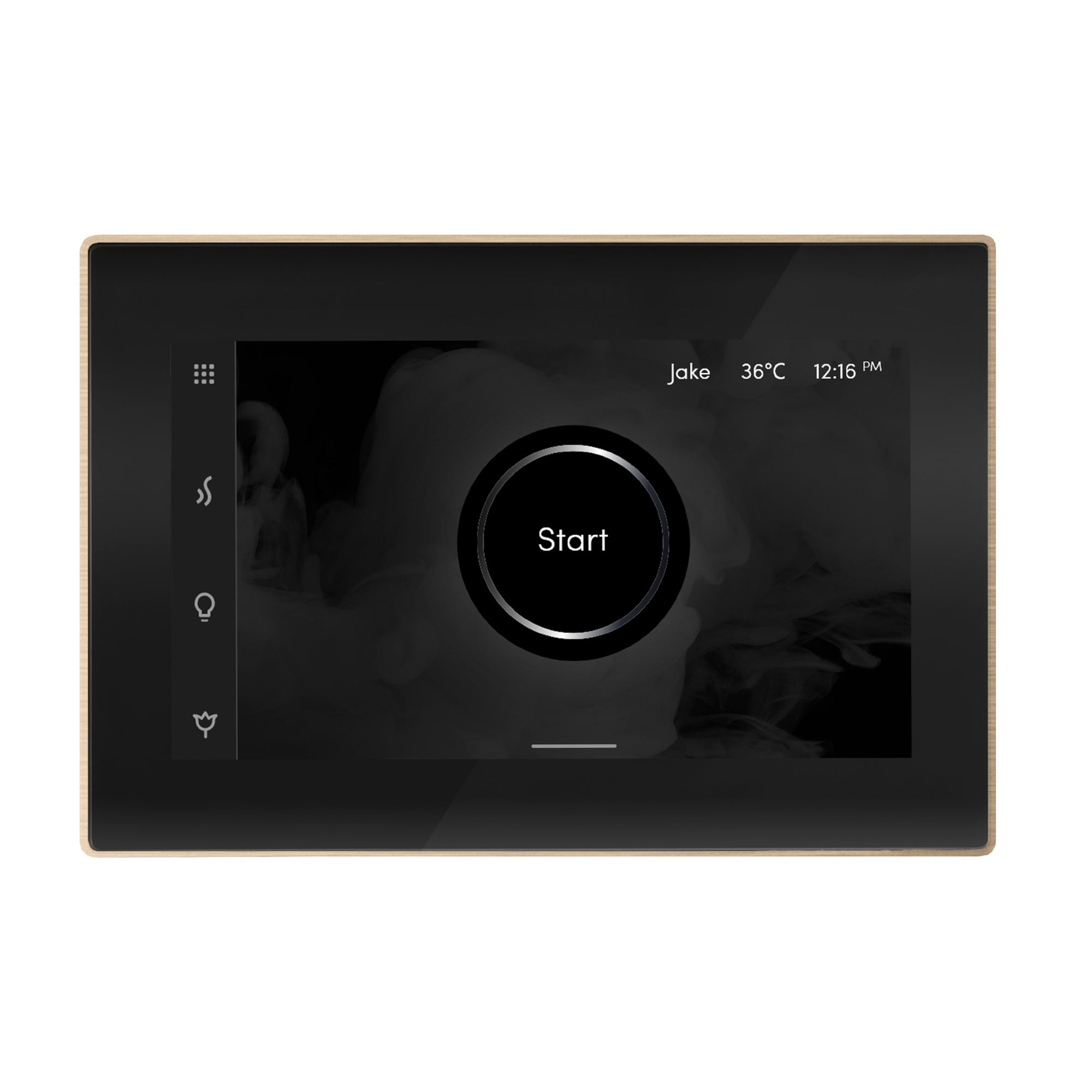
None of these change your kW calculation. They determine wiring routing and interface placement. Sauna Heater Supply’s team can confirm compatibility against your chosen generator before you check out.
How Does Ventilation Affect Steam Generator Sizing?
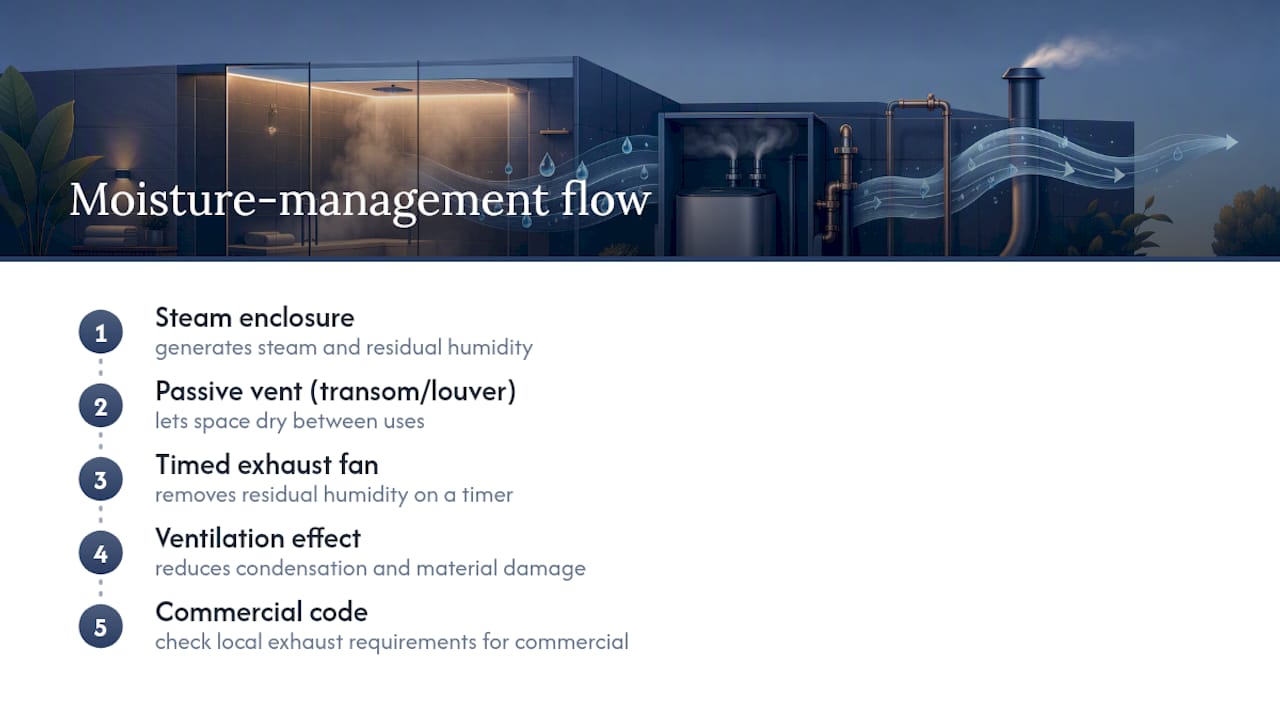
A steam room that can’t vent moisture after each session will show mold and coating failure long before the generator itself becomes the problem. Sizing the generator correctly does not replace proper ventilation planning. Most steam enclosures need a way to exhaust residual humidity between sessions, whether that’s a dedicated exhaust fan tied to a timer or a passive vent that lets the space dry between uses.
Humidity control also interacts with your original volume calculation. A room that traps moisture retains heat differently than a well-ventilated one, which is part of why manufacturer material multipliers assume a properly sealed, properly vented enclosure rather than a leaky one. If your room design includes a transom vent, louvered door insert, or an exhaust fan wired on a delay timer, factor that into your material assumptions since ventilation reduces the risk of condensation-driven material degradation that eventually change how the room’s surfaces retain heat.
For commercial installations, local code often dictates minimum exhaust requirements for steam rooms separate from any residential guidance, since these spaces see continuous use across many more sessions per week. Check your jurisdiction’s mechanical code before finalizing duct or fan specifications alongside your generator order. A generator sized perfectly for the room’s volume still underperforms in a space that holds onto humidity between uses, since residual moisture affects how quickly the next session reaches temperature.
Where Should You Place the Steam Generator for Best Results?
Placement affects performance in ways that pure volume math doesn’t capture. Manufacturers typically recommend installing the generator within a set distance of the steam room, often within 25 to 30 feet of the steam head, since longer steam-line runs lose heat and pressure before steam ever reaches the outlet.
A generator tucked into an unconditioned crawl space or an unheated exterior closet loses more heat through the supply line than one installed in a conditioned mechanical room or vanity cabinet close to the steam enclosure. That heat loss doesn’t show up in your cubic-volume calculation, but it shows up in your warm-up time once the system is running. If your installation requires a longer run than the manufacturer’s recommended maximum, ask about insulated steam line kits or consider whether the next size up compensates for the loss.
Placement also affects service access. A generator installed inside a tight cabinet with no clearance around the unit makes routine maintenance harder and can trap heat around the unit itself, shortening component life. Leave clearance space on at least one side for filter access and drain valve service. Getting placement right the first time avoids a situation where a correctly sized generator underperforms simply because of where it sits relative to the room it’s heating.
Does Water Quality Affect Steam Generator Performance?
Hard water is one of the most overlooked factors in long-term steam generator performance, and it has nothing to do with your kW calculation. Steam generators boil water continuously, which means mineral content in your water supply, calcium and magnesium in particular, builds up as scale inside the tank and on heating elements over time.
Scale buildup reduces the effective heating surface of the element, which means a generator that was sized correctly on day one can start behaving like an undersized unit within a year or two in a hard-water region. The generator isn’t failing. It’s fighting a layer of mineral deposit between the element and the water it needs to heat. That’s why manufacturers in hard-water regions often recommend an inline filtration or descaling system as a maintenance add-on, not an optional upgrade.
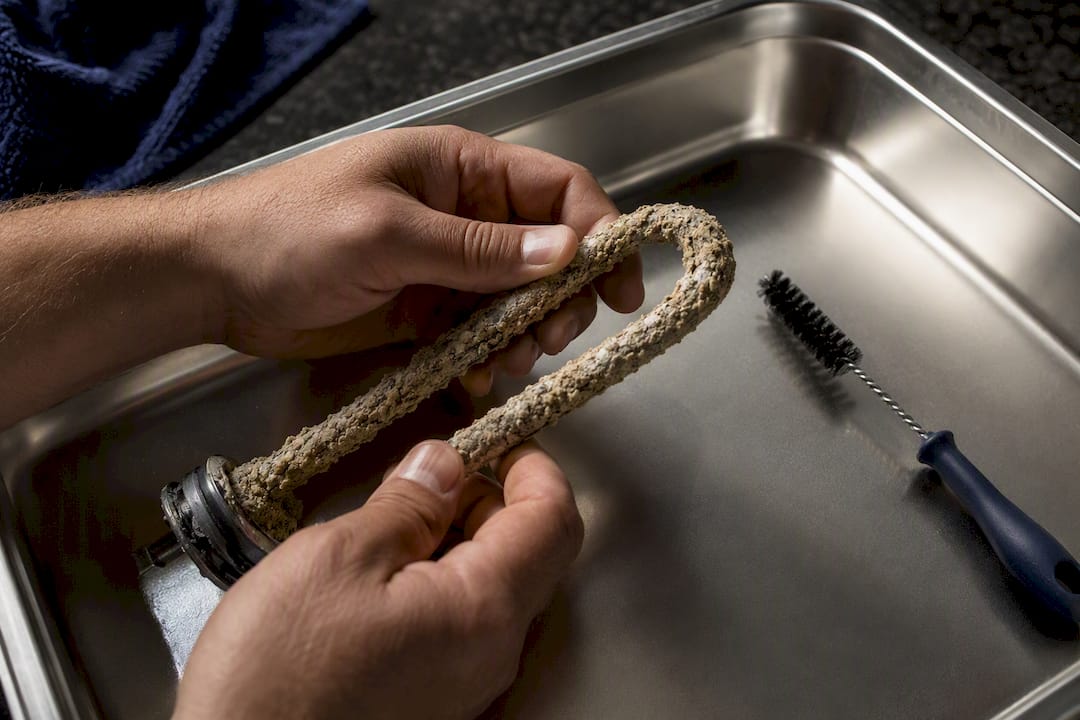
If your water supply tests high in hardness, budget for a filtration or softening solution alongside your generator purchase rather than treating it as an afterthought once symptoms show up. It’s a cheaper fix upfront than replacing heating elements early on a unit that was never actually undersized to begin with.
How Does Sizing Affect Long-Term Maintenance?
An undersized generator doesn’t just run poorly. It ages faster.
Oversized units carry their own maintenance profile. Frequent short-cycling means the heating element goes through more start-stop thermal stress over the same period, which can shorten component life in a different way than undersizing does. Correct sizing, in other words, isn’t just about comfort and warm-up time. It’s a direct input into how often you’ll be replacing elements, descaling tanks, or calling for service.
Routine maintenance schedules should factor in your specific sizing decision. A generator running near its rated capacity in a hard-water region needs more frequent descaling checks than one with margin to spare. Keep your original sizing worksheet, cubic volume, material multipliers, and final kW, on file so any future service technician understands why the unit was specified the way it was, rather than guessing at whether it was ever sized correctly in the first place.
An Installer’s Take on Getting Sizing Right the First Time
The mistake I see most often isn’t bad math. It’s math done with confidence on incomplete measurements, someone forgot the glass, skipped the bench volume, or measured floor area instead of the full envelope. Round up, always add glass compensation, and physically verify the vapor barrier is intact before you finalize a model. Anything beyond a single residential enclosure, especially multi-unit or commercial jobs, deserves an engineer’s sign-off rather than a calculator alone. Sauna Heater Supply’s product pages and support team can help confirm compatibility once you’ve got your number.
— Teddy
Shop Steam Shower Controls That Match Your Sized Generator
Once you’ve settled on the right kW, the control panel and steamhead you pair it with shape how the room actually feels to use every day. Sauna Heater Supply carries all three control lines built for that final step, and the team checks compatibility against your specific generator before anything ships.
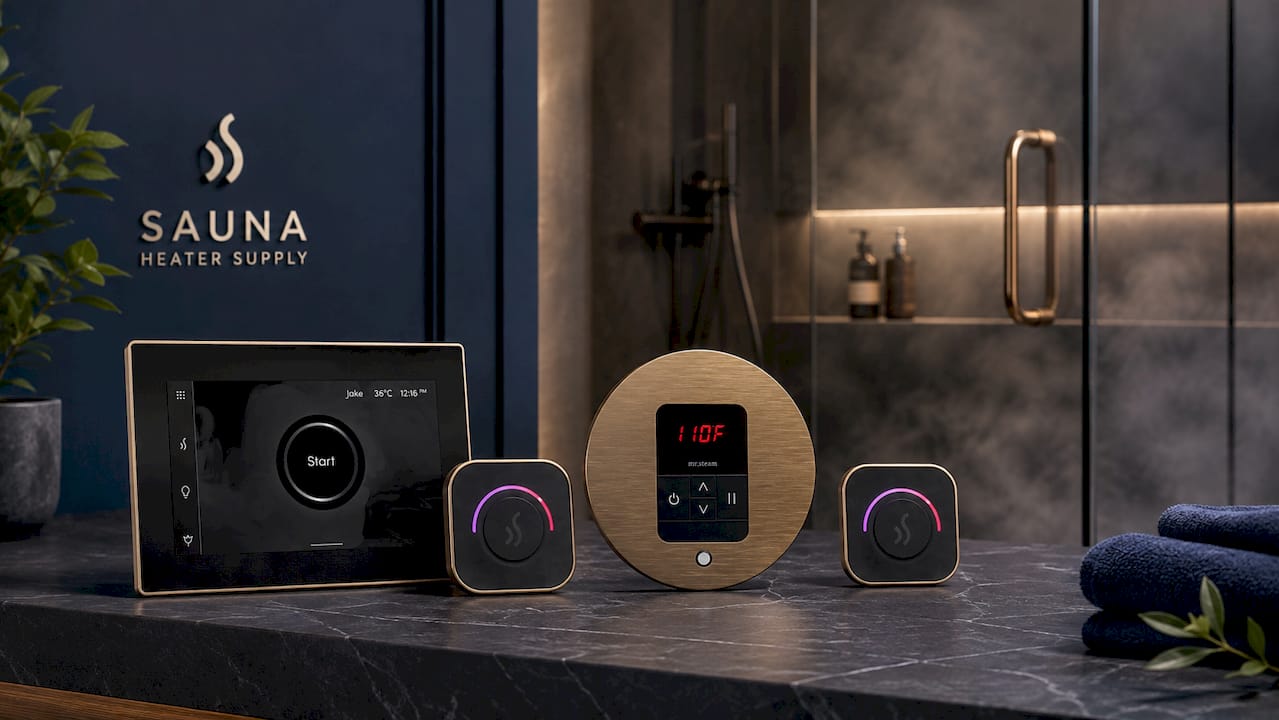
The iSteamX Steam Shower Control and Steamhead works well for standard residential installations needing full digital control. The TempoTouch Steam Shower Control and Steamhead gives you a simplified touch interface for the same functional range. The iTempo Round Steam Shower Control and Steamhead fits tighter spaces where panel real estate is limited. Every purchase comes with a price match guarantee, direct access to product specialists who can confirm your generator pairing, and fast shipping so your project doesn’t stall waiting on parts. Visit Sauna Heater Supply to check compatibility on your chosen control and get your final order moving today.
Sources
- Invigoration® Series Steam Generators and Controls (Kohler sizing PDF)
- Residential SimpleSteam sizing guide (Delta PDF)
- Steam Generator Calculator – Size Your System Accurately