










U.S. Homeowners: Ask 4 Questions Before Hiring a Sauna Electrician
Hire a licensed, insured electrician with sauna or hot tub wiring experience, not a general handyman, and bring the heater’s spec sheet to the first conversation. Sauna heaters draw sustained, continuous loads for hours at a time in a hot, humid enclosure, which is exactly the combination the National Electrical Code treats with extra scrutiny. Have the model number, kW rating, voltage, and amperage in hand, along with the planned heater location, before you make the first call.
TL;DR:
- The electrician must perform load calculations and install a dedicated, properly gauged circuit for the sauna heater, not share existing wiring.
- Most sauna heaters run on 240V and require sizing at 125% of their continuous current, with outdoor installations needing weatherproof disconnects and outdoor-rated conduit.
- Costs range from $700 to $3,000 for the electrical work, with longer distances, trenching, or panel upgrades significantly increasing expenses.
- Verify the electrician’s licensing, insurance, references, and their commitment to permits and inspections before hiring.
- Homeowners should gather heater specs and plan wiring timing with contractors to avoid unnecessary wall re-openings and ensure code compliance.
Table of Contents
- What does hiring an electrician for sauna installation actually involve?
- What are the key electrical code requirements for a sauna?
- What does it cost to hire a sauna electrician, and how long does it take?
- How do you choose the right sauna electrician?
- How should you prepare before the electrician arrives?
- How Sauna Heater Supply supports safe, code-compliant installs
- Recommended sauna heater packages and how to use them with your electrician
- Sources
What does hiring an electrician for sauna installation actually involve?
A qualified electrician does more than run a wire from the panel to the heater. The work starts with a site visit and a load calculation: how many amps your service panel has left, how far the heater sits from the panel, and whether existing circuits can share the load or need their own dedicated line.
From there, most custom builds happen in two stages. Rough-in wiring goes in behind the walls before insulation and cladding go up, and the final hookup, including the heater connection and any digital control wiring, happens once interior finishes are complete. Skipping this staging is one of the most common reasons homeowners end up reopening finished walls.
A properly scoped job includes:
- Load calculation and circuit design based on the heater’s kW and amperage rating.
- Dedicated circuit installation, sized in wire gauge and breaker rating specifically for that heater, never shared with lighting or other outlets.
- Outdoor-rated conduit and a weatherproof disconnect if the sauna sits outside or in an unheated space.
- Permit filing and inspection scheduling, so the work is documented and legally signed off.
- Final connection and testing once the heater and controls are physically installed.
This is specialty electrical work. Sauna circuits combine high continuous amperage with a genuinely wet, hot environment, and licensed sauna wiring specialists treat that combination differently than a standard outlet or appliance circuit. A general handyman who has never sized a continuous-load circuit is not the right person for this job, no matter how competent they are with a drill.
What are the key electrical code requirements for a sauna?
Most traditional electric sauna heaters run on 240V, while smaller infrared or portable units sometimes use a standard 120V plug-in circuit. Your electrician determines this from the heater’s nameplate, not by guesswork, so the spec sheet matters more than most homeowners realize.
The National Electrical Code requires continuous loads, which a sauna heater absolutely qualifies as, to be sized at 125% of the heater’s rated continuous current. That 25% buffer isn’t a suggestion; it’s what keeps the breaker and wiring from overheating during hours of steady operation. A 9kW heater needs noticeably different wire gauge and breaker sizing than a 6kW unit, and distance from the panel changes the calculation further because longer runs need thicker conductors to avoid voltage drop.
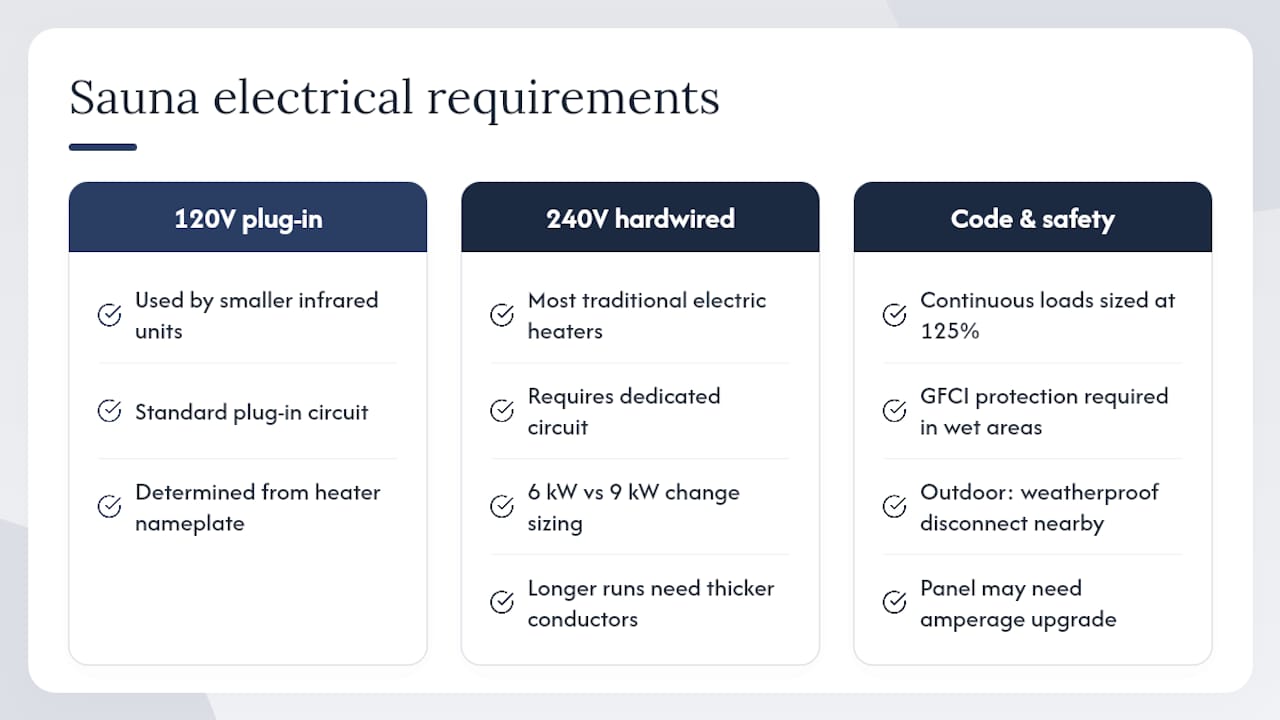
GFCI protection deserves its own mention. Ground-fault circuit interrupters detect small imbalances in current flow and cut power in a fraction of a second, which matters enormously in an environment where sweat, steam, and standing water are the norm rather than the exception. Outdoor and wet-area sauna circuits generally require this protection, and a reputable electrician won’t treat it as optional.
Where the sauna sits determines the rest. Outdoor installations need a weatherproof disconnect switch within sight of the heater, along with outdoor-rated conduit that may require trenching from the house to the sauna structure. If your existing panel doesn’t have the amperage headroom for a new dedicated circuit at this size, your electrician will likely recommend a panel upgrade. They determine that by adding up your home’s existing connected load against the panel’s rated capacity, not by eyeballing it.
What does it cost to hire a sauna electrician, and how long does it take?
Expect a fairly wide range depending on your home’s existing panel and the sauna’s location, but a straightforward dedicated circuit installation commonly runs $700 to $3,000 for the electrical portion alone. That’s before permits, which vary by municipality, or any panel upgrade, which is a separate and larger line item.
Timeline follows a similar split. A simple indoor install with an accessible panel can sometimes be done in half a day. Built-in custom saunas that need rough-in wiring behind walls followed by a separate final hookup after cladding usually mean two site visits scheduled weeks apart, coordinated with your general contractor’s build schedule.
Several factors push the price up:
- Distance between the panel and the sauna location, since longer conductor runs cost more in both material and labor.
- Trenching for outdoor units, which adds excavation cost and often a second crew day.
- A required panel upgrade, which can add substantially more than the circuit run itself.
- Local permit fees, which differ by city and county.
- After-hours or emergency electrician for sauna scheduling, which typically carries a premium over a standard appointment.
Ask for a written, itemized quote that separates labor, materials, permit fees, and any panel work into distinct lines. Get two to three estimates before committing. A quote that bundles everything into one flat number without breaking out what you’re actually paying for is harder to compare and harder to trust.
How do you choose the right sauna electrician?
Vetting an electrician for this job comes down to a short list of qualifications and a handful of direct questions. Start with the basics: an active state electrical license, current liability insurance, and ideally a résumé that includes sauna or hot tub installs specifically, not just general residential wiring.
- Verify the license and insurance directly through your state’s electrical licensing board rather than taking a business card at face value.
- Ask for two or three references from similar installs, ideally sauna or spa-related jobs, and actually call them.
- Confirm they pull permits and schedule inspections themselves. This is standard professional practice, not an optional upsell.
- Ask whether they back the work with a signed workmanship warranty, and get the terms in writing.
During your first call, ask these questions directly:
- “Have you wired sauna heaters before, and can you describe a recent job?”
- “Will you size the circuit at 125% of my heater’s continuous load, per NEC?”
- “Will you pull the permit and schedule the inspection, or is that on me?”
- “Can I get a written estimate that breaks out labor, materials, and permit costs?”
Watch for red flags that should end the conversation quickly. An electrician who resists pulling permits, gives a vague answer on wire gauge or breaker sizing, or suggests plugging the heater into an existing outlet or extension cord instead of hardwiring a dedicated circuit is not someone to hire. That last one in particular is a serious hazard, not a shortcut worth taking.
Pro Tip: Call your state licensing board’s public lookup tool before you ever meet the electrician in person. Most states let you confirm license status and check for disciplinary history online in under five minutes, and it costs you nothing.
How should you prepare before the electrician arrives?
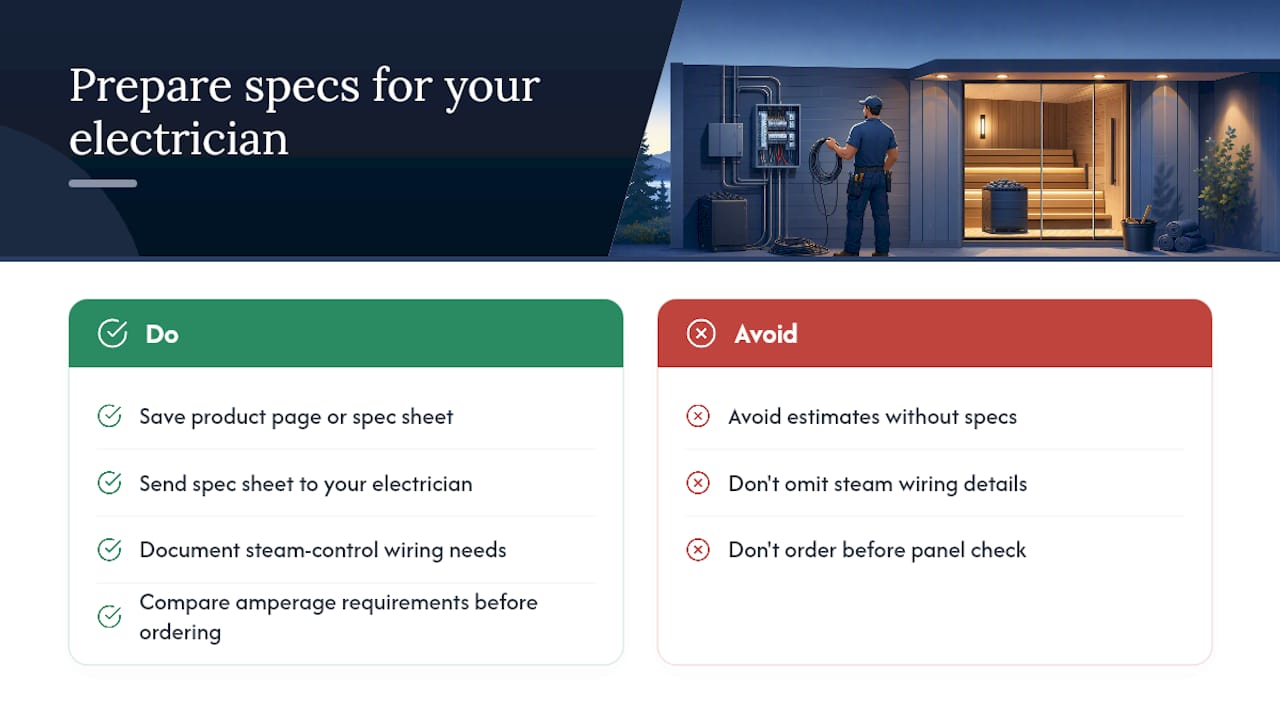
A little prep work on your end speeds up the site visit and helps the electrician give you an accurate quote instead of a rough guess. Pull together the heater’s model number, kW rating, voltage, and amperage from the spec sheet before the first appointment.
If you’re working with a general contractor or builder, decide together whether rough-in wiring happens now or closer to final installation, since coordinating this timing avoids reopening finished walls later. Clear physical access to the planned heater location and measure the approximate distance to your panel; this single number changes the wire gauge conversation significantly.
For outdoor saunas, a few extra items matter:
- Confirm planned trench routing and depth relative to your local frost line.
- Decide where the weatherproof disconnect will live before conduit gets installed.
- Flag any landscaping or hardscaping that could affect the conduit path.
How Sauna Heater Supply supports safe, code-compliant installs
Every heater package we carry comes with clear kW, voltage, and amperage specifications your electrician needs before quoting the job, and our electrical planning guides walk through how those numbers translate into real-world circuit sizing. We’ve watched enough installs stall out because a homeowner ordered a heater before confirming their panel had the capacity, and that’s a fixable problem if you check specs first.
Our team helps match heater kW ratings to your home’s existing electrical capacity and answers spec questions before you order, which saves a second call to your electrician down the road. If you’re not sure which heater fits your panel, ask before you buy, not after.
— Teddy
Recommended sauna heater packages and how to use them with your electrician
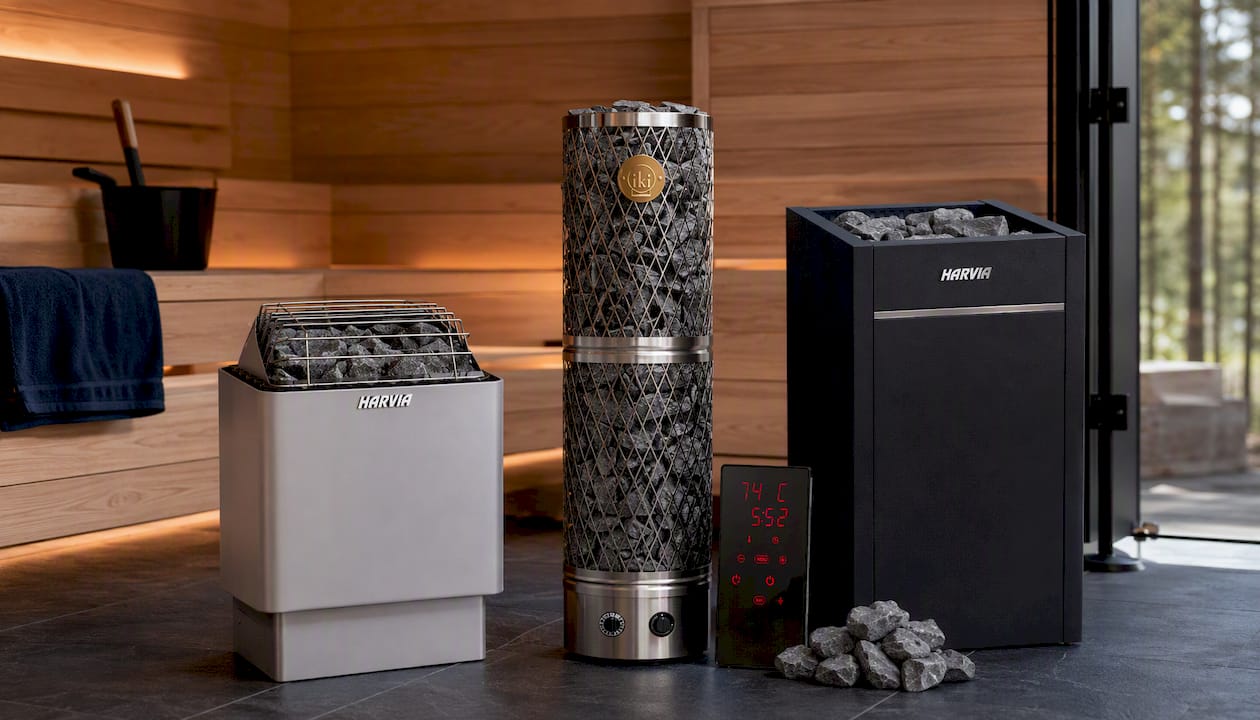
Sauna Heater Supply stocks the heater packages and controls electricians most often ask homeowners to identify by model, including the Harvia Kip45W Heater Package, the IKI Pillar 9kW with WiFi controller, the Saunum Air 7 Sauna Heater Package, and the Saunum Air L 15 Package. Barrel sauna buyers can look at the Finnmark Thermo-Aspen Combination Barrel Sauna FD-7 and the Finnmark Cedar Combination Barrel Sauna FD-6, both of which list amperage requirements right on the product page.
If your project includes a steam component, the iSteamX Steam Shower Control and Steamhead, the Temperature Probe for iSteam, AirTempo, iTempo, and iTempoPlus Controls, and the iTempo Round Steam Shower Control each have their own low-voltage wiring needs your electrician will want documented ahead of time.
Save the product page or download the spec sheet for whichever heater you’re considering, and send it to your electrician before the quoting call. That one step turns a rough estimate into an accurate one. If you’re unsure which package fits your panel capacity or room size, contact our team for pre-install spec verification, or browse the full heater catalog to compare amperage requirements side by side before you order.
Sources
For deeper technical background, see SafeElectricity.org’s explanation of GFCI protection, The Sauna Place’s breakdown of NEC continuous-load sizing, and Sauna Heater Supply’s own guide to sauna heater installation staging.
- Sauna & Hot Tub Electrical Hookups | ZG Electrical Inc
- Sauna electrical setup: what homeowners need to know – The Sauna Place
- Safeelectricity
- Sauna wiring & electrical installation services — TriStar Electric