









Sauna Heater Sizing: Precise kW Guide for Every Room
Proper sauna heater sizing comes down to one core formula: calculate your room’s adjusted cubic footage, then apply approximately 1 kW per an appropriate amount of adjusted volume, and round up to the next available heater size. That single rule, applied correctly, prevents the most common and costly mistake in sauna installation: undersizing.
Here is a 3-step checklist to get your kW estimate before reading further:
- Measure your sauna room (length × width × height in feet) to get base cubic footage.
- Adjust that volume upward for glass, stone tile, log walls, or uninsulated exterior walls.
- Convert adjusted cubic footage to kW using the 1 kW per 35–45 ft³ rule, then round up to the next heater size available.
The Harvia sauna calculator and the Sauna Guide size calculator both use this same workflow. Saunaheatersupply carries heaters across the full residential and commercial kW range, so once you have your adjusted volume, matching it to a model is straightforward.
Key Takeaways
Proper sauna heater sizing requires adjusted room volume, not raw cubic footage, divided by 35–45 to reach a kW target, then rounded up and confirmed against the manufacturer’s stated range.
| Point | Details |
|---|---|
| Adjust before converting | Add ~4 ft³ per sq ft of glass; multiply by 1.3 for log walls before calculating kW. |
| Use the midpoint rule | Choose a heater where your adjusted volume lands near the middle of its rated min–max range. |
| Round up always | Undersizing causes premature heater failure; the next size up is the safer and cheaper long-term choice. |
| Check electrical first | An 8 kW heater at 240V draws ~33.3A; confirm breaker, conductor, and panel capacity with a licensed electrician. |
| Saunaheatersupply as your resource | Saunaheatersupply lists manufacturer volume ranges on every product page and offers pre-purchase sizing support. |
Table of Contents
- How do you calculate sauna room volume accurately?
- How do glass, log walls, and cold surfaces change your required capacity?
- What formula converts adjusted volume to heater power?
- How does heater type affect sizing decisions?
- What electrical limits affect which heater you can install?
- What sizing mistakes cost the most, and how do you avoid them?
- Matching your kW calculation to real products
- The case for conservative sizing and manufacturer charts
- Saunaheatersupply makes sizing and ordering straightforward
- Sources
How do you calculate sauna room volume accurately?
Start with the basic formula: length × width × height = cubic feet. An 8 ft × 6 ft × 7 ft sauna yields 336 ft³. That number is your starting point, not your final figure.
Pitched or uneven ceilings require a sectional approach. Divide the room into rectangular zones, calculate each zone’s volume separately, and add them together. For a simple shed-pitch ceiling, use the average of the low and high wall heights as your effective height.
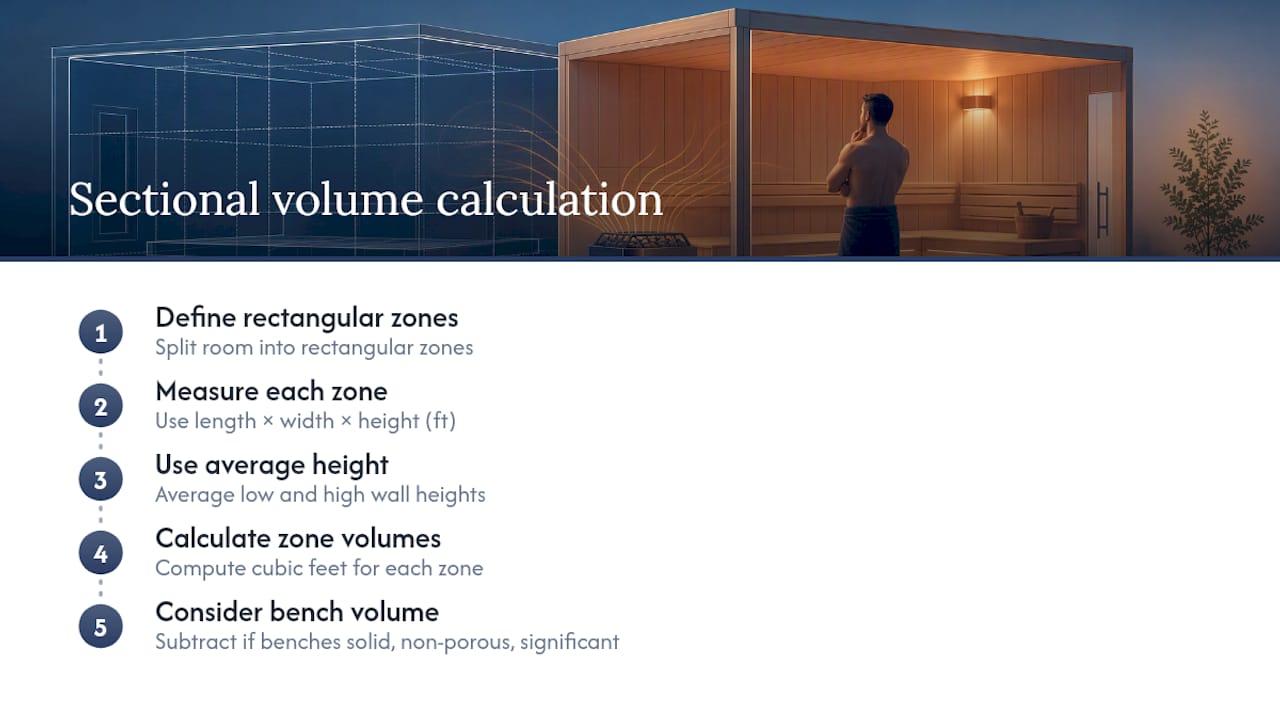
Bench volume is generally small enough to ignore in residential saunas. In a compact 4-person room where benches occupy a significant share of the floor plan, subtract bench volume only if the benches are solid and non-porous.
Once you have a clean base volume, you are ready to apply construction adjustments.
How do glass, log walls, and cold surfaces change your required capacity?
Raw room volume understates the real heat load whenever your sauna includes glass, stone tile, concrete, or log walls. These surfaces absorb heat instead of reflecting it, forcing the heater to work harder to reach temperature.
Harvia’s sizing guidance sets the industry standard for these adjustments:
- Glass doors and windows: Add approximately 4 ft³ of equivalent volume for every 1 sq ft of glass surface. A standard 24" × 72" glass door (12 sq ft) adds roughly 48 ft³ to your adjusted volume.
- Stone tile or concrete walls/floors: Apply the same ~4 ft³ per sq ft adjustment for each non-insulated stone or concrete surface.
- Log or unfinished wood walls: Treat the room as if it were approximately 30% larger than measured. Multiply your base volume by 1.3.
- Uninsulated exterior walls (cold climates): Add 15–25% on top of other adjustments. A sauna in an unheated garage in Minnesota warrants the full 25% buffer.
Worked example: Start with 336 ft³. Add 48 ft³ for a glass door. No log walls. Add 15% for an uninsulated exterior wall (336 + 48 = 384 ft³ × 1.15 = 442 ft³ adjusted). That adjusted figure is what you bring to the kW conversion step.
The HUUM calculator applies the same logic: enter room dimensions and non-insulated surface areas, and it outputs a recommended kW that already accounts for these loads.
What formula converts adjusted volume to heater power?
The practical conversion used by manufacturers and independent calculators is approximately 1 kW per 35–45 ft³ of adjusted volume, or about 1 kW per 1 m³. The Sauna Guide calculator uses roughly 1 kW per 35 ft³ as its baseline, which is the more conservative end of the range and the safer choice for rooms with any cold surfaces.
Sizing rule: Divide your adjusted cubic footage by 35–45 to get your minimum kW. Always round up to the next available heater size, and choose a model where your adjusted volume falls near the midpoint of the manufacturer’s stated min–max range.
For the 442 ft³ example above: 442 ÷ 40 = 11.05 kW. Round up to the next available size, likely a 12 kW unit. Confirm that 442 ft³ sits near the midpoint of that model’s rated range before ordering.
Harvia’s guidance explicitly warns that undersizing is the most common and costly mistake. A heater running at the top of its rated range continuously wears out faster and never reaches optimal temperature. Rounding up costs little at purchase; replacing an undersized heater costs far more.
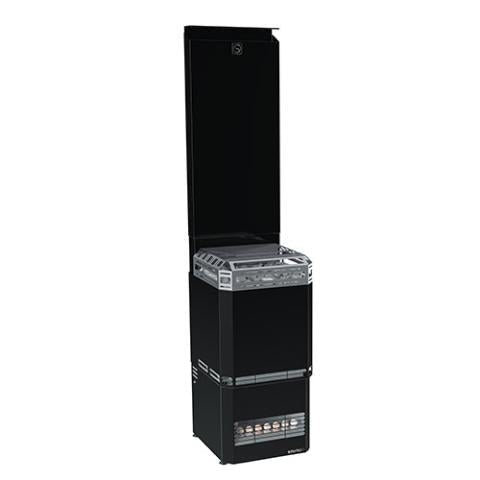
One practical ceiling worth noting: at 240V on a standard 40A residential circuit, the usable maximum is around 9 kW before a panel upgrade becomes necessary.
How does heater type affect sizing decisions?
The kW formula stays the same across heater types, but the type you choose influences which kW rating is practical and what stone capacity you get.
- Wall-mounted electric heaters: Compact, lower stone capacity (typically around 50 lbs). Good for smaller rooms up to roughly 300 ft³. Sizing is straightforward; follow the formula and manufacturer range.
- Pillar/tower electric heaters: Larger stone capacity, often 200 lbs or more, which produces softer, longer-lasting löyly. Sauna Monthly notes that the added thermal mass of a tower heater justifies selecting a slightly higher kW rating, typically +1 kW above the formula result, to heat the stones efficiently.
- Wood-burning heaters: Sizing follows the same volume-based logic, but output is less precise than electric. Size conservatively and choose a model rated for a volume range that comfortably covers your adjusted figure.
- Commercial-rated units: These are designed for larger volumes and higher duty cycles. Follow the manufacturer’s commercial min–max range; do not apply residential rules-of-thumb to commercial installations.
Always verify the heater model’s published min–max volume range on the manufacturer’s spec sheet. Your adjusted volume should land near the midpoint of that range, not at its upper limit.
What electrical limits affect which heater you can install?
Heater kW translates directly to circuit requirements. The formula is: Amps = (kW × 1,000) ÷ Voltage. For a 240V circuit, an 8 kW heater draws approximately 33.3A, which fits a 40A dedicated breaker with standard 8 AWG conductor. A 10 kW heater draws about 41.7A, requiring a 50A breaker and 6 AWG conductor.
Most single-family homes in the United States have a 200A service panel. A large sauna heater can consume a significant share of that capacity. Heaters above 9 kW on a 240V single-phase circuit often push against typical residential panel limits, and anything requiring 60A or more may trigger a panel upgrade or a service call to the utility. The Sauna Guide calculator flags this ceiling explicitly.
Pro Tip: Before ordering a heater above 8 kW, pull your panel’s current load schedule and share it with a licensed electrician. Coordinating the heater size with the electrical upgrade cost upfront can save you from ordering a unit you cannot legally or safely install. Saunaheatersupply’s electrical planning guide covers breaker and conductor sizing in detail.
Consult a licensed electrician to confirm breaker size, conductor gauge, and panel capacity before finalizing your heater selection. This step is not optional.
What sizing mistakes cost the most, and how do you avoid them?
- Undersizing: The single most expensive mistake. A heater running at its maximum rated load continuously fails earlier and never delivers the heat output the room needs.
- Using raw volume without adjustments: Skipping the glass, log wall, and cold-surface corrections produces a kW estimate that is too low for the actual heat load.
- Ignoring stone mass: Choosing a wall heater with minimal stone capacity when a tower unit would serve the room better means weaker löyly and a less satisfying session.
- Missing electrical limits: Ordering a 12 kW heater for a panel that cannot support it creates installation delays and added costs.
- Ignoring usage patterns: A sauna used daily by multiple people needs a heater at the higher end of its rated range. Occasional solo use allows more flexibility.
Pro Tip: When switching from a wall-mounted heater to a pillar or tower model, plan for a +1 kW step above your formula result to account for the larger stone mass. Verify your breaker and panel capacity before ordering, since that extra kW often pushes the circuit to the next breaker size.
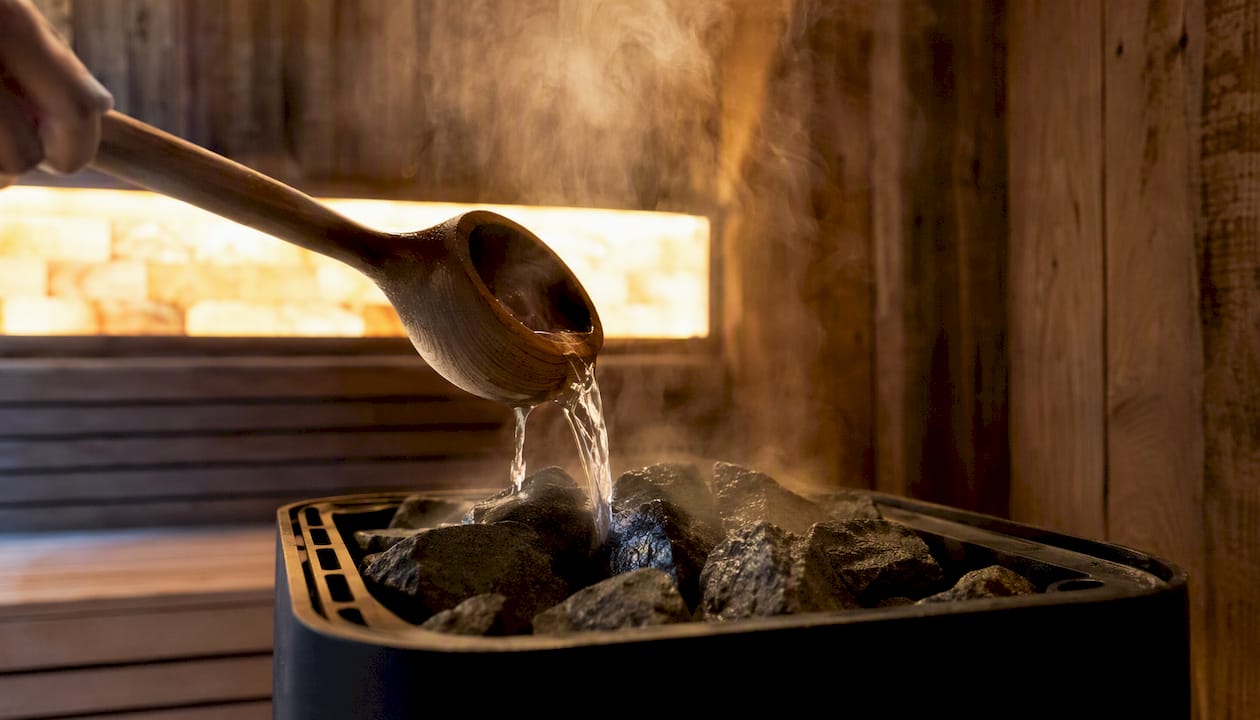
A short practical checklist: round up always, target the midpoint of the manufacturer’s range, confirm the stone package and controller specs match the heater, and factor in how often you will ladle water. Frequent ladling increases steam demand and favors a higher stone capacity.
Matching your kW calculation to real products
Once you have your adjusted volume and target kW, matching to a specific product is a direct lookup against the manufacturer’s min–max range.
- Confirm adjusted volume using the measurement and adjustment steps above.
- Identify your target kW by dividing adjusted volume by 35–45 and rounding up.
- Check the product’s rated range on the product page; your adjusted volume should sit near the midpoint.
- Verify stone package specs and confirm the controller is compatible with your planned circuit.
- Confirm electrical feasibility with a licensed electrician before placing the order.
Three products from Saunaheatersupply cover a wide range of common sizing outcomes:
- The Saunum Air L 10 Sauna Heater is a 10 kW electric unit suited to mid-size rooms. Check the product page for its published min–max volume range and confirm your adjusted cubic footage lands near the midpoint.
- The Saunum Sauna Stone Package pairs with compatible heaters to increase stone mass, improving löyly quality. If your calculation points to a tower-style unit, adding a dedicated stone package is worth the investment.
- For outdoor or cabin installations, the Auroom Libera Wood Cabin Sauna Kit is a complete wood-cabin kit. Size the included or paired heater against the kit’s interior volume, applying the full cold-surface and exterior-wall adjustments since cabin walls typically have less insulation than an interior room.
For installation steps and pre-purchase checks, Saunaheatersupply’s heater installation guide walks through what to verify before the heater arrives.
The case for conservative sizing and manufacturer charts
The most consistent mistake I see is builders trusting the raw room volume and skipping the adjustment step entirely. A 300 ft³ sauna with a glass wall and a log interior is not a 300 ft³ heat load. It is closer to 450 ft³ once the adjustments are applied, and a heater sized for 300 ft³ will run at its limit every session.
The professional practice is simple: calculate adjusted volume, divide by 35–40 to be conservative, round up, and then open the manufacturer’s spec sheet to confirm the model’s stated range. Your adjusted volume should sit near the midpoint of that range, not at the top. If it lands at the top, move to the next model up.
Stone package decisions deserve the same attention. A tower heater with a proper stone load produces noticeably better steam than a wall unit running at its ceiling. When the electrical capacity allows it, the tower option is worth the extra kW and the circuit upgrade.
Saunaheatersupply’s product pages include manufacturer range data, and the team can help you confirm fit before you order.
Saunaheatersupply makes sizing and ordering straightforward
Getting the kW calculation right is only half the job. Ordering the wrong model because the product page did not clearly show the min–max volume range, or because the stone package was not factored in, is just as costly as a bad calculation.
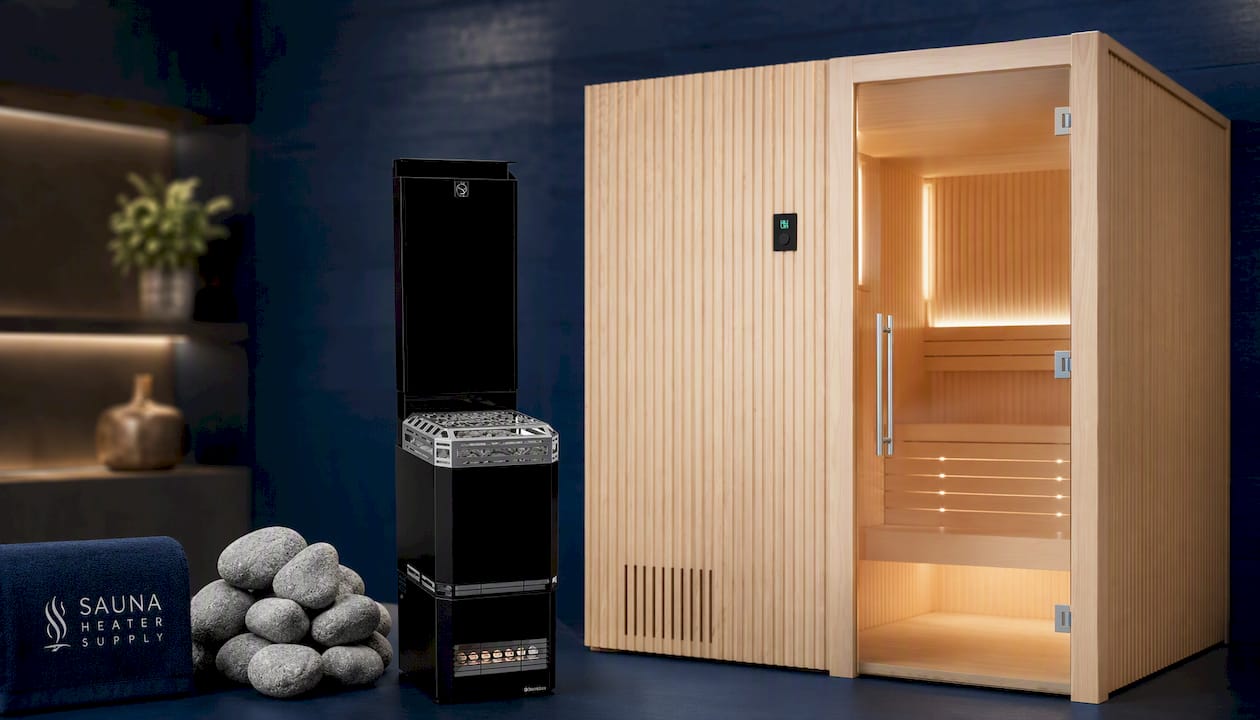
Saunaheatersupply curates electric, wood-fired, and gas heaters across the full residential and commercial kW range, with stone packages and controls matched to each unit, and complementary wellness equipment like the Drip Sauna Tank for Effective Detox and Weight to enhance your sauna experience. Every product page lists the manufacturer’s rated volume range so you can verify your adjusted cubic footage against the midpoint before adding to cart. The team offers pre-purchase expert checks, so if your calculation puts you between two models, you get a direct answer rather than a guess.
Visit the Saunum Air L 10 product page to confirm fit for mid-size rooms, or contact Saunaheatersupply directly for sizing help on larger or commercial installations.
Sources
- How do I select the correct heater power? – English
- Sauna Heater Size Calculator: Find the Right kW for Your Room | Sauna Guide
- How to size a sauna heater (and why tower heaters make better steam) | Sauna Monthly
- Sauna calculator | Harvia
- Sauna Heater Size Calculator - HUUM