








Sauna Remote Start Code: Why There Isn't One and What to Do
There is no universal remote start code for a home sauna. Remote start is a feature of a specific heater and control system. It is enabled through the manufacturer’s app or control panel, and it depends on a physical safety device in the sauna room. If you are looking for a code to unlock remote start, or an error code that blocks it, the sections below explain what is actually going on and how to fix it.
TL;DR
- No universal “remote start code” exists. Remote start is turned on through the heater’s own control, app or smart home integration, following the manufacturer’s instructions.
- Under the electric sauna heater standard IEC/EN 60335-2-53, remote control of an electric heater requires a safety switch in the sauna, usually a door switch or an integrated safety function.
- Codes such as E1 are usually sensor or communication faults, not remote start locks.
- Do not bypass a safety sensor to force remote start. Unlisted add-ons can create fire risk and affect inspections, warranty and insurance.
- The safe route is a heater and control that are designed for remote operation and installed to the manufacturer’s instructions.
Table of Contents
- What people mean by a sauna remote start code
- How remote start actually works
- Why you cannot enter a code to bypass it
- What the codes on your display mean
- Remote start by sauna type
- How to set up remote start the right way
- Our perspective
- Find a remote-ready heater and control
- Common mistakes to avoid
- FAQ
- Sources
What people mean by a sauna remote start code
The search usually comes from one of three situations.
- You want to start the sauna from your phone and are looking for a code or password to switch the feature on.
- Your sauna shows a code on the display (E1, E7 or similar) and you suspect it is blocking remote start.
- You want to add remote start to a heater that does not have it, such as an older traditional heater or an inexpensive infrared cabin.
In each case the answer is the same at its core. Remote start is not unlocked with a code that works across brands. It is a function built from three parts: a heater, a control that can accept remote commands, and a safety device that confirms the room is safe to heat. If one part is missing, remote start will not work, or should not be added.
How remote start actually works
A sauna heater runs at high temperatures. If it switches on while a towel is draped over it, or while someone is inside who does not expect it, the result can be a fire or a burn. For that reason, starting the heater from another room is treated differently from pressing the button on the sauna wall.
The heater safety standard is explicit about this. Harvia’s support documentation states that remote control of an electric sauna heater through a smartphone app, home automation system or other remote device requires a safety switch in the sauna, under IEC/EN 60335-2-53. The same page notes that a safety switch is not required when the heater is operated from its own control panel, or when total heater power exceeds 20 kW. The standard itself covers electric sauna heating appliances and infrared emitting units with a rated input not exceeding 20 kW, which is where nearly all home saunas fall.

The door switch and the confirmation step
For home use, the most common safety device is a door switch. As Harvia describes it, the switch works so that remote control must be reactivated from the control panel after every session or every time the door is opened. Some heater models have the safety switch built into the heater itself, so no separate door switch is needed. For commercial installations, a dedicated safety device is the typical choice.
In practice this means:
- You walk into the sauna, check that nothing is on or near the heater, and close the door.
- You confirm on the control panel that remote start is allowed for this session.
- From then on, the app or schedule can start the heater.
- If the door opens, the permission is cancelled and has to be given again at the panel.
This is the nearest thing to a “remote start code”: a deliberate confirmation made at the sauna itself. It is a physical step, not a number you can look up or reuse.
Why you cannot enter a code to bypass it
Some forum threads suggest wiring a smart relay across the heater contactor or jumping the door sensor. We advise against both.
In the United States, the National Electrical Code requires fixed electric heating equipment to be listed and labeled. The NEC’s heating equipment article, Article 424, includes a listed equipment requirement for electric heating products. A heater, its control and its safety sensors are certified as a system. Adding an unlisted relay, or defeating a sensor, takes the installation outside what was tested.
The practical consequences go beyond the code book:
- Inspection: an installation that departs from the manufacturer’s instructions can fail an electrical inspection.
- Warranty: manufacturers generally tie coverage to installation per their instructions, so check your heater’s warranty terms.
- Insurance: if there is a fire, an insurer will look at whether the equipment was installed and modified as listed. Ask your own insurer how it treats modified equipment.
- Cybersecurity: a heater reachable over the internet through an uncertified gadget adds a network risk to an electrical one.
If you have already done this kind of modification, talk to a licensed electrician before using the sauna again. We cover what to ask in our guide on hiring a sauna electrician.
What the codes on your display mean
If the sauna is showing a code, it is almost certainly a fault code, not a remote start lock. Fault codes differ by manufacturer, so the manual for your exact control is the final word. As an example, one manufacturer’s controller manual lists E1 as a temperature sensor that is not connected, with other entries covering a shorted sensor and a communication failure. Many brands follow a similar pattern.
| Typical code type | What it usually points to | First thing to check |
|---|---|---|
| E1 (sensor not connected) | Open circuit on the temperature sensor | Sensor plug and wire at the control unit |
| Short circuit codes | Damaged or pinched sensor wire | Wire run, insulation, connectors |
| Communication failure (often E7) | Control and heater not talking | Cable between control and heater, power cycle |
| Cloud or app message | Temporary Wi-Fi or service outage | Router, then try again later |
Treat the table as a guide to the type of fault, not a lookup for your model. For example, Harvia notes that a failed control message from its app can be a temporary cloud service connection failure that clears on its own. That is very different from a sensor fault.
A safe first response to a fault code
- Switch the sauna off at the control and let it cool.
- Write down the code exactly as shown.
- Power cycle the control. We describe the full sequence in our sauna control troubleshooting guide.
- If the code returns, look up that code in your manual.
- For anything involving wiring inside the heater or the breaker panel, hire a licensed electrician. Do not open live components yourself.
Remote start by sauna type
Electric heaters with a wall control
These are the simplest to make remote capable. Choose a control that supports Wi-Fi or a smart home protocol, and a heater that either has an integrated safety switch or works with a door switch. If your current control is old, a retrofit is often the right path. See our walkthrough on retrofitting a sauna controller before you buy.

Infrared cabins
Infrared cabins are often sold with basic controls and no app. Adding remote start to an inexpensive cabin with aftermarket parts is a common hobby project, but it is exactly the type of change that leaves the listed equipment behind. If you want phone control, the cleaner route is to choose a cabin or control that offers it from the manufacturer.
Wood-fired and gas heaters
A wood-fired heater cannot be started remotely, because someone has to load and light the fire. Gas heaters have their own combustion safety requirements and need installer guidance. For these types, remote features are limited to monitoring or ventilation, if offered at all.
Outdoor and barrel saunas
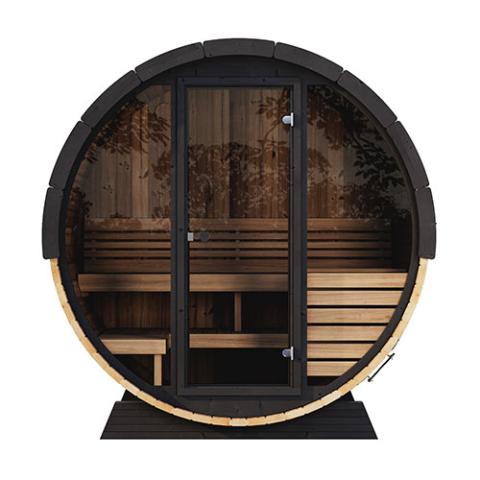
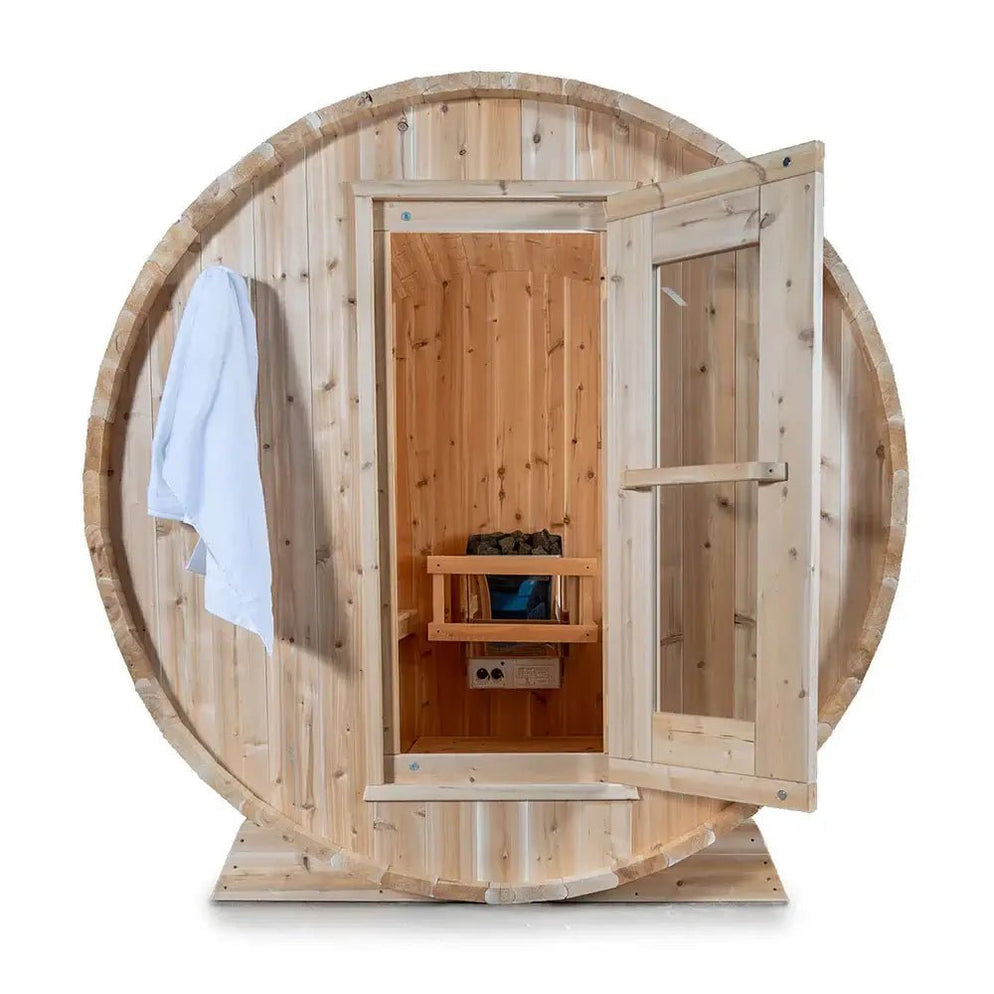
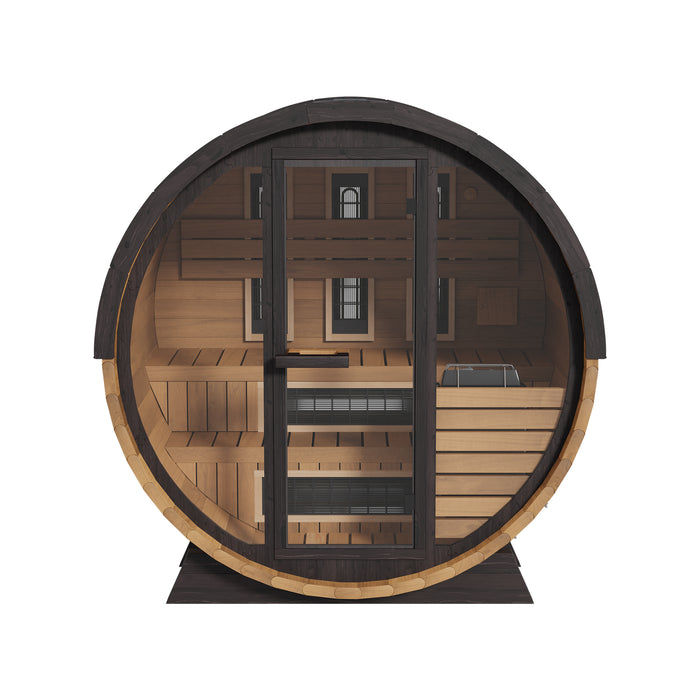
The same rules apply outdoors. A barrel sauna with an electric heater can be remote capable if the heater and control support it and the door switch is fitted. The feeder, breaker and wiring have to suit the load. Our sauna power requirement guide and the electrical requirements for traditional saunas walk through that planning.
How to set up remote start the right way
- Confirm the heater is electric and note its kilowatt rating and model.
- Check whether it has an integrated safety switch. If not, find the door switch the manufacturer specifies for that heater.
- Choose a control built for remote use. Wi-Fi, app scheduling and notifications are the features to look for. Our shop carries the Saunum AirIQ Wi-Fi control for this purpose.
- Verify compatibility of the control with your heater’s power and your electrical supply before ordering.
- Have a licensed electrician install it if it involves the heater circuit, contactor or breaker. Our sauna heater installation guide shows what the job involves.
- Test the sequence at the panel. Close the door, confirm remote permission, start from the app, then open the door and check that remote permission is cancelled.
- Keep the manual and the model numbers for warranty and inspection.
Daily habits that keep remote start safe
- Keep the heater area clear of towels, clothing and anything stored in the room.
- Do the physical walk-in check every session. The door switch is designed around that habit.
- Do not let children or guests use the app without understanding the confirmation step.
- Use a strong password on your Wi-Fi and on the app account.
Our perspective
We see the same misunderstanding often. A buyer wants to press a button on the phone and have a hot sauna waiting. That is a reasonable wish, and the right equipment delivers it. The trouble starts when the search for a shortcut leads to a relay or a jumper that removes the safety check.
Our view is simple. Remote operation should be hardware-enforced. Apps and Wi-Fi can glitch, and a mechanical door sensor gives a physical confirmation that software cannot. A system that asks you to confirm at the sauna door is not an inconvenience. It is the feature that makes remote start acceptable in the first place.
We also advise buyers to choose the heater and control together. A control that is compatible with the heater, a safety switch that the manufacturer specifies and a licensed installer cost more thought up front than a hobby fix, but they avoid questions at inspection or with an insurer. Our team matches heaters, controls and parts to the space and the electrical supply, and we are an authorized reseller, so you get products with manufacturer warranty support.
— Teddy
Find a remote-ready heater and control
If you want phone control that works with the safety systems, start with the heater. Browse our sauna heaters and check which models have an integrated safety switch or support a door switch, then pair them with a Wi-Fi control. If you are planning a whole room, our complete saunas and our design and installation services are listed on the Sauna Heater Supply site. Tell us your heater model, room size and electrical supply, and we will help you pick a compatible setup. We back our pricing with a price match guarantee.

Common mistakes to avoid
- Searching for a code instead of reading the manual. The manual for your exact heater and control explains how remote mode is enabled.
- Mixing brands without checking compatibility. A control rated for one power range may not suit a larger heater.
- Treating a sensor fault as a remote start problem. Fix the sensor wiring or replace the part. Our guide to thermostat replacement lists the checks that prevent wrong-part orders.
- Ignoring the breaker. If the breaker trips when the sauna starts, the cause is electrical, not the app. See why saunas trip breakers.
- Blocking airflow around the heater. Placement and clearances matter, and our heater placement guide explains the intake rule.
FAQ
Can you remote start a sauna?
Yes, if the heater and control are designed for it and a safety switch is present. For electric heaters, the standard calls for a safety switch in the sauna when remote control is used. Wood-fired heaters cannot be started remotely.
Can I turn my sauna on with my phone?
Yes, with a heater or control that has an app and Wi-Fi. You will usually need to confirm at the sauna panel after closing the door before the app can start the heater. Check your manufacturer’s instructions for the exact steps.
What does the E1 error code mean on a sauna?
On many controls, E1 indicates a temperature sensor that is not connected, for example an open circuit or loose plug. Codes vary by brand, so confirm in your manual. Because it involves wiring, call a licensed electrician if the fix is inside the heater or panel.
What are the electrical code requirements for a sauna?
In the U.S., heaters and controls must be listed and installed to the manufacturer’s instructions under the NEC, and the circuit has to be sized for the heater’s load. Local rules and the authority having jurisdiction have the final say. Our sauna electrical requirements guide covers the planning points.
Sources
- Safety devices for electric heaters, Harvia support
- Control panel error messages, Harvia support
- UL 60335-2-53 standard listing, UL Standards & Engagement
- NEC Code-Making Panel 17 report, NFPA
- Sawo Aries heater manual, error codes, ManualsLib