










Sauna Electrical Requirements for Homeowners and Installers
Most traditional electric sauna heaters need a dedicated 240V circuit sized to the heater’s kW rating. Small plug-in infrared units can sometimes run on a standard 120V circuit, but that circuit still has to be dedicated to the heater alone.
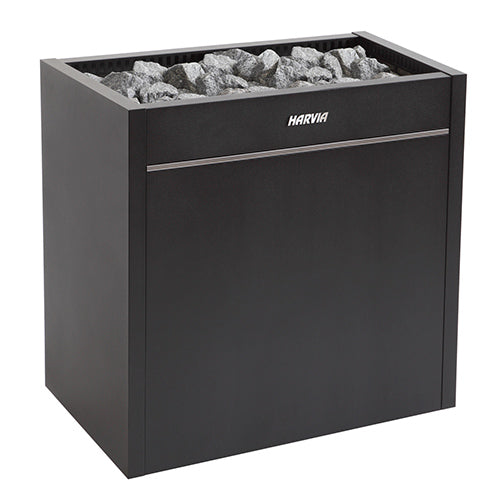
Here’s a real-world example: a 6 kW heater draws about 25 amps at 240V. Apply the National Electrical Code’s 125% continuous-load rule, and you land at roughly 31.25 amps, which typically means a double-pole breaker sized above 30 amps with correctly sized copper conductors. That single calculation is the backbone of nearly every sauna electrical requirements question you’ll run into.
Before you touch a wire or call an electrician, do this:
- Find the heater’s exact kW and voltage rating on the manufacturer spec sheet.
- Confirm whether the unit is a 120V plug-in or a 240V hard-wired model.
- Call a licensed electrician if the calculated circuit exceeds 20A or the heater requires three-phase power.
Key Takeaways
Sizing a sauna circuit correctly requires matching heater kW to voltage, applying the NEC’s 125% continuous-load rule, and confirming every choice against the manufacturer’s spec sheet and local code.
| Point | Details |
|---|---|
| Identify heater voltage | Small infrared plug-ins may use 120V, but traditional heaters almost always need a dedicated 240V circuit. |
| Apply the 125% rule | Multiply amps by 1.25 for continuous loads before selecting a breaker and wire gauge. |
| Use heat-rated conductors indoors | THHN or THWN-2 in conduit is required inside the hot room; NM-B Romex is not suitable there. |
| Confirm panel capacity early | A subpanel or service upgrade may be needed for long runs or already-maxed panels. |
| Get expert product matching | Saunaheatersupply offers spec-sheet guidance and compatibility checks to match heaters like the IKI Pillar 9kW to your home’s electrical capacity. |
Table of Contents
- Which Saunas Use 120V vs 240V Power?
- How Do You Calculate Sauna Wire Size and Breaker Size?
- What NEC Rules Apply to Sauna Heater Circuits?
- What Wire Type Should You Use Inside a Sauna?
- Where Should Sauna Controls and Heaters Be Placed?
- Does Your Panel Have Enough Capacity for a Sauna?
- Do You Need a Permit for a Sauna Electrical Installation?
- What Do Real Sauna Wiring Calculations Look Like?
- What Surge Protection Do Sauna Heaters Need?
- What Conduit Should You Use for Sauna Wiring Runs?
- How Does Electrical Setup Affect Sauna Energy Efficiency?
- An Installer’s Notes From the Field
- Get Expert Help Matching Your Heater to Your Home’s Electrical Capacity
- Frequently Asked Questions About Sauna Electrical Requirements
- Sources
Which Saunas Use 120V vs 240V Power?
Small plug-in infrared saunas typically draw between 1,500 and 1,800 watts, which fits comfortably on a standard 120V, 15A or 20A dedicated circuit. These units are popular for apartments and rentals because they don’t require rewiring, but the circuit still can’t share outlets with anything else in the room.
Traditional electric heaters are a different animal entirely. Most residential models range from 4.5 kW to 12 kW, and nearly all of them require a 240V circuit, either single-phase or, on the higher end, three-phase. A 9 kW heater like the IKI Pillar needs meaningfully more amperage than a 4.5 kW unit, which directly changes your breaker and wire gauge decisions.
The buy-and-install implications are straightforward:
- 120V units: easier install, no electrician required in many cases, but slower heat-up and limited to small spaces.
- 240V units: faster warm-up, larger heating capacity, but mandatory dedicated circuit and usually professional installation.
Pro Tip: Check your heater’s data plate before assuming voltage. Some compact 240V heaters look similar in size to 120V infrared panels, but the wiring behind them is completely different.
How Do You Calculate Sauna Wire Size and Breaker Size?
The math behind wiring a 240V sauna heater isn’t complicated, but skipping a step is where installers get into trouble. Start with the basic formula:
- Amps = Watts ÷ Volts. A 6,000-watt heater on 240V draws 25 amps.
- Apply the NEC continuous-load factor. Multiply the amp draw by 1.25, since sauna heaters run continuously for extended periods. That’s 25 × 1.25 = 31.25 amps.
- Round up to the next standard breaker size. In this case, that’s a 40A double-pole breaker.
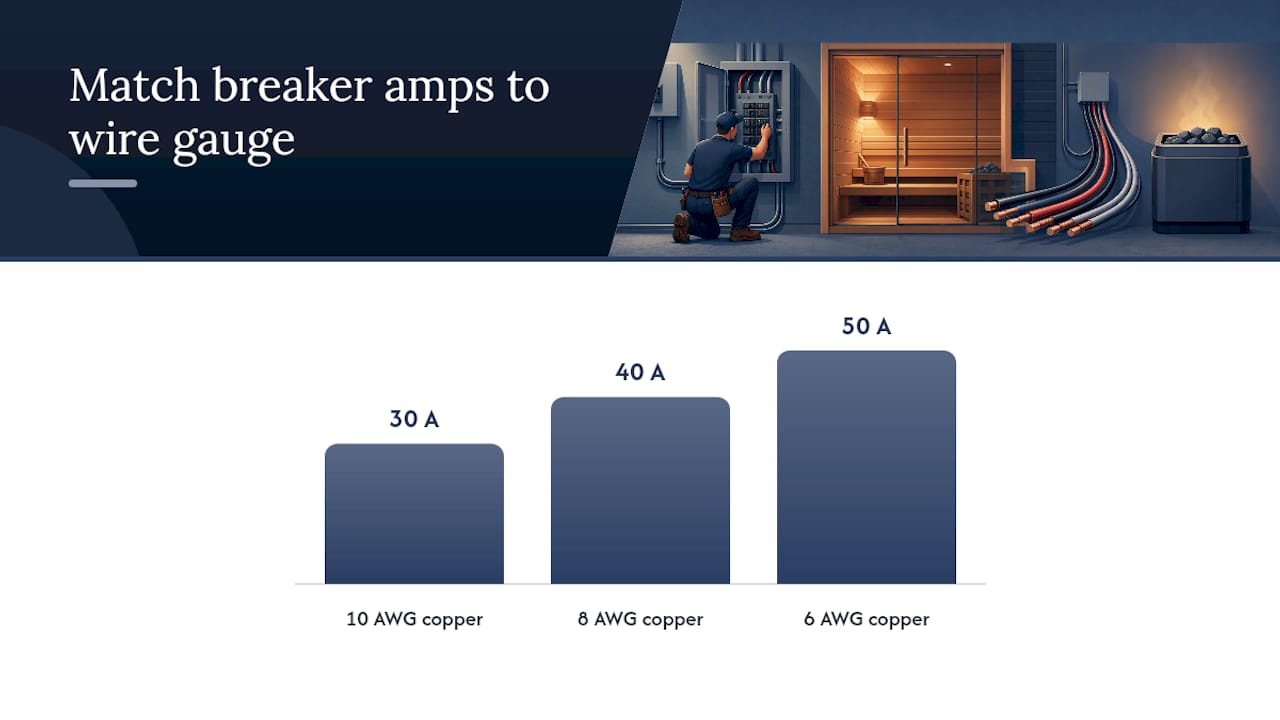
- Match the wire gauge to the breaker. For a 40A circuit at a short run, 8 AWG copper is the typical choice.
Here’s how that scales across common heater sizes:
These figures assume short conductor runs and standard ambient conditions. WireRef’s sauna wiring reference confirms this exact pattern: 10 AWG on a 30A circuit, 8 AWG on 40A, and 6 AWG on 50A, all copper, all sized for continuous-duty heater loads.
Heaters above roughly 8 to 10 kW sometimes move to 208V three-phase service in commercial or larger residential setups, which changes the amperage math slightly. ThermalFinn’s electrical guide breaks down three-phase calculations if your project falls into that range. For nearly everything under 8 kW in a home, single-phase 240V is what you’re working with.
What NEC Rules Apply to Sauna Heater Circuits?
Sauna heaters fall under NEC Article 424, which governs fixed electric space-heating equipment, and treats them as continuous loads. That classification is exactly why the 125% sizing rule exists. A few installations near water features may also trigger Article 680, so it’s worth flagging that possibility to your electrician early.
Hard-wired 240V heaters require a double-pole breaker matched to the heater manufacturer’s listed amperage, not just the NEC minimum. If the spec sheet calls for a larger breaker than the code minimum, follow the manufacturer. That listing requirement exists to keep the installation compliant with UL certification, and skipping it can void the warranty.
GFCI protection for sauna heater circuits is genuinely inconsistent across the country. NEC doesn’t universally require GFCI on hard-wired heater circuits, but GFCI devices remain a critical safety layer in any wet or high-heat environment, and plenty of local jurisdictions add their own requirements. A disconnect switch within sight of the heater is standard practice regardless of GFCI status.
Local adoption of the NEC varies more than most homeowners expect. Some counties are still enforcing a code edition from several cycles back, while others have already adopted amendments that go beyond the national baseline.
Pro Tip: Print the NFPA’s enforcement map for your state and bring it to your permit office. It saves a round-trip when the clerk asks which code edition applies.
Before submitting for permit, confirm: dedicated circuit confirmed, breaker matches manufacturer listing, disconnect location identified, and GFCI status checked against your local amendment.
What Wire Type Should You Use Inside a Sauna?
Copper conductors are the standard for sauna circuits. Aluminum wiring introduces connection and expansion issues that aren’t worth the marginal cost savings in a high-heat environment.
Inside the hot room itself, wire insulation matters more than most homeowners realize. THHN or THWN-2 rated conductors run through conduit are the accepted approach for in-room wiring, because standard NM-B cable, commonly known as Romex, isn’t rated for the sustained high temperatures inside a sauna cabin. NM-B is fine for the run outside the hot room, but it shouldn’t cross into the heated space.
A few additional specs worth locking down:
- Use rigid or flexible metal conduit sized with proper fill percentage, never packed tight.
- Seal every wall penetration where conduit enters the hot room to prevent heat and moisture migration.
- Bond and ground metal components properly, especially on detached or outdoor sauna structures.
- Account for ambient temperature derating. Sauna rooms can push well past 150°F near the ceiling, and elevated ambient temperature reduces a conductor’s safe ampacity, so a wire that’s technically rated for 40A at room temperature may need to be upsized for a heat-soaked installation.
Where Should Sauna Controls and Heaters Be Placed?
Control units and disconnect switches belong outside the hot room, full stop. Running control wiring through a wall penetration to an exterior-mounted panel keeps electronics away from heat and humidity that will shorten their lifespan.
Manufacturers publish specific clearance diagrams for a reason:
- Maintain the minimum clearance the manufacturer specifies between the heater and combustible surfaces, benches, and walls.
- Mount temperature sensors at the height and location shown in the installation manual, not wherever is convenient.
- Confirm basic ventilation is in place so the heater isn’t starved of airflow, which affects both safety and element longevity.
Pro Tip: Before ordering a controller separately, verify it’s actually compatible with your heater model. A temperature probe built for iSteam, AirTempo, iTempo, and iTempoPlus systems won’t necessarily work with an unrelated heater brand.
Does Your Panel Have Enough Capacity for a Sauna?
Not every home panel has room for another 240V, 40A to 60A circuit. Start by checking your panel’s total amperage rating against what’s already allocated to existing circuits.
- Add up the amperage of major existing loads (HVAC, range, dryer, EV charger).
- Compare that total against your panel’s main breaker rating.
- If the math is tight, have an electrician run a full NEC load calculation rather than guessing.
A subpanel or service upgrade becomes necessary when the sauna is far from the main panel, when you’re adding a sauna alongside a hot tub or pool on the same property, or when your existing service is already maxed out. Willamette Carpentry’s guide to sauna electrical planning notes that subpanels near detached or outdoor saunas are common precisely for this reason. Get quotes early. Panel upgrades add real time and cost to a project timeline.
Do You Need a Permit for a Sauna Electrical Installation?
Virtually every U.S. jurisdiction requires a permit and inspection for a new high-amperage circuit, and skipping this step creates real fire risk, code violations, and insurance exposure if something goes wrong later.
When vetting an electrician, ask for:
- Proof of license and active insurance.
- Direct experience with sauna or spa heater installations.
- Confirmation they’ll pull the permit themselves.
- References from a similar past job.
Bring the heater spec sheet, your planned mounting location, and the approximate wire run length to that first conversation. It speeds up the quote significantly.
What Do Real Sauna Wiring Calculations Look Like?
A 6 kW indoor heater on 240V single-phase draws 25 amps. Multiply by 1.25 for the continuous-load factor and you get 31.25 amps, which rounds up to a 40A double-pole breaker on 8 AWG copper. That’s the most common residential setup Saunaheatersupply customers install.
A 1.8 kW plug-in infrared unit on 120V draws 15 amps. Applying the same 125% rule brings it to 18.75 amps, which fits a dedicated 20A circuit on standard 12 AWG copper.
The most common installer mistake isn’t the math. It’s skipping voltage-drop calculations on longer runs. Runs over roughly 50 feet need a voltage-drop check, and undersized wire on a long run can starve the heater of full power even when the breaker size is technically correct.
Pro Tip: Read a heater’s spec sheet top to bottom before ordering breakers or wire. The kW rating, voltage, and amperage draw are usually printed together, and mismatching any one of them throws off the entire circuit calculation.
What Surge Protection Do Sauna Heaters Need?
Sauna heaters sit on circuits that carry significant continuous current, which makes them more exposed to voltage spikes from grid fluctuations, lightning-adjacent events, or nearby equipment switching on and off. A single serious surge can damage heating elements, control boards, or WiFi-enabled controllers on modern heater packages.
Whole-house surge protectors installed at the main panel are the most efficient way to cover a sauna circuit, since they protect every circuit downstream rather than just one appliance. For heaters with electronic controllers, like WiFi-connected models such as the Harvia Kip45W package, a point-of-use surge protective device adds another layer specifically for the sensitive electronics, separate from the heating element itself.
This matters more on smart heater packages than it did on older analog units. A basic mechanical thermostat has almost nothing to damage during a power spike. A WiFi controller board with touchscreen displays and app connectivity is a different story, and replacing a fried control panel costs considerably more than a surge protective device would have.
If your home has a history of power fluctuations, or if the sauna circuit shares a subpanel with heavy equipment that cycles on and off frequently (well pumps, HVAC compressors), mention this to your electrician. They can spec a surge protective device sized to the panel during the same visit that handles your breaker and wiring installation, which is far more efficient than retrofitting one later.
What Conduit Should You Use for Sauna Wiring Runs?
Conduit choice for a sauna circuit depends on where the run sits relative to the hot room. Outside the sauna cabin, electrical metallic tubing (EMT) is a common and cost-effective choice for protecting THHN conductors on their way to the heater. Inside the hot room itself, many installers prefer rigid metal conduit or a properly rated flexible metal conduit that can handle the sustained heat near the ceiling and heater location.
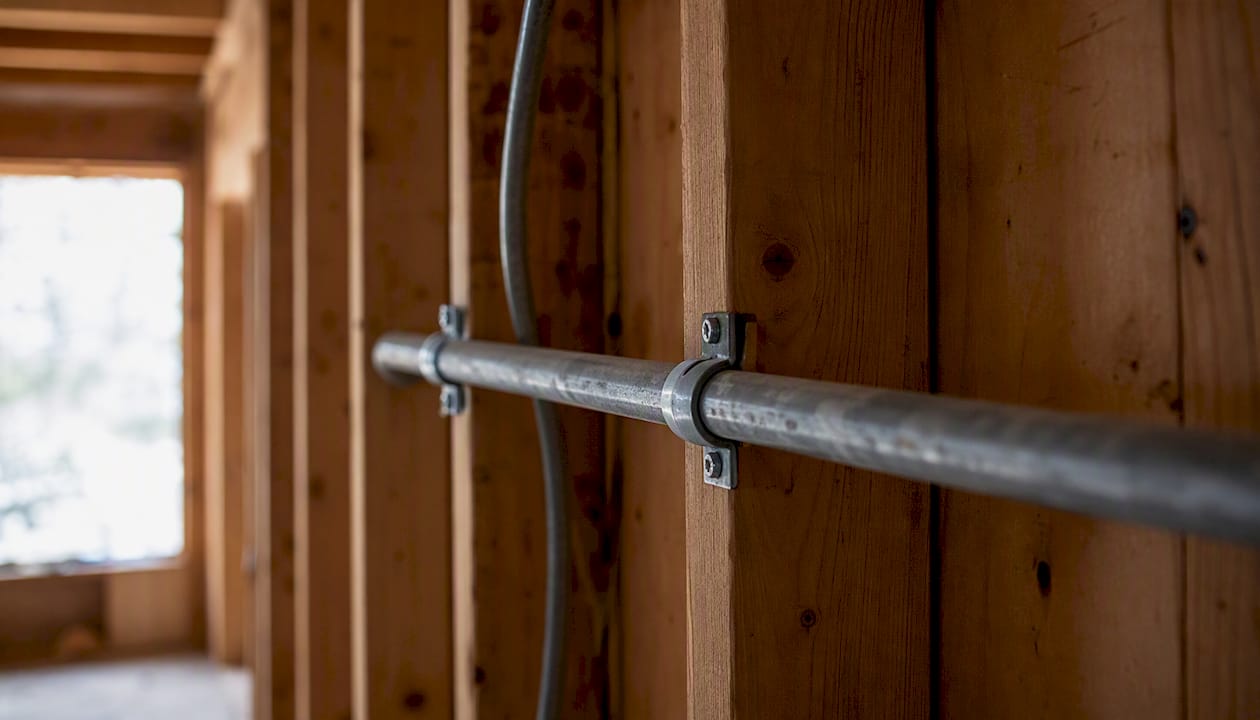
Conduit fill matters more than people expect. A conduit packed too tight traps heat around the conductors, which compounds the ambient-temperature derating problem already at play inside a hot sauna room. Running slightly oversized conduit isn’t wasted material. It’s a legitimate way to keep conductor temperatures in check.
Sealing matters just as much as sizing. Every point where conduit penetrates a sauna wall needs to be sealed against both heat transfer and moisture intrusion, since sauna rooms cycle repeatedly between high heat and residual humidity after each session. A poorly sealed penetration can let humid air migrate into wall cavities over years of use, which creates a slower, less visible problem than an undersized wire ever would.
If you’re already opening a wall for the run, this is the moment to plan for future flexibility. Pulling one extra conductor or upsizing the conduit by half an inch costs very little during the initial install and can save an entire re-run later if you upgrade to a heater with different amperage needs.
How Does Electrical Setup Affect Sauna Energy Efficiency?
The electrical installation itself has a real, measurable effect on how efficiently a sauna heater runs, separate from the heater’s own design. Undersized wire on a long run causes voltage drop, and a heater running at reduced voltage draws more current to produce the same heat output, which means longer warm-up times and higher energy use over the life of the sauna.
Getting the wire gauge right the first time, rather than the bare code minimum, is one of the simplest efficiency decisions in the entire project. An 8 AWG run instead of a marginal 10 AWG run on a longer distance keeps voltage closer to nominal at the heater terminals, which keeps the element running at its rated efficiency.
Controller choice plays a role too. WiFi-enabled controllers with accurate temperature sensors, like the packages built around AirTempo and iTempo control systems, let the heater cycle more precisely instead of overshooting target temperature and wasting energy on unnecessary reheating. A heater that constantly overshoots because of a cheap or poorly placed sensor burns more electricity over a season than one with well-calibrated controls.
Subpanel placement matters for efficiency as much as it does for code compliance. A shorter, properly sized run from panel to heater loses less energy to resistance than a long run does, even when both are technically within code. If you have a choice between panel locations during a new build, putting the sauna circuit’s home run as short as reasonably possible pays off in lower long-term operating cost, not just easier installation.
An Installer’s Notes From the Field
Route conductors before you insulate the room, not after. Always check actual voltage at the panel with a meter rather than assuming a nameplate number, since older panels sometimes run a few volts low. Verify controller and heater compatibility before the drywall goes up.
Oversize your conduit whenever a wall is already open. Test the GFCI (if installed) at commissioning, not months later. Keep the manufacturer spec sheet and inspection receipts together. You’ll want both if you ever sell the house or file an insurance claim.
Get Expert Help Matching Your Heater to Your Home’s Electrical Capacity
Getting the kW-to-amperage math right is only half the job. The other half is picking a heater that actually fits your space, your panel, and your controller preferences, and that’s where Saunaheatersupply’s product specialists earn their keep. Every heater listing on the site includes the spec sheet details you need before your electrician ever shows up.
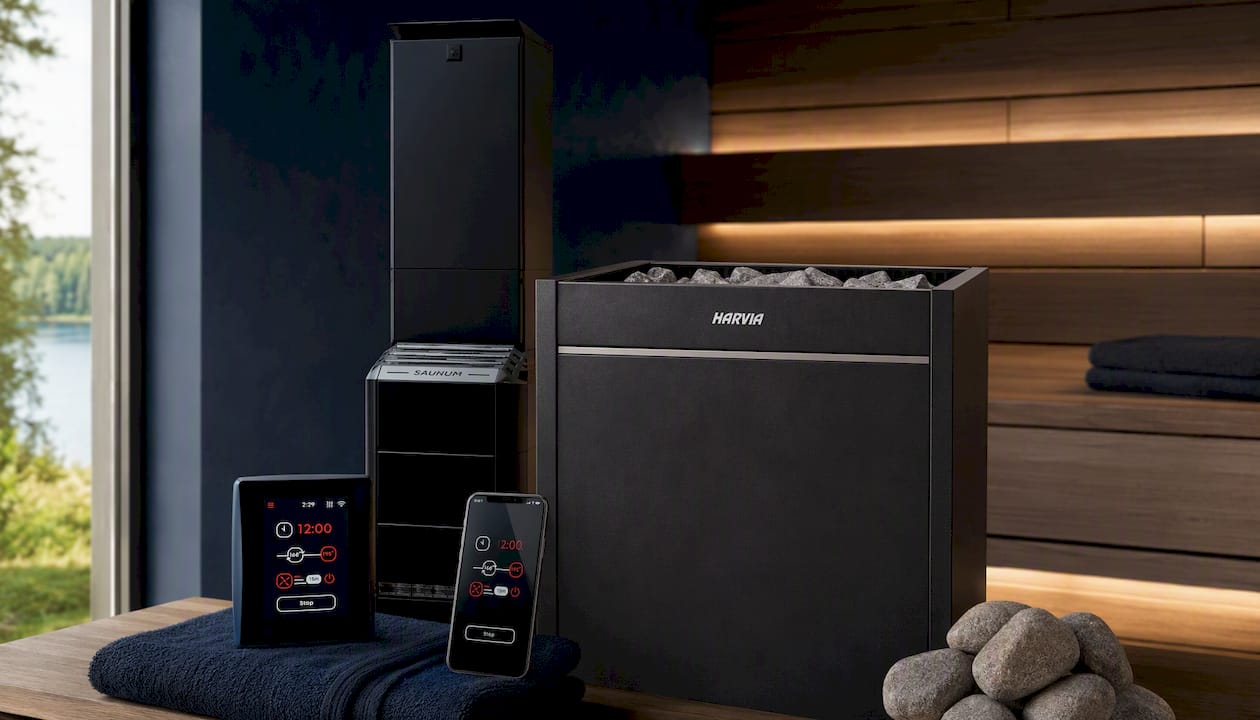
If you’re comparing options, the IKI Pillar 9kW with WiFi controller is a strong mid-size traditional heater for homeowners who want smart controls without oversizing their circuit unnecessarily. For smaller spaces or a gentler heat profile, the Saunum Air 7 package pairs a compact heater with a matched controller so you’re not guessing at compatibility. Both come with full spec sheets so your electrician has exact amperage and clearance figures before the first wire gets pulled.
Reach out with your target heater model and a photo of your panel’s label before you order. Saunaheatersupply’s team will confirm the heater matches your available capacity and flag anything your electrician should know in advance, saving you a return trip if something doesn’t fit.
Frequently Asked Questions About Sauna Electrical Requirements
Do all sauna heaters need a 240V circuit? No. Traditional hard-wired heaters almost always need 240V, but small plug-in infrared units often run on a dedicated 120V circuit instead.
What breaker size do I need for a 6 kW sauna heater?
Can I use Romex inside my sauna room? Standard NM-B Romex is not rated for the sustained heat inside a sauna cabin. Use THHN or THWN-2 conductors in conduit for any wiring that runs through the hot room itself.
Is a GFCI required for a sauna heater circuit? It depends on your local code amendment. The NEC does not universally mandate GFCI protection for hard-wired sauna heaters, so check with your local building department.
Do I need a permit to install a sauna heater? Yes, in virtually every U.S. jurisdiction, a new dedicated high-amperage circuit requires both a permit and an inspection before the sauna can be used.
Sources
Bring these references to your electrician or local inspector when finalizing your installation plan:
- Sauna Wiring: Wire Size, Breaker, and High-Temperature…
- Sauna Heater Electrical Requirements: Wiring, Breakers & Amps Guide | ThermalFinn
- NEC enforcement maps | NFPA
Recommended
- Sauna Power Requirement | Electrical Planning for Installation — Sauna Heater Supply
- Traditional Sauna Electrical Requirements: 2025 Guide — Sauna Heater Supply
- Sauna Heater Installation: Step-by-Step Guide for Homeowners — Sauna Heater Supply
- Steam Room vs Sauna: What Homeowners & Contractors Should Choose — Sauna Heater Supply