









Cut Home Sauna Energy 10–25% with Ceiling First Retrofits
A home electric sauna typically uses energy amounts varying by heater type and room heat loss. Traditional electric heaters commonly consume a higher range per session, and infrared units use a lower range. At typical residential electricity rates, the cost per session is generally well below two dollars. The single biggest lever for cutting that number is reducing heat-up time through better insulation and correctly sized heating.
TL;DR:
- Heating time accounts for 50 to 65 percent of energy use, so reducing heat-up duration via insulation and proper sizing yields the biggest savings.
- Infrared saunas use significantly less energy per session, typically between 0.5 and 3.5 kWh, compared to traditional electric heaters that can exceed 8 kWh.
- Insulation upgrades, especially ceiling and wall insulation, can cut heat-up energy by 10 to 25 percent, making a substantial long-term difference.
- Regular maintenance, such as inspecting door seals and cleaning heater elements, ensures sustained efficiency and prevents gradual performance decline.
- Using automation, smart controls, and scheduling preheats can further reduce unnecessary energy consumption without any major construction or behavioral changes.
Table of Contents
- What Drives Sauna Energy Consumption Per Session?
- Infrared vs. Traditional vs. Portable: Which Type Uses the Least Power?
- How Much Does Insulation Really Save on Sauna Energy?
- Simple Habits That Cut Sauna Energy Use Today
- Which Upgrades Give You the Best Return on Investment?
- Maintenance Habits That Keep Efficiency From Slipping
- What’s the Carbon Footprint of Running a Home Sauna?
- Can You Power a Sauna With Solar or a Heat Pump?
- Design Choices That Bake In Efficiency From the Start
- How Smart Controls Help You Use Less Energy Without Thinking About It
- Author Perspective:
- Get the Right Heater for Your Efficiency Goals
- Sources
What Drives Sauna Energy Consumption Per Session?
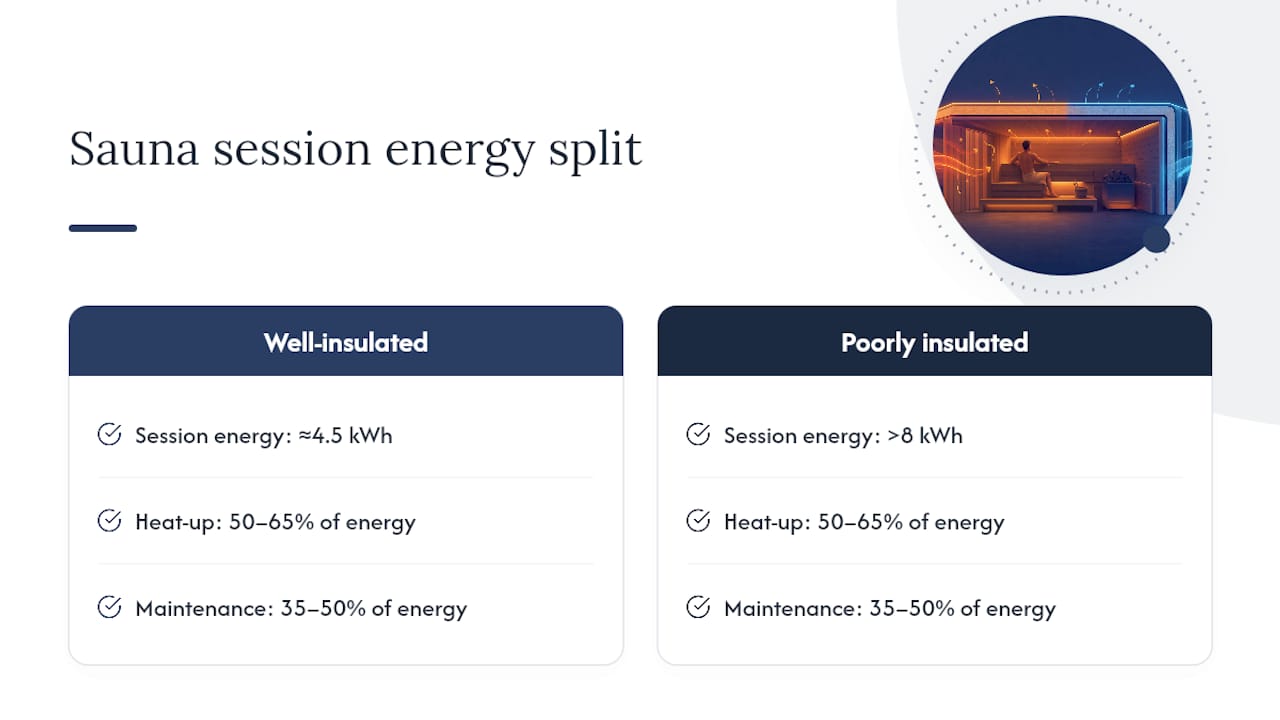
Energy use in a home sauna comes down to three variables: the heater’s kilowatt rating, the room’s insulated volume, and how long the heater runs before you step in. A well-insulated 4x6 sauna with a properly sized heater might use 4.5 kWh for a full session. A poorly insulated room with an oversized or undersized heater can push that number past 8 kWh, even though both rooms feel roughly the same size to the person standing inside them.
Most of that energy doesn’t go toward keeping you warm once you’re inside. It goes toward heating the room from a cold start. Heat-up typically accounts for 50 to 65 percent of total session energy, with the remaining draw coming from maintenance cycling as the heater’s thermostat kicks the elements on and off to hold temperature. That split matters because it tells you where to focus: shaving five minutes off preheat saves more energy than trimming five minutes off your actual session.
Here’s how the numbers play out at different usage patterns and electricity rates:
These figures line up with independent cost analyses showing traditional saunas running 3 times a week landing in the $90 to $250 per year range, with infrared units at the same frequency often costing 70 to 80 percent less. If your utility bills a peak rate above $0.20/kWh, the gap between heater types widens fast. Rather than guessing, plug your heater’s wattage and session length into the DOE’s appliance energy calculator using your actual utility rate. A basic plug-in energy monitor on the circuit gives you an even more precise read, especially useful if you’re comparing before-and-after numbers on an insulation upgrade.
Infrared vs. Traditional vs. Portable: Which Type Uses the Least Power?
The heater technology you choose sets your energy baseline before insulation or habits ever enter the picture. Electric-resistance heating, the principle behind every conventional sauna heater, converts nearly all incoming electricity directly into heat. The difference between sauna types is how that heat gets delivered and how much thermal mass it has to warm up first.
- Infrared saunas heat your body directly with radiant panels rather than warming the surrounding air and rock mass. They typically draw 1 to 3.5 kWh per session, reach usable output in 10 to 15 minutes, and rarely exceed 1.8 kW of connected load in a home cabin.
- Traditional electric heaters warm a bed of volcanic rock that radiates heat and humidity into the room. Expect 4.5 to 12 kWh per session, with preheat times of 30 to 45 minutes depending on room volume and heater sizing.
- Portable and small-cabin units (freestanding tents or compact one-person cabins) often pair infrared elements with minimal insulated volume, pushing session energy as low as 0.5 to 1.5 kWh, though real-world savings depend heavily on ambient room temperature around the unit.
- Wood-fired heaters sidestep the electric bill entirely, drawing power only for any fan or blower accessory. The trade-off is fuel cost, longer unattended heat-up, and less precise temperature control compared to a thermostatically controlled electric unit.
If your main goal is lowering the electric bill, infrared wins on raw kWh. If you’re chasing the traditional Finnish experience with steam and higher heat, a well-insulated traditional heater closes much of that gap.
How Much Does Insulation Really Save on Sauna Energy?
Construction choices matter more than almost anything else you’ll decide, because they determine how much of the heater’s output escapes before it ever reaches you. Retrofit data on wall and ceiling insulation consistently shows 10 to 25 percent reductions in heat-up energy depending on which upgrade you make and how poorly insulated the room was to begin with.
- Target R-19 for walls and R-25 or higher for the ceiling. Heat rises, so an underinsulated ceiling loses disproportionately more energy than an underinsulated wall of the same square footage.
- Keep the room volume tight to your actual usage. A sauna sized for two people that’s built to fit six wastes kilowatts heating empty cubic feet every single session.
- Minimize vision glass and upgrade to double-pane where you do use it. A single-pane glass door can lose measurably more heat per square foot than an insulated wood door, and glass area is one of the most overlooked sources of steady-state heat loss in home sauna builds.
- Install a reflective foil vapor barrier behind the interior paneling. It does double duty, blocking moisture from reaching structural framing while reflecting radiant heat back into the room instead of letting it absorb into the wall cavity.
Getting these choices right from the start, or correcting them during a remodel, does more for your energy bill than any behavioral change you could make afterward. For a detailed walkthrough of stud spacing, vapor barrier placement, and paneling choices, see Saunaheatersupply’s guide on how to insulate a sauna for maximum efficiency.
Simple Habits That Cut Sauna Energy Use Today
You don’t need to rebuild a wall to see savings this month. A handful of operational changes, applied consistently, can meaningfully reduce the kWh a session costs without touching your sauna’s construction.
- Time your preheat window tightly. Start the heater only as long before your session as your specific unit needs, typically 20 to 30 minutes for traditional heaters and under 15 for infrared. A Wi-Fi controller or basic timer plug lets you start heating from your phone so the sauna hits temperature right as you arrive, instead of running idle for an extra half hour.
- Close the exhaust vent while heating, then open it once you’re inside. This keeps the heater from fighting a constant air exchange during the most energy-intensive phase, then restores fresh air for comfort during the session itself.
- Restack and inspect your heater rocks every few months. Cracked or dust-covered stones hold less heat and slow warm-up, and manufacturer guidance points to proper stacking as a direct fix for sluggish heat-up times.
- Batch sessions for multiple household members instead of running separate heat-up cycles for each person. Two people sharing one preheat cycle roughly halves the per-person energy cost of that session.
- Shift sessions off peak utility hours if your provider offers time-of-use rates; running the same session during an off-peak window can cut the cost by a third or more without changing your kWh draw at all.
Pro Tip: Lowering your setpoint from a scorching 190°F to a still-satisfying 158°F (70°C) and stepping in as soon as the heater signals ready, rather than waiting for a “fully soaked” room, can shave 10 to 15 percent off a session’s energy use with barely a noticeable difference in heat.
Which Upgrades Give You the Best Return on Investment?
Not every improvement pays back at the same speed. If you’re planning a retrofit or a new build, prioritize in this order:
- Ceiling insulation first. It’s the single highest-loss surface in most sauna rooms and often the cheapest square footage to upgrade during a remodel.
- Wall insulation second. Pair it with the vapor barrier while the walls are already open rather than treating them as separate projects.
- Door and glass upgrades third. Swapping a single-pane door for insulated double-pane, or simply shrinking the glass panel size, reduces a steady drain that runs the entire session, not just during heat-up.
- Correct heater sizing fourth. An oversized heater wastes capacity; an undersized one runs longer to compensate. Match kilowatts to your actual insulated room volume rather than defaulting to whatever the previous owner installed.
If your room is already tight and well-insulated but heat-up still feels slow, the fix is likely the heater itself. Swapping a traditional unit for an infrared package cuts operating energy dramatically with no construction work at all. If your room leaks heat regardless of heater type, insulation work will outperform any heater swap on long-term savings. Saunaheatersupply’s guide to sauna power requirements and electrical planning walks through matching kW to room volume before you buy.
Maintenance Habits That Keep Efficiency From Slipping
Insulation and heater choice set your ceiling for efficiency, but neglected maintenance erodes it month by month. A heater that ran efficiently on installation day can quietly lose 10 to 15 percent of its performance within a year or two if nobody checks on it.
Heating elements accumulate mineral scale and dust that insulate the element from the air it’s supposed to heat, forcing longer run times to hit the same setpoint. Wiping down exposed elements and inspecting for scale buildup during your seasonal rock restacking catches this early. Door seals and gasket material compress and crack over time, opening small gaps that leak conditioned air continuously, not just during heat-up. A quick visual check of the door seal twice a year, replacing it when it feels stiff or cracked, closes that gap before it becomes a noticeable draft.
Ventilation components deserve the same attention. A vent that’s stuck partially open bleeds heat throughout the session; one that’s stuck closed traps humidity and forces the heater to work against poor air quality. Cleaning and testing vent operation belongs on the same maintenance schedule as your stones. For heaters installed in commercial or multi-user settings, where wear accumulates faster, Saunaheatersupply’s commercial sauna maintenance guidance covers inspection intervals that apply just as well to a heavily used home unit. A five-minute check every few months protects the efficiency gains your insulation and heater sizing already earned you.
What’s the Carbon Footprint of Running a Home Sauna?
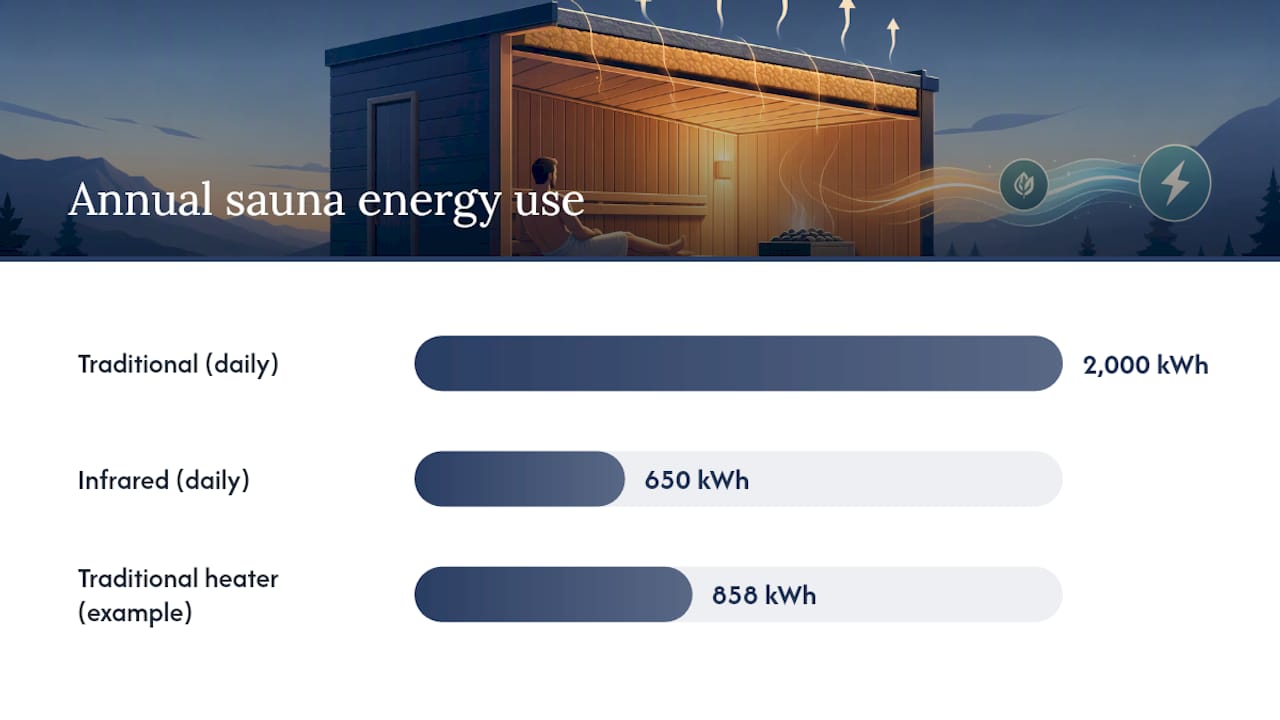
A home sauna’s environmental footprint tracks almost exactly with its electricity use, since electric-resistance heating draws power straight from the grid with no combustion happening on-site. The carbon impact of a given session depends less on the sauna itself and more on how your local utility generates electricity. A traditional heater running 858 kWh a year in a region powered heavily by natural gas or coal carries a meaningfully larger footprint than the same heater run on a grid dominated by hydro, nuclear, or wind.
This is where heater choice and insulation double as environmental decisions, not just cost decisions. Cutting your annual sauna energy use from roughly 2,000 kWh down to 650 kWh, the rough gap between daily traditional use and daily infrared use shown earlier, reduces associated grid emissions by a proportional amount, regardless of your local fuel mix. Wood-fired heaters shift the equation entirely, trading grid electricity for combustion emissions from the wood itself, which carries its own footprint depending on fuel source and burn efficiency.
For homeowners weighing environmental impact alongside cost, the practical takeaway mirrors the cost advice: heat-up time is where most of the energy, and therefore most of the associated emissions, gets spent. Every insulation upgrade or heater downsize that shortens heat-up reduces both your bill and your grid draw at the same time. There’s no separate “green” checklist here. Efficiency and environmental impact move together on this particular appliance.
Can You Power a Sauna With Solar or a Heat Pump?
Solar power pairs naturally with sauna use because sessions are discretionary. You can run them whenever the sun is producing, unlike a refrigerator that has to run around the clock. A rooftop solar array sized for general household use can often absorb a sauna’s draw entirely if sessions happen during daylight hours, especially with a lower-wattage infrared unit that pulls well under 2 kW.
Battery storage extends that flexibility to evening sessions, letting you bank daytime solar production and discharge it during a preheat cycle after sunset. The economics depend heavily on your existing solar setup and local net metering rules, so this works best as an addition to a system you’re already running rather than a standalone investment just for sauna use.
Heat pumps play a different role. They’re not a direct substitute for a sauna heater, since a heat pump can’t reach the 150 to 190°F range a sauna room needs, but they matter indirectly. If your sauna sits inside or adjacent to a heat-pump-conditioned space, that background conditioning affects how cold the room starts before you fire up the heater. A garage or basement sauna starting from 45°F needs meaningfully more heat-up energy than one starting from a heat-pump-maintained 65°F. Positioning your sauna in a conditioned part of the home, rather than an unheated outbuilding, is a legitimate renewable-adjacent efficiency strategy even without solar panels involved.
Design Choices That Bake In Efficiency From the Start
The materials and layout decisions made before a single heater turns on determine your energy baseline for the life of the sauna. Solid wood species with lower thermal conductivity, cedar and hemlock are common choices, hold heat better against the room than thinner or denser alternatives, reducing how hard the heater works to maintain temperature once it’s reached.
Window and glass placement deserves more thought than most builds give it. A small viewing window positioned high on a wall, away from the bench line, loses less heat than a full glass door because it minimizes surface area while still giving the room a sense of openness. If you want a glass door for aesthetics, double-pane construction narrows the efficiency gap versus a solid wood door considerably.
Ceiling height is another quiet lever. A standard 7-foot sauna ceiling requires less energy to heat than an 8-foot ceiling with the same footprint, simply because there’s less air volume to bring up to temperature. Builders chasing a more spacious feel sometimes raise ceiling height without realizing they’ve also raised the heater’s workload for every future session.
Bench placement relative to the heater matters too. Positioning benches so bathers sit closer to the heat source, within the heater manufacturer’s clearance guidelines, lets you run a slightly lower room temperature while still delivering the same perceived heat, trimming both energy use and preheat time.
How Smart Controls Help You Use Less Energy Without Thinking About It
Automation removes the guesswork from timing, which is exactly where most wasted sauna energy hides. A Wi-Fi-enabled controller lets you start preheat remotely so the room hits temperature right as you’re ready, instead of running an extra 20 minutes because you started it “just in case” earlier than necessary.
Scheduling features go further, letting you program consistent start times around your actual routine, say, every Tuesday and Friday at 6:45 PM, so the heater never runs longer than the session actually requires. Some controllers also support temperature setback modes that hold a lower standby state between sessions in high-frequency households, cutting the energy penalty of leaving a sauna “on call” without fully powering it down and restarting from cold each time.
Auto shut-off timers protect against the most wasteful scenario of all: a heater left running after everyone’s finished and gone back inside the house. Pairing a smart controller with a energy monitor on the same circuit turns your sauna into a system you can actually audit, showing you in real numbers whether a schedule change or an insulation upgrade moved the needle.
Author Perspective:
Most homeowners fixate on heater wattage and skip the room math entirely. It is important to consider kilowatts per cubic foot before anything else, because a heater that’s undersized for the room runs constantly and never feels efficient, no matter how good the insulation is.
The insulation-versus-heater-type question depends on what’s already built. If the room is tight and well-sealed, switching to infrared can reduce costs. If the room leaks heat through a thin wall or an old glass door, no heater swap fixes that. Fix the envelope first, then decide if you want to change heater types.
Get the Right Heater for Your Efficiency Goals
Choosing the right heater matters more for your energy bill than almost any other single decision, and Saunaheatersupply curates options across every efficiency tier rather than pushing one heater type on every buyer.
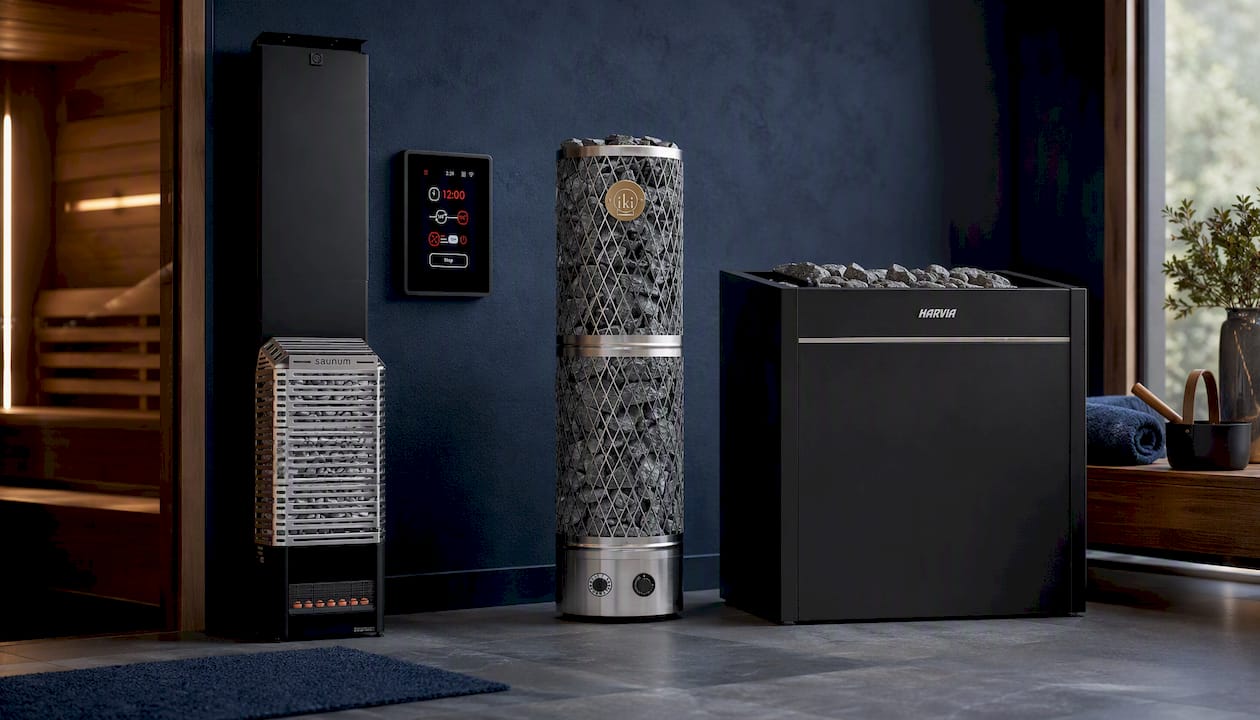
If you’re prioritizing low kWh draw and fast heat-up, the Saunum Air 7 Sauna Heater Package gives infrared-preferring buyers a compact, well-specified setup built for frequent use without running up the electric bill. Tech-forward buyers who want remote scheduling and real-time monitoring should look at the IKI Pillar 9kW with Wi-Fi controller glass, which pairs higher output with app-based control for larger rooms. Traditionalists who want the full stone-mass experience and don’t mind a longer preheat will find that in the Harvia Virta Pro HL200E, a rock-heavy heater built for the classic Finnish sauna feel. Browse the full lineup and talk to Saunaheatersupply’s team about sizing your heater correctly for your room before you buy.
Sources
- Sauna Energy Consumption: kWh Per Session & How to Reduce Costs | ThermalFinn
- Cost to Run a Sauna - Electricity Data & Real Numbers 2026 | UseSauna