











Commercial Sauna Maintenance for Facility Managers
The right commercial sauna maintenance plan is simple: run weekly visual inspections, log every task in a CMMS, and keep spare heater elements and high-limit switches on-site before you need them. Skip any one of those three and you’re gambling with downtime.
Do this today, in this order:
- Check the breaker and high-limit reset button on every heater and confirm each one holds a load without tripping.
- Inspect the rock bed for cracked or packed stones, since crumbled rocks are a common cause of high-limit trips.
- Confirm the temperature probe sits where the manufacturer specifies, not wherever the last installer left it.
A single reactive sauna failure shuts down a revenue-generating amenity and opens the facility to liability questions if there’s no maintenance record to show; for traditional cultural examples of sauna operations and cleaning practices, see the Altai Mountains Resort - Ridder, Kazakhstan. Always disconnect power at the dedicated breaker before touching a heater, even for a “quick look.”
Pro Tip: Photograph the rock bed and control panel every week. A dated photo log settles warranty disputes faster than a verbal description ever will.
Key Takeaways
Reliable commercial sauna maintenance combines a weekly-to-quarterly inspection schedule, CMMS-logged work orders, and an on-site spares kit for the three parts that fail most often.
| Point | Details |
|---|---|
| Run a three-tier schedule | Weekly visual checks, monthly stone and panel work, quarterly calibration and electrical checks. |
| Stock the big three spares | Keep a spare element, high-limit switch, and stone kit on-site per heater model. |
| Log everything in a CMMS | Timestamped work orders create audit-ready records and support parts reorder triggers. |
| Know your escalation line | Any breaker repeat-trips, 240V panel work, or internal heater access goes to a licensed electrician. |
| Source OEM-compatible parts | Sauna Heater Supply carries heater packages and replacement probes built for commercial-grade servicing. |
Manuals and Guides Worth Keeping on File
Keep these on hand for technician reference and audit documentation:
- Finsauna ClubHeat Installation Manual for wiring, GFI warnings, and troubleshooting flow.
- Scandia Sauna Heater Troubleshooting Guide for step-by-step diagnostic sequences.
- Hotel Spa & Wellness Equipment CMMS Guide for building out your PM and recordkeeping structure.
- Sauna Heater Supply School for parts sourcing and installation reference.
Table of Contents
- Building a Preventive Maintenance Schedule That Actually Holds Up
- What Electrical and Safety Checks Are Non-Negotiable?
- How Do You Diagnose a Sauna Heater That Won’t Heat?
- Which Spare Parts Should Every Facility Keep On-Site?
- Why a CMMS Changes the Economics of Sauna Upkeep
- When Should You Call a Licensed Technician?
- Sources
Building a Preventive Maintenance Schedule That Actually Holds Up
Commercial sauna care works best on a three-tier rhythm: weekly checks catch small problems, monthly tasks handle wear, and quarterly work verifies the electrical and calibration side of the system. This is the backbone of any serious sauna maintenance services program, whether you run it in-house or bring in a contractor.

Weekly, walk each unit and check the heating element and high-limit switch visually, confirm the temperature sensor hasn’t shifted, inspect the door gasket and vents for gaps, and give the bench and stones a quick once-over for damage or debris.
Monthly, go deeper. Descale or swap stones that show mineral buildup, check solenoid valves and drain lines if you’re running a steam generator alongside the sauna, and open the control panel to wipe down dust and confirm nothing looks scorched or loose.
Quarterly, this becomes a calibration exercise. Test the thermostat and high-limit cutoff against a known reference, torque-check electrical terminals since heat cycling loosens connections over time, and verify ventilation is still moving air at the rate the room was designed for. This is also the point to schedule a vendor safety inspection, something commercial heater guidance from Narvi treats as a standard part of annual upkeep.
| Task | Why it matters | Who should do it | Evidence to log |
|---|---|---|---|
| Element & high-limit visual check | Catches early wear before a heater fails mid-service | In-house staff | Photo, technician initials, date |
| Stone descaling/replacement | Prevents packed rocks from tripping the high-limit | In-house staff or contractor | Rock batch/serial if available, quantity replaced |
| Thermostat & high-limit calibration | Confirms safety cutoffs fire at the correct temperature | Licensed technician | Calibration readings, reference value used |
| Electrical terminal torque check | Loose terminals cause heat and arcing over time | Licensed electrician | Torque values, terminals checked |
Pro Tip: Standardize your stone replacement cadence across every heater in the building and record the batch when the supplier provides one. If several units start tripping around the same week, a shared bad batch is easier to spot than a coincidence of aging elements.
What Electrical and Safety Checks Are Non-Negotiable?
Lock out power at the dedicated breaker before opening any heater housing, full stop. Fixed electric sauna heaters fall under NEC Article 426 for fixed outdoor and indoor heating equipment, and that code exists because sauna heaters combine high heat, high humidity, and line voltage in one enclosure.
- The high-limit switch cuts power if the cabin overheats. If you reset it once and it holds, log the event; if it trips again within a day, something else is wrong, usually crumbled rocks or a drifting thermostat.
- Thermostat and temperature probes need to sit at the manufacturer’s specified height and location. A probe mounted too close to the heater reads hot and shuts the system down early; one mounted too far away lets the room overheat before it reacts.
- Quarterly calibration checks on thermostats and high-limit cutoffs should produce a logged reading against a reference thermometer, not just a pass/fail note.
Manufacturer manuals matter here more than general wiring knowledge. Finsauna’s installation manual specifically warns against installing a GFI in the sauna heater circuit on models where it isn’t specified, since nuisance tripping in a hot, humid enclosure can mask a real fault or just cause needless downtime. Follow the OEM wiring diagram exactly, even when it seems to conflict with a general electrical habit, or the warranty is the first thing you lose.
How Do You Diagnose a Sauna Heater That Won’t Heat?
Work the problem in order, cheapest and safest checks first.
- Confirm the breaker hasn’t tripped and the panel disconnect is in the “on” position.
- Check the timer and thermostat settings. A unit set correctly but still not heating points past user error.
- Look for a tripped high-limit switch and reset it once, safely, with power confirmed off during the physical check.
- If the heater still won’t fire after a clean reset, the issue is likely one of three parts: the heating element, the high-limit switch itself, or the thermostat, which account for most service calls on commercial units.
Match the symptom to the likely cause before you call anyone:
- Heater completely dead: breaker, disconnect, or a failed element.
- Slow to heat: partially failed element bank on multi-element units, or a thermostat reading incorrectly.
- Uneven heat: element wiring issue on a multi-bank heater, or phase sequencing problems that Scandia’s troubleshooting flow specifically calls out for larger commercial units.
- Repeated high-limit trips: packed or crumbled rocks first, thermostat drift second.
- Breaker trips repeatedly: stop here. This is electrician territory, not a maintenance task.
Record any control-panel error code exactly as displayed, along with the time it appeared, before you reset anything. That detail alone can save a technician a callback visit.
Pro Tip: A technician can safely swap rocks, reset a high-limit switch, and check a breaker. Anything involving the internal wiring compartment or the 240V circuit belongs to a licensed electrician, no exceptions.
Which Spare Parts Should Every Facility Keep On-Site?
A minimum viable spares kit turns a two-day closure into a same-day fix. Stock heater elements, high-limit switches, thermostat and control probes, contactors, common fuse sizes, and a default stone kit sized to your heater model.
- Keep at least one spare element per heater model you operate, and reorder at the 30-day lead-time mark rather than waiting for a failure.
- Buy OEM or manufacturer-approved parts only. Off-brand elements and sensors can void the warranty even if they physically fit.
- Track vendor lead times in your CMMS so reorder points reflect reality, not guesswork.
| Part | Why it’s critical | On-site quantity | Lead-time note |
|---|---|---|---|
| Heater element | Most common failure point on any commercial unit | 1 per heater model | Reorder at 30 days out |
| High-limit switch | Safety cutoff, frequent trip point | 1 per heater model | Usually ships fast, keep 1 spare |
| Thermostat/control probe | Drift causes uneven heat or false trips | 1–2 per control platform | Confirm compatibility before ordering |
| Stone kit | Crumbled rocks cause overheating trips | 1 full kit per heater | Stock ahead of peak season |
Pro Tip: Order replacement sauna stones in bulk if you run multiple heaters of the same size. It’s cheaper per unit and keeps every cabin on the same replacement cycle.
Why a CMMS Changes the Economics of Sauna Upkeep
A CMMS turns preventive sauna maintenance from a memory exercise into a searchable record. Recurring PM tasks get scheduled automatically, spare-parts triggers fire before you run out of critical parts, and every inspection gets a timestamp that holds up if an insurer or auditor ever asks for proof of service.
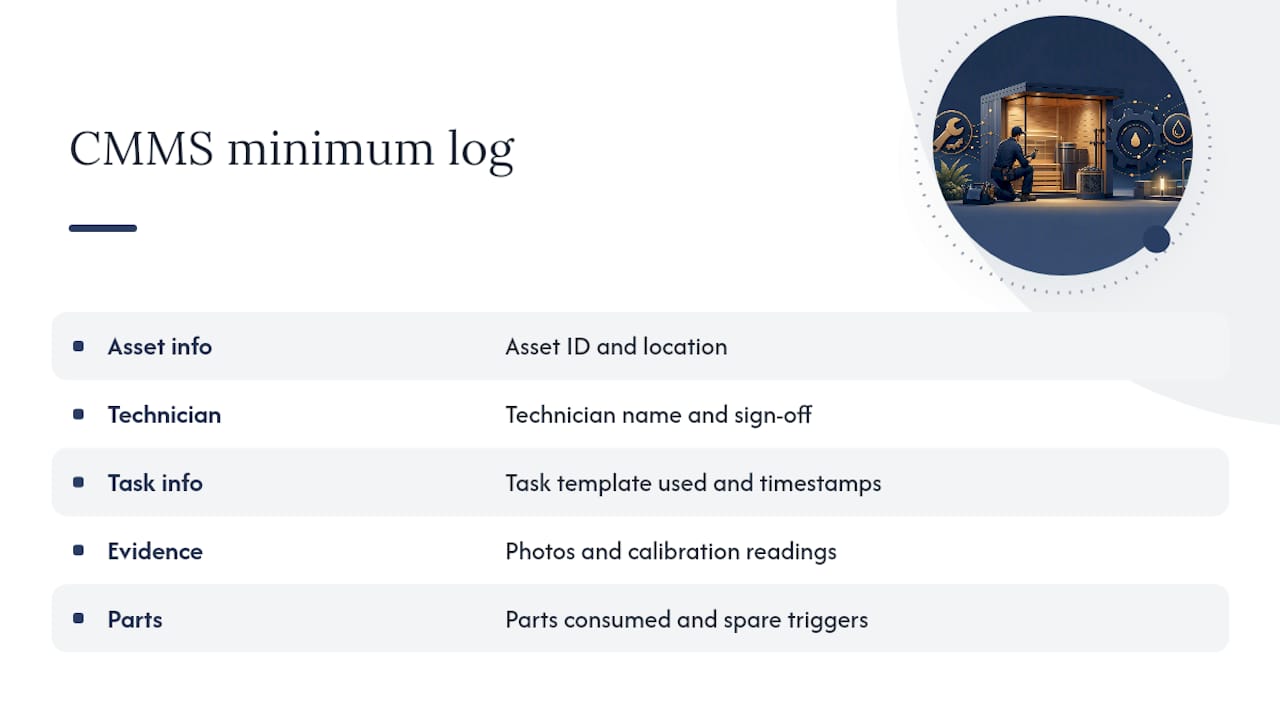
Log at minimum: asset ID and location, technician name, the task template used, photos, parts consumed, timestamps, calibration readings, and a sign-off. Some platforms go further. OxMaint notes that sensor-connected systems can flag failures 7 to 21 days before they happen, which is enough lead time to order a part instead of scrambling for one.
Pro Tip: Import a standard PM template per heater model rather than writing tasks from scratch for each unit. Consistency across templates makes cross-asset failure patterns much easier to spot.
When Should You Call a Licensed Technician?
Some failures are yours to fix. Others aren’t.
- Repeated breaker trips after a clean reset, meaning the problem isn’t the sauna, it’s the circuit.
- Any work inside the heater’s wiring compartment or on the 240V supply panel.
- A heating element that’s failed and requires internal access to replace.
- A control board that’s throwing errors your reset sequence doesn’t clear.
Emergency electrician callouts for commercial equipment typically run higher than a scheduled repair, and the room stays closed the entire time. A documented CMMS-based PM program combined with on-site spares is what keeps that cost rare instead of routine, since most of the failures that trigger an emergency call are exactly the ones weekly inspections catch early.
Sauna maintenance isn’t a side task, it’s a facility risk line
Too many operators still treat the sauna as a set-it-and-forget-it amenity instead of equipment with the same failure modes as an HVAC unit or a pool pump. A cracked rock bed or a drifting thermostat doesn’t announce itself. It shows up as a closed room, an annoyed member, and a maintenance log with nothing in it. Fold sauna PM into the same CMMS discipline you already apply to other building systems, and the room stays open.
How Sauna Heater Supply Supports Your Maintenance Program
Sauna Heater Supply gets you OEM-compatible parts and heater packages fast, so a failed element or thermostat probe doesn’t turn into a week-long closure while you wait on a backordered part.

If your current heater is aging out or you’re standardizing parts across multiple rooms, browse commercial-capable packages like the Harvia Kip45W Heater Package with WiFi controls and stones included, or the IKI Pillar 9kW for a glass-and-control setup that’s easy to service. Running steam alongside your sauna? The temperature probe compatible with iSteam, AirTempo, iTempo, and iTempoPlus controls is a common replacement part worth keeping on the shelf, not just on the reorder list. For guidance on wiring and technical questions before you buy, the Sauna Heater Supply School walks through installation basics that pair well with the maintenance steps above. Check current stock on the parts you need most and get your spares kit built out before the next failure, not after.
Sources
- Hotel Spa & Wellness Equipment Maintenance CMMS Guide
- Sauna Heater Repair Guide 2026: Common Problems, Fixes & When to Call a Pro
- FINSAUNA ClubHeat Installation Manual (2026)
- Scandia Sauna Heater Troubleshooting Guide