









Sauna Temperature Range: Safe Zones and Health Benefits
What is the ideal sauna temperature range?
The right sauna temperature range depends on the type of sauna you’re using, but the core guidelines are straightforward. Traditional Finnish saunas perform best within a high-temperature range typically between moderate to high heat levels, with the sweet spot for most users sitting comfortably hot at head height on the upper bench. Infrared saunas run considerably cooler, generally at lower temperatures that provide a gentler heat using radiant energy to warm the body directly.
The 195°F ceiling matters for a specific reason: the North American Sauna Society notes that UL Safety Standard UL 875 sets 195°F as the maximum allowable sauna temperature in the United States. Going higher does not produce better health outcomes and raises the risk of heat exhaustion and thermal injury.
Key temperature and safety essentials at a glance:
- Traditional Finnish sauna: operates within a moderate to high temperature range suitable for deep heat exposure
- Infrared sauna: uses lower temperature levels and gentler heat over longer sessions
- Steam room: features moderate heat combined with very high humidity
- Beginners: should start at a lower, more comfortable temperature for short periods before progressing
- Session duration: typical sessions last a safe moderate time with breaks
- Exit cues: dizziness, nausea, or racing heart are signs to end the session
- Hydration: drinking water before and after is important; alcohol should be avoided
- Humidity: low humidity in dry saunas; adding water to stones increases perceived heat without changing thermostat temperature
Table of Contents
- How temperature settings vary by sauna type
- What the science says about sauna temperatures and health
- Safety guidelines for getting sauna temperatures right
- How humidity changes what you feel in the sauna
- Choosing a sauna heater that holds the right temperature
- Ready to build a sauna that hits the right temperature every time?
- Key Takeaways
How temperature settings vary by sauna type
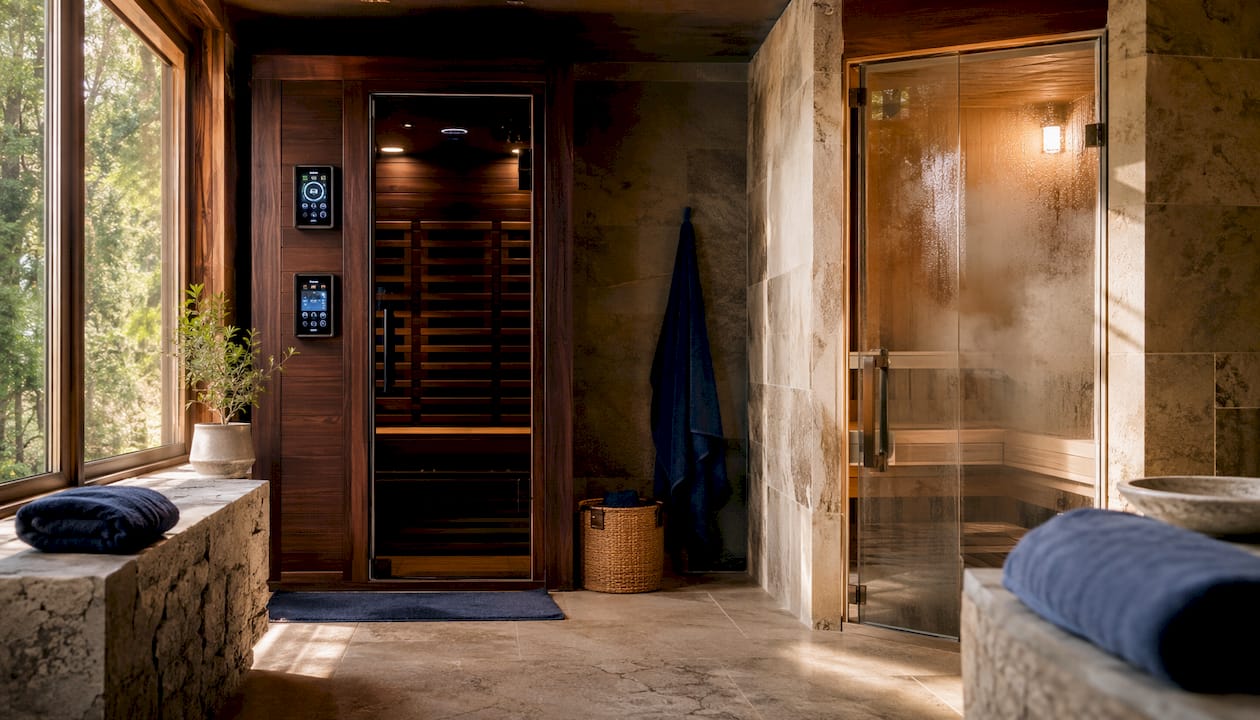
Not all saunas heat the same way, and the differences in temperature and humidity between types are significant enough to affect both comfort and safety planning.
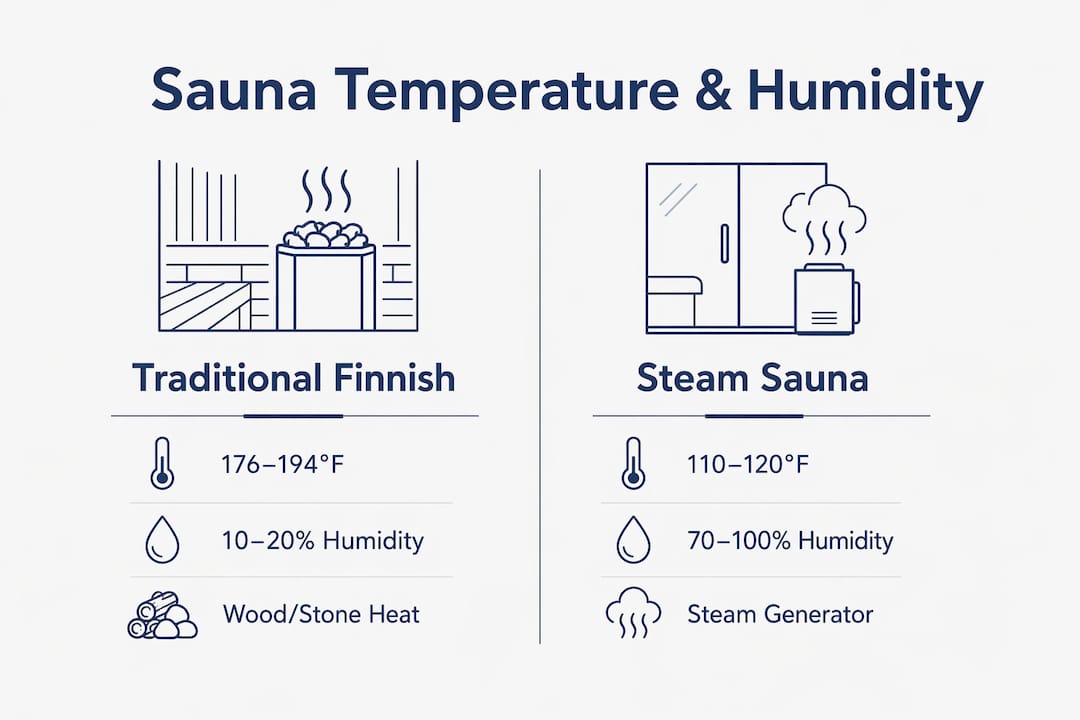
| Sauna Type | Air Temperature | Humidity | Primary Heat Source |
|---|---|---|---|
| Traditional Finnish | High temperature range typical of dry heat saunas | Low humidity typical of dry environments | Heated stones / electric or wood-fired heater |
| Infrared | Lower temperatures to provide radiant heat | Low ambient humidity | Infrared radiant panels |
| Steam Room | Moderate temperatures paired with full humidity | Very high humidity near saturation | Steam generator |
| Soft Sauna / Bio Sauna | Moderate temperatures with controlled humidity | Moderate humidity levels | Electric heater with humidity control |
One detail that surprises many first-time sauna owners: the thermostat reading and the temperature you actually experience are not the same number. Temperature stratifies significantly inside a sauna room. Air temperature varies within the sauna, generally higher near the ceiling than at lower bench levels, causing thermostats placed high to overstate the temperature experienced by a user sitting on the bench. The number that matters is what you feel at head height when seated on the upper bench.
Sauna type heat profiles:
- Traditional Finnish: High dry heat, low humidity; the classic Scandinavian experience. Löyly (water poured on stones) temporarily spikes perceived heat.
- Infrared: Penetrates tissue directly at lower air temperatures; popular for users who find high heat uncomfortable. Sessions often run 30–45 minutes.
- Steam room: The combination of 100% humidity and moderate heat creates an intense perceived temperature well above what the thermometer shows.
- Soft/bio sauna: A middle ground between Finnish and steam; common in European spa facilities and increasingly available for home installation.
Pro Tip: If you’re reading the thermostat near the ceiling and planning your session around that number, subtract 10–15°F to get a realistic sense of what you’re actually sitting in.
What the science says about sauna temperatures and health
The health case for regular sauna use is grounded in well-documented Finnish research, not wellness marketing. The Kuopio Ischemic Heart Disease (KIHD) study, one of the most cited bodies of sauna research, found the strongest cardiovascular benefits among participants who used a sauna 3–7 times weekly at approximately 176–194°F, with sessions averaging around 14 minutes. Participants in that cohort averaged a thermostat temperature of 79°C (176°F).

Cardiologist and sauna researcher Dr. Jari Laukkanen, whose work has been published in journals including the American Journal of Cardiology, has consistently linked regular sauna bathing to reduced risk of cardiovascular disease, sudden cardiac death, and all-cause mortality. His research points to the physiological load of heat exposure, specifically the rise in core body temperature and the resulting cardiovascular response, as the mechanism behind these benefits.
What the research does not support is the idea that hotter is better. Exceeding 195°F does not amplify health benefits; it shortens the time you can safely stay in the sauna and increases the risk of heat exhaustion. The physiological responses that drive benefit, including heart rate elevation, core temperature rise, and heat shock protein activation, occur reliably within the 176–194°F range. Pushing past that threshold adds stress without adding reward.
Heat shock proteins (HSPs) are worth understanding here. These cellular repair proteins activate in response to thermal stress and play a role in muscle recovery, cellular protection, and metabolic function. They respond to the heat load itself, not to extreme temperatures, so a well-executed session at 180°F activates them just as effectively as one at 210°F, with far less physiological risk.
Alternating heat and cold exposures during a sauna session, rather than sitting through one long continuous stretch, optimizes both cardiovascular benefit and safety by preventing core body temperature from climbing too high. Short rounds of 15–20 minutes followed by a cooling phase represent the protocol most consistent with the research evidence.
Safety guidelines for getting sauna temperatures right
Understanding the recommended heat levels is one thing; applying them safely is another. These guidelines are grounded in physiology, not caution for its own sake.
Recommended session structure:
- Beginners: Start at 150–160°F for 5–10 minutes per round. Give your body two to four sessions before increasing temperature or duration.
- Experienced users: 15–20 minutes per round at 176–194°F, with cooling breaks between rounds.
- Maximum temperature: Do not exceed 195°F regardless of heater type; this is both the UL safety limit and the physiological ceiling where risk outpaces benefit.
- Cooling breaks: Step out, cool down with a shower or cool air, and rest for at least 5–10 minutes between rounds.
Key safety practices:
- Drink 16–24 oz of water before your session; rehydrate immediately after
- Avoid alcohol before or during sauna use; it impairs the body’s ability to regulate heat
- Never use a sauna alone if you are new to it or have a cardiovascular condition
- Sit on the lower bench if the heat feels too intense; the temperature difference between benches is real and significant
- Proper ventilation is not optional: intake vents should sit low near the heater, with exhaust vents high on the opposite wall to prevent oxygen depletion and dangerous hot-air stratification
- Listen to your body above all else; dizziness, nausea, or chest discomfort are exit signals, not challenges to push through
Pro Tip: A sauna thermometer placed at bench height gives you the actual temperature you’re experiencing, not the ceiling reading. It’s a small investment that makes session planning far more accurate.
Gradual acclimatization matters more than most people expect. The body’s heat tolerance improves meaningfully over the first several sessions. Trying to match an experienced bather’s temperature settings on your first visit is one of the most common mistakes beginners make.
How humidity changes what you feel in the sauna
Air temperature alone does not tell the full story of how hot a sauna feels. Humidity plays a direct role in heat transfer to the skin, and understanding that relationship helps you manage your sessions more precisely.
A traditional dry Finnish sauna runs at 10–20% relative humidity. At that level, sweat evaporates quickly, which keeps the skin cooler than the air temperature suggests. A steam room at 100% humidity and 115°F can feel far more intense than a dry sauna at 160°F, because sweat cannot evaporate and the body loses its primary cooling mechanism.
The practice of pouring water on heated stones, called löyly in Finnish, temporarily raises humidity and dramatically increases the heat you feel on your skin. Adding water to sauna stones increases heat transfer to the body without changing the thermostat reading at all. That’s why a sauna at 170°F with regular löyly can feel more demanding than one at 185°F with no steam.
Humidity’s practical effects:
- At 10–20% humidity, the air feels breathable and dry; most users can tolerate higher temperatures
- At 30–40% humidity, perceived heat increases noticeably; session duration may need to shorten
- At 60%+ humidity, even moderate temperatures feel intense; this is the bio sauna range
- At 100% humidity (steam room), the body’s cooling capacity is nearly eliminated
The Rule of 200 offers a practical way to stay in a safe zone: add the air temperature in °F to the relative humidity percentage. The total should not exceed 200. A sauna at 180°F and 15% humidity scores 195, which is within range. The same sauna with humidity pushed to 30% scores 210, which crosses the threshold.
Excessive humidity combined with high heat is where heat exhaustion risk climbs fastest. If you’re adding löyly frequently, lower the target air temperature to compensate.
Choosing a sauna heater that holds the right temperature
Getting the temperature right starts with having a heater that can actually reach and hold your target range for the size of your space. Undersized heaters struggle to hit 176°F in a large room; oversized ones can push temperatures past safe limits before you’ve had time to settle in.
Heater types and their temperature characteristics:
- Electric heaters: The most controllable option for home installations. Built-in thermostats and timers let you set precise target temperatures and preheat the sauna before you step in. Models like the Harvia Cilindro Half Series 9kW include integrated time and temperature controls that make hitting the 176–194°F sweet spot repeatable.
- Wood-fired heaters: Capable of reaching very high temperatures, which makes sizing and monitoring especially important. They produce a distinctive radiant heat and support traditional löyly practice well. The Harvia Legend 240 GreenFlame is a well-regarded option for outdoor and cabin saunas where wood firing is practical.
- Gas heaters: Less common in residential settings but useful where electricity costs are high or the installation is remote. They heat quickly and hold temperature well in larger rooms.
Heater selection criteria for temperature control:
- Room volume: Calculate cubic footage (length × width × height) and match heater output accordingly; a general rule is 1 kW per 45 cubic feet for insulated rooms
- Insulation quality: Poor insulation forces the heater to work harder and makes temperature stability difficult
- Stone capacity: More stones mean better heat retention and more consistent temperature after löyly
- Control features: Digital thermostats and timers allow precise temperature settings and prevent overshooting
- Safety certifications: Look for UL-listed heaters, which are tested to the 195°F maximum standard required in the United States
Proper heater sizing ensures your target temperature range is consistently met without the heater cycling on and off excessively or the room overshooting into unsafe territory. Saunaheatersupply carries electric, wood-fired, and gas heater options across a range of capacities, with expert guidance available to match the right unit to your room dimensions and usage goals.
For commercial installations or larger home saunas, a higher-output electric unit like the Harvia Virta Series 10.5kW provides the consistent output needed to maintain target temperatures across longer operating periods.
Ready to build a sauna that hits the right temperature every time?

Getting the temperature right starts with the right heater. Saunaheatersupply offers a curated selection of electric, wood-fired, and gas sauna heaters sized for every room, from compact home saunas to full commercial installations. Every product is matched to UL safety standards, and the team provides personalized guidance to help you select the heater that fits your space and your goals.
Browse the full range at Saunaheatersupply and find the heater that keeps your sessions in the optimal zone, session after session.
Key Takeaways
The most effective sauna protocol combines a temperature in the 176–194°F range for traditional saunas, sessions of 15–20 minutes with cooling breaks, and a properly sized heater that holds the target temperature reliably.
| Point | Details |
|---|---|
| Traditional sauna range | 150–195°F is the safe operating range; 176–194°F at head height is the optimal zone. |
| (Note: Ensure all references to the optimal zone are consistently stated as 176–194°F. If any part of the text mentions a figure like ‘174°F’ or ‘around 174°F’ for the optimal or average zone, update it to 176–194°F.) | |
| Infrared sauna range | 110–140°F using radiant heat; supports longer, gentler sessions than traditional saunas. |
| Temperature vs. humidity | The Rule of 200 (temperature °F + humidity %) should not exceed 200 for safe heat exposure. |
| Session structure | 15–20 minutes per round with cooling breaks optimizes cardiovascular benefit and safety. |
| Heater sizing matters | Match heater output to room volume to hold target temperatures without overshooting. |