









Best Outdoor Sauna Kits for U.S. Homeowners: Picks and Advice
For most U.S. homeowners, the best outdoor sauna kits are weather-rated prefab cube/cabin models and thermowood barrel saunas paired with a correctly sized electric heater. If you have a compact yard and want fast assembly, a thermowood barrel like the Finnmark Thermo-Aspen Combination Barrel Sauna FD-7 is the most practical choice. For families or small groups who want better heat retention and a more spacious interior, a prefab cube cabin such as the SaunaLife Model G11 fits the bill. Buyers who want the fastest possible setup should look at modular plug-and-play kits that connect to a 220V/30A outlet and assemble in under two hours.
Quick TL;DR:
- Best for small yards: Thermowood or cedar barrel sauna (compact footprint, efficient airflow, 2–4 person capacity, wood-fired or electric heater compatible)
- Best for groups/family: Prefab cube or cabin kit (superior heat retention, larger bench capacity, pairs well with a 9–15 kW electric heater)
- Best quick-assembly/plug-and-play: Modular prefab cube-cabin kits that assemble in under two hours, such as the SaunaLife Model CL5G, priced at approximately $5,990.
Top picks at a glance:
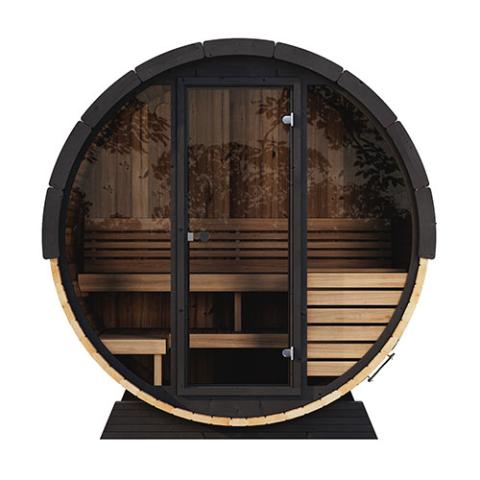
- Finnmark Thermo-Aspen Combination Barrel Sauna FD-7 — Thermowood barrel with combination heater compatibility; ideal for wet and cold climates. Mid-range price band.
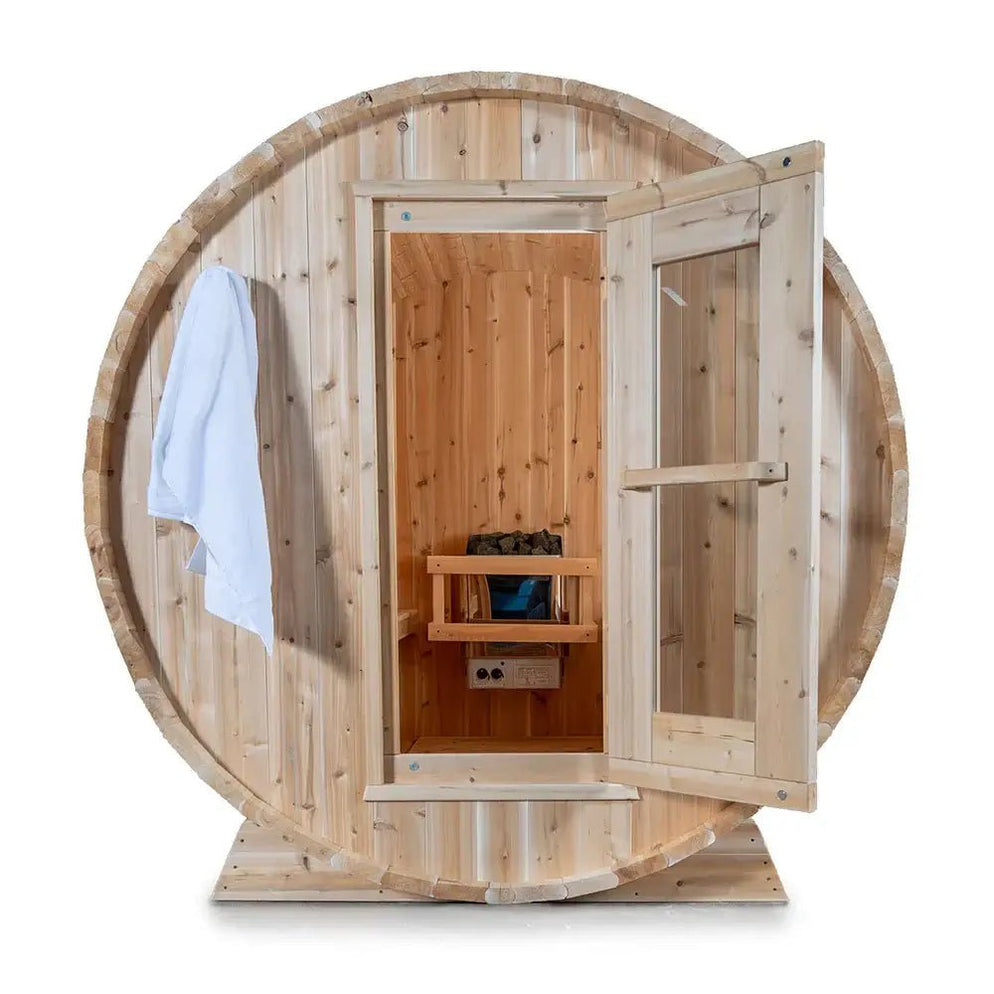
- Finnmark Cedar Combination Barrel Sauna FD-6 — Western Red Cedar barrel with classic aesthetics and natural rot resistance. Mid-range price band.
- SaunaLife Model G11 — Large prefab cabin kit for families; pairs with a 9–15 kW electric heater. Upper-mid price band.
- SaunaLife Model CL5G — Cube-cabin style with strong heat retention; one of the top-selling cube models on the market at approximately $5,990.
Table of Contents
- How do you choose the right outdoor sauna kit?
- What are the main outdoor sauna kit types, and which fits your yard?
- What heater do you need, and what are the electrical requirements?
- Which wood and construction choices matter most for outdoor durability?
- What should you budget, and how long does installation take?
- What design mistakes should you avoid when buying a kit?
- Which models does Saunaheatersupply recommend?
- How do you maintain an outdoor sauna kit and what should the warranty cover?
- What seller experience tells you about common install delays
- Key Takeaways
- What most buyers get wrong about outdoor sauna kits
- Saunaheatersupply has the heaters, kits, and expertise to get you started
- Useful sources for technical specs and installation planning
How do you choose the right outdoor sauna kit?
The single most important decision is kit type mapped to your installation readiness. Prefab kits deliver faster installation with large pre-built panels, while pre-cut or custom kits require more carpentry skill but integrate precisely into existing structures like sheds or garages. Before you look at aesthetics or price, answer this: can you manage a two-person panel assembly, or do you need a contractor?
Once you know your installation capacity, work through these site factors in order:
- Footprint and drainage: The sauna must sit on a level, well-drained surface. An outdoor sauna foundation should be level within 1/8 inch over 10 feet; anything beyond that causes door misalignment and heat loss.
- Access: Delivery trucks need clearance. Confirm your driveway and gate width before ordering a palletized kit.
- Local climate: Wet and cold climates demand rot-resistant wood (Western Red Cedar or Thermowood) and a vapor barrier. Hot-humid climates need strong ventilation design.
- Heater compatibility: Confirm the kit’s cubic footage and match it to the heater’s kW rating before purchase.
- Future maintenance costs: Cheaper wood species and thinner walls cost less upfront but require more frequent sealing and repair.
Budget breakdown by price band:
- $1,500–$4,000: Budget infrared or small barrel kits, typically kit-only with no heater included
- $4,000–$8,000: Quality barrel kits with heater compatibility; this range covers most mid-size outdoor barrel and small cabin options
- $10,000–$30,000: Custom traditional builds, fully installed, including foundation, electrical, and professional labor
Some U.S. buyers reduce out-of-pocket cost through HSA/FSA programs like TrueMed for qualified wellness installs, or through financing programs such as Bread® that offer split payments over 12–36 months with no origination fee in many cases.
Questions to ask the seller before you buy:
- What is the wall thickness, and does the kit include a vapor barrier?
- What are the wiring specs and required breaker size for the included or recommended heater?
- What is the shipping lead time, and what components are included versus sold separately?
- Does the kit include roofing material, or is that a separate purchase?
Pro Tip: Schedule your electrical inspection and foundation pour before the kit ships. The most common installation delay is an unprepared site — not the kit itself.
What are the main outdoor sauna kit types, and which fits your yard?
Three kit categories dominate the market: barrel saunas for compact yards and efficient heating, cube/cabin prefab kits for larger groups and better heat retention, and pre-cut or custom kits for buyers who need a precise architectural fit. Cube-cabin and barrel styles lead the outdoor sauna kit market, with each serving a distinct buyer profile.
| Kit Type | Best For | Material Tendencies | Heat Efficiency | DIY Difficulty | Typical Assembly Time |
|---|---|---|---|---|---|
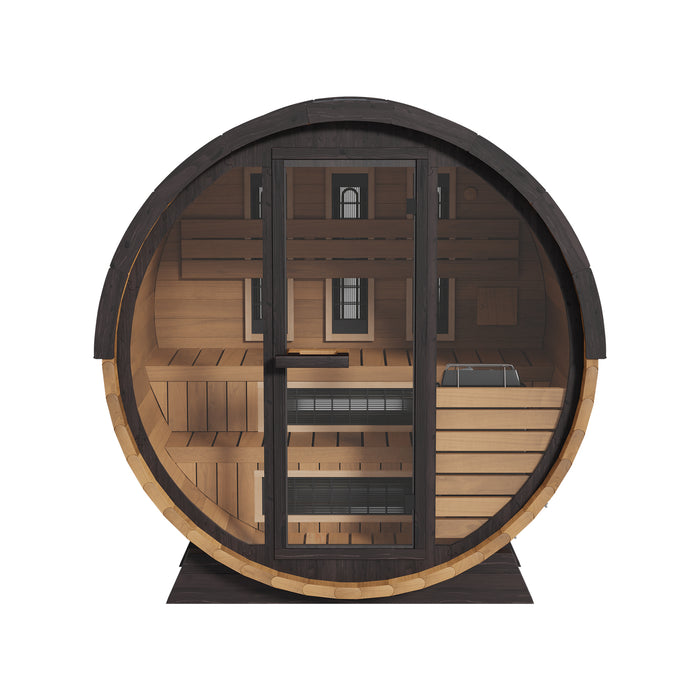
| Barrel | Small yards, 2–4 people, visual charm | Cedar, Thermowood | High (round shape retains heat well) | Easy | 4–8 hours |
| Cube/Cabin Prefab | Groups, families, year-round use | Cedar, Thermowood, Spruce | Very high (insulated panels) | Easy–Medium | 4–12 hours |
| Pre-Cut/Custom | Existing structure integration, odd footprints | Any species | Varies by build quality | Hard | 1–3 days |
Barrel saunas
- Compact footprint fits tight yards and decks
- Round shape promotes natural airflow and even heat distribution
- Limited bench space compared to cabin styles; typically seats 2–4 people
- Easier to assemble than a full cabin; most two-person kits go up in a single day
- Less wall insulation than a prefab cabin, which can mean slightly longer heat-up times in very cold climates
Cube/cabin prefab kits
- Superior heat retention due to thicker, insulated wall panels
- Larger interior accommodates 4–8 people with tiered bench layouts
- Window options add natural light without sacrificing thermal performance
- Assembly requires two people and basic carpentry tools; most kits include pre-drilled components
- Higher upfront cost, but lower long-term heating costs per session
Pre-cut/custom kits
- Best when the sauna must fit inside an existing shed, garage, or unusual footprint
- Requires framing, insulation, and paneling from scratch; not recommended for first-time DIY builders
- Allows full control over bench layout, door placement, and wood species
- Prefab kits offer the fastest, most predictable installation timeline; pre-cut kits are better when the sauna must integrate with existing architecture
What heater do you need, and what are the electrical requirements?
Sizing rule: match heater output in kilowatts to sauna volume. A general starting point is 1 kW per 45 cubic feet of sauna space, though insulation quality and ceiling height affect this.
Sizing examples by sauna size:
- Small barrel (2-person, ~150 cubic feet): 3–4.5 kW electric heater or a small wood-burning stove
- Mid-size cabin (4-person, ~250 cubic feet): 6–9 kW electric heater
- Large cabin (6–8 person, ~400+ cubic feet): 9–15 kW electric heater
Most full-size electric sauna heaters in the U.S. require a dedicated 240V circuit. Failing to plan this electrical work is the most common source of install delay. Smaller modular kits can run on a 220V/30A outlet, which some homeowners already have in their garage or on their back patio. Infrared kits are the exception: most plug into a standard 120V/20A outlet with no special wiring needed.
For traditional sauna electrical requirements, the typical checklist includes:
- Dedicated breaker sized to the heater’s amperage draw
- Correct wire gauge (typically 6 AWG or 8 AWG for 240V circuits)
- Conduit rated for outdoor or wet-location use
- GFCI protection where local code requires it for outdoor installations
- Permit pulled before rough-in inspection
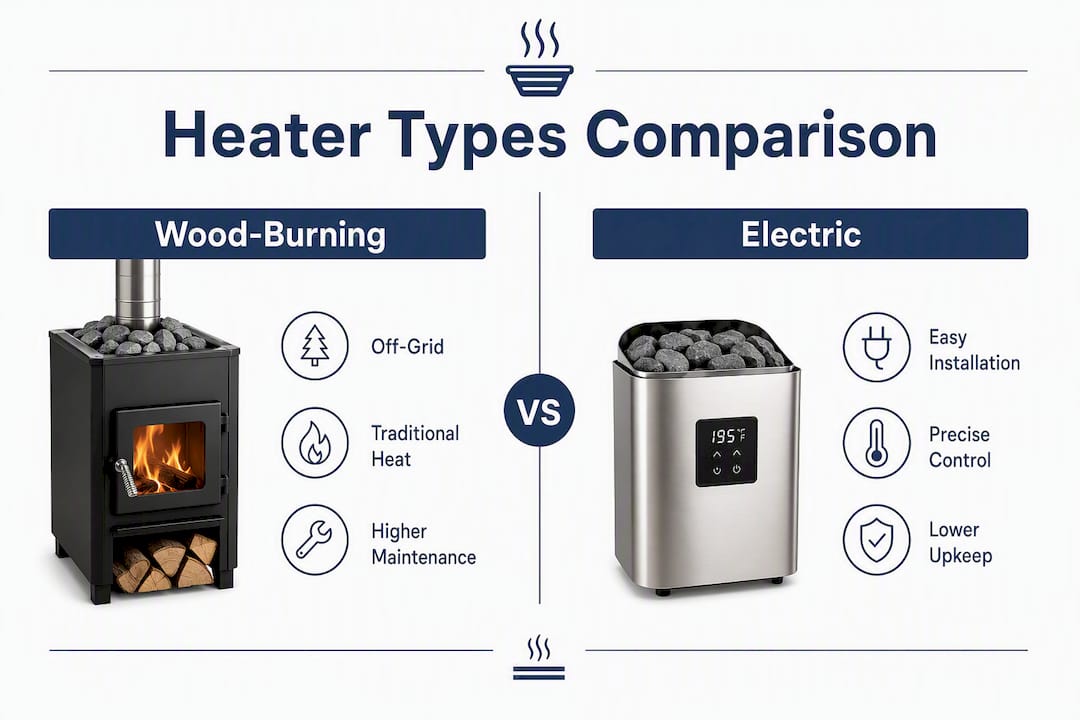
Wood-burning stoves are a strong option for buyers who prefer off-grid operation or want the traditional löyly experience. They require a chimney or thru-wall flue, local burn permits in many jurisdictions, dry fuel storage nearby, and a non-combustible hearth pad. Ventilation design is also different: wood stoves need a fresh-air intake low on the wall and an adjustable vent near the ceiling. The Cozy Heat SW Thru-Wall 18 Sauna Stove is a practical option for buyers going this route, with a thru-wall design that simplifies chimney routing.
For a full breakdown of wood-burning vs. electric heater trade-offs, Saunaheatersupply’s resource library covers both options in detail.
Pro Tip: Place the heater guard rail at the manufacturer’s specified clearance distance, and position the temperature probe at bench height — not near the ceiling — for accurate readings that protect both the heater and the occupants.
Which wood and construction choices matter most for outdoor durability?
Choose your wood species based on your local climate first, budget second. Western Red Cedar and Thermowood are the two most durable choices for outdoor installations in wet, cold, or high-humidity environments. Wood choice matters more than sticker price for long-term satisfaction, and selecting the wrong species for your climate is one of the most expensive mistakes a buyer can make.
Wood species comparison:
- Western Red Cedar: Naturally rot-resistant, dimensionally stable through moisture cycles, and carries a pleasant aromatic scent. It costs more than spruce or aspen but requires less maintenance over time. Best for wet Pacific Northwest climates and cold northern states.
- Thermowood (thermally modified wood): Heat-treated to remove moisture and sugars, making it highly resistant to rot, warping, and insect damage. Odor-neutral, which some buyers prefer. Slightly more expensive than cedar but performs exceptionally well in freeze-thaw climates.
- Aspen/Spruce: Low resin content makes aspen ideal for interior bench surfaces because it stays cool to the touch. Spruce is affordable and widely available but less rot-resistant than cedar or Thermowood when exposed to outdoor moisture. Best used for interior components rather than exterior cladding.
| U.S. Climate | Recommended Exterior Wood | Interior Bench Wood | Key Maintenance Note |
|---|---|---|---|
| Wet/Temperate (Pacific NW) | Western Red Cedar | Aspen | Seal annually; check roof flashing each spring |
| Cold/Freeze-Thaw (Midwest, Northeast) | Thermowood | Aspen or Cedar | Inspect caulking after first winter; re-seal every 2 years |
| Hot-Humid (Southeast, Gulf Coast) | Thermowood or Cedar | Aspen | Prioritize ventilation design; check for mold annually |
| Dry/Hot (Southwest) | Cedar or Spruce | Aspen | UV-protective finish recommended; less rot risk |
Maintenance callouts:
- Apply a UV-protective exterior oil or sealant to cedar every 12–24 months depending on sun and rain exposure
- Inspect roof overhangs and flashing each spring; a short overhang is the leading cause of premature wall rot
- Thermowood requires less frequent sealing than untreated cedar but still benefits from a light oil finish every two years
- Interior bench wood should never be sealed or painted; keep it bare for safe skin contact at high temperatures
What should you budget, and how long does installation take?
Site preparation and electrical work are the two cost and time drivers that most buyers underestimate. The kit price is only part of the total investment.
Sample timeline from delivery to first burn:
- Day 1: Kit delivery, inspection for shipping damage, and staging near the installation site
- Days 1–3: Foundation or base preparation (gravel pad, concrete pavers, or deck framing)
- Days 2–4: Kit assembly (1–2 days for prefab barrel or cabin; up to 3 days for pre-cut custom)
- Days 3–7: Electrician rough-in and inspection (schedule this before delivery if possible)
- Day 7–10: Final connections, heater installation, and first heat cycle
Price-range bullets:
- Kit only (no heater): $4,000–$8,000 for quality barrel and mid-size cabin kits
- Kit plus heater: Add $800–$3,000 depending on kW rating and brand
- Professional installation (labor only): $1,500–$5,000 depending on foundation type and electrical complexity
- Full custom build, installed: $10,000–$30,000
The biggest cost jumps come from poured concrete foundations (versus gravel pads), hardwired 240V electrical versus plug-in configurations, and permit fees that vary by municipality.
Permit checklist:
- Structural permit: required in most U.S. jurisdictions for any permanent outdoor structure over a certain square footage (check local building department thresholds)
- Electrical permit: required for any new 240V circuit; always pull this before the electrician starts
- HOA approval: required in many communities before any backyard structure is installed
- Chimney/burn permit: required for wood-burning stoves in many counties and air-quality districts
Delivery and logistics notes:
- Outdoor sauna kits typically ship on a freight pallet; confirm your delivery address has forklift or liftgate access
- Inspect every panel and component against the packing list before signing the delivery receipt
- Stage components in a dry, covered area if assembly cannot begin immediately after delivery
- Manufacturer installation guides specify framing tolerances, vapor barrier placement, and drainage requirements that affect warranty validity
What design mistakes should you avoid when buying a kit?
Poor roof design, missing vapor barriers, inadequate drainage, and thin walls are the four most common failures that reduce performance and lead to costly repairs. Catching these issues before purchase is far easier than fixing them after assembly.
Red-flags checklist for product specs and photos:
- Wall thickness under 38mm (1.5 inches) for an outdoor installation signals poor insulation and faster heat loss
- No mention of a vapor barrier in the kit specs or installation manual
- Flat or low-pitch roof without a meaningful overhang (at least 12 inches on each side)
- Unspecified or low-grade wood with no species name listed in the product description
- Floor described as “wood decking” with no drainage provision or non-absorbent surface option
- No heater guard rail included or specified
Before-you-buy questions to ask the vendor:
- “Can you send me the wall section detail showing insulation and vapor barrier layers?”
- “What is the roof pitch, and how much overhang does the kit include?”
- “What wood grade and species is used for the exterior cladding versus interior panels?”
- “Is the floor system designed for drainage, and what surface is recommended under the sauna?”
Common issues and typical remedies:
Buyers who skip the vapor barrier often discover condensation damage inside the wall cavity within the first two winters. Retrofitting a vapor barrier after assembly requires partial disassembly and typically costs several hundred dollars in labor. Thin-wall kits that perform adequately in mild climates frequently struggle to hold temperature in cold northern winters, leading buyers to overwork the heater and shorten its service life. A proper foil vapor barrier installed during assembly is one of the highest-value steps in any outdoor sauna kit build, particularly in climates with significant humidity swings.
Drainage is the other frequent oversight. Installations on untreated wood or gravel without a managed drain plan risk premature base rot. A non-absorbent base (concrete pavers, composite decking, or a poured slab with a center drain) adds modest upfront cost but protects the structure’s floor framing for the life of the sauna.
Which models does Saunaheatersupply recommend?
Three buyer profiles cover the majority of outdoor sauna purchases: couples or solo users who want a compact, efficient setup; families or small groups who need more bench space and stronger heat output; and buyers who prioritize the fastest possible assembly with minimal site prep.
Compact and efficient: couples and solo users
The Finnmark Thermo-Aspen Combination Barrel Sauna FD-7 is built from thermally modified aspen, combining the rot resistance of Thermowood with the low-resin, skin-friendly properties of aspen interior surfaces. It supports both electric and wood-fired heater configurations, making it one of the more flexible barrel options on the market. For buyers who prefer classic cedar aesthetics, the Finnmark Cedar Combination Barrel Sauna FD-6 delivers natural rot resistance and the familiar cedar scent in the same barrel format.
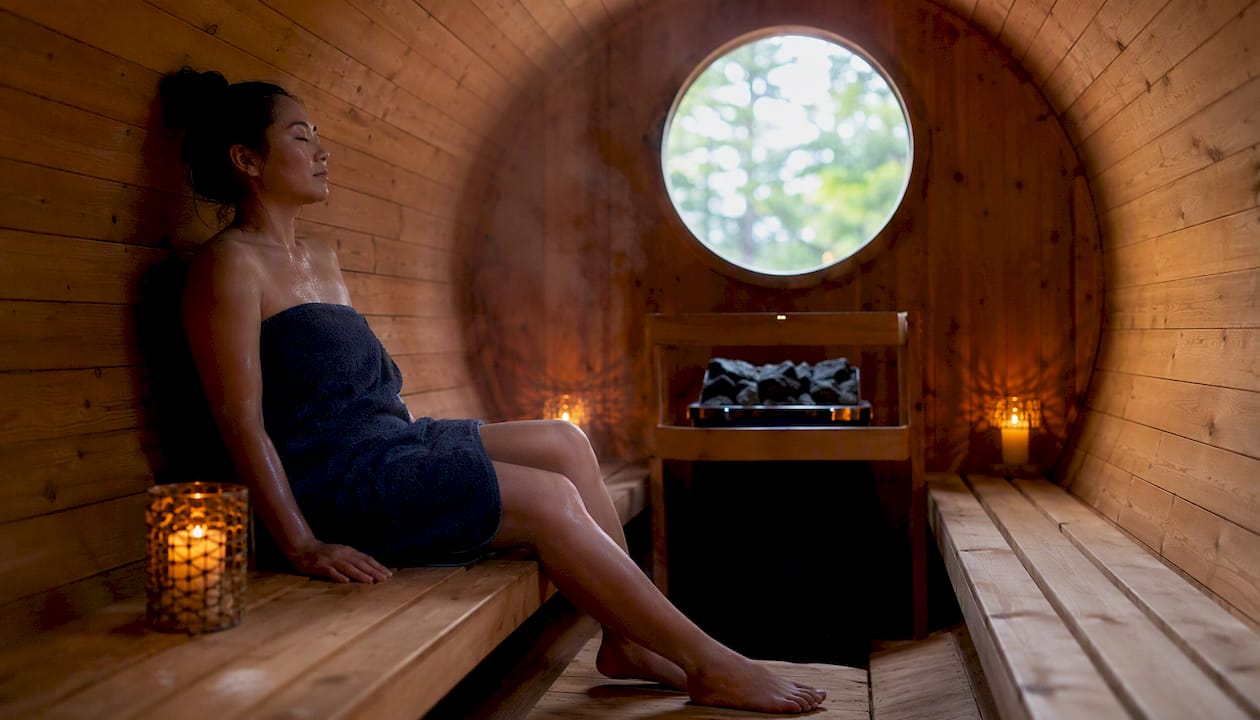
Heater pairing: The Saunum Air 7 Sauna Heater Package is a well-matched electric option for smaller barrel volumes, with a compact footprint and straightforward controls. For precise temperature monitoring, pair it with the Temperature Probe for iSteam, AirTempo, iTempo, and iTempoPlus Controls to get accurate bench-height readings.
Installation readiness: Level gravel pad or concrete pavers; 240V dedicated circuit for electric heater; two-person assembly in 4–8 hours.
Family and small group: maximum capacity and heat retention
The SaunaLife Model G11 is a large prefab cabin kit built for multi-person use, with tiered bench capacity and panel construction that holds heat efficiently even in cold climates. For buyers who want a slightly smaller cabin footprint, the SaunaLife Model G3 offers a more compact cabin profile with the same prefab assembly advantages.

Heater pairings: The IKI Pillar 9kW with WiFi Controller Glass is a strong match for mid-to-large cabin volumes, with WiFi control for remote preheat. For larger interiors, the Saunum Air L 15 Package delivers 15 kW of output with Saunum’s air equalization technology for even heat distribution. Buyers who want steam integration can add the iSteamX Steam Shower Control and Steamhead for a combined sauna and steam experience.
Installation readiness: Concrete pad or reinforced deck; dedicated 240V circuit with correct breaker sizing; two-person assembly over one to two days.
Quick assembly: plug-and-play priority
The SaunaLife Model CL5G is one of the top-selling cube-cabin models on the market, priced at approximately $5,990, and designed for straightforward panel assembly. For buyers who want a proven heater pairing with WiFi control and a complete package, the Harvia Kip45W Heater Package WiFi with Stones is a popular choice that ships with sauna stones and a WiFi-enabled controller for remote operation.
Installation readiness: Level surface required; 220V/30A outlet or dedicated 240V circuit depending on heater choice; two-person assembly in 4–8 hours.
How do you maintain an outdoor sauna kit and what should the warranty cover?
Simple seasonal checks extend the life of any outdoor sauna kit significantly. The structure, heater, and wood surfaces each have their own maintenance cadence, and staying on top of all three prevents the kind of compounding damage that leads to expensive repairs.
Maintenance schedule:
- After each use: Wipe down bench surfaces, leave the door slightly ajar to allow moisture to escape, and remove any water pooled on the floor
- Monthly: Check heater stones for cracks or excessive mineral buildup; replace cracked stones promptly to protect the heating element
- Annually (spring): Inspect exterior wood for cracking, checking roof flashing and overhang condition; re-apply exterior sealant or oil if the surface has dulled or started to gray
- Annually (fall): Inspect door seals and hinges; check floor framing for any signs of moisture intrusion or soft spots; confirm vapor barrier integrity at wall penetrations
- Every 2–3 years: Full heater service check, including element inspection, thermostat calibration, and wiring connections; replace sauna stones if they have degraded significantly
Warranty checklist — what a solid kit warranty should include:
- Structural warranty covering woodwork and panel integrity for at least 1–2 years
- Heater warranty covering parts and labor for a minimum of 2–3 years (many quality brands offer 5 years)
- Delivery damage policy: the vendor should accept freight damage claims when reported within a specified window after delivery
- Clear exclusions: most warranties void for improper electrical installation or failure to follow the vapor barrier and drainage instructions
When to call support versus DIY:
Contact the vendor or a licensed electrician for any issue involving the heater’s wiring, a tripped breaker that does not reset, or a control panel error code. Wood surface repairs (sanding, re-oiling, replacing a cracked bench board) are straightforward DIY tasks. Door alignment issues caused by a settling foundation require leveling the base before adjusting the door hardware.
What seller experience tells you about common install delays
The most frequent project delay is a missing electrical circuit or an out-of-level foundation discovered after the kit arrives. Both are avoidable with a short pre-delivery checklist.
Actionable planning tips from seller experience:
- Inspect the delivery immediately and photograph any shipping damage before the freight driver leaves; claims filed after the driver departs are significantly harder to process
- Pre-book a licensed electrician at least two weeks before your expected delivery date; electricians with sauna experience are booked quickly, especially in spring and summer
- Reserve a flat, covered staging area near the install site so panels stay dry if assembly is delayed by weather
- Confirm heater specs with the vendor before ordering: voltage, amperage, and required breaker size must match your planned electrical circuit exactly
- Request the full installation manual and spec sheet at purchase, not after delivery; reviewing it in advance surfaces questions while there is still time to adjust the order
Build quality and heater compatibility determine long-term value more than initial price, a point reinforced consistently by third-party editorial testing. Buyers who focus exclusively on the lowest kit price often discover that a thin-wall kit with an undersized heater costs more to operate and maintain over three to five years than a mid-range kit with a properly matched heater would have from the start.
A realistic timing buffer of two to three weeks between kit delivery and first use accounts for foundation curing, electrician scheduling, and the inevitable small adjustments during assembly. Planning for that buffer removes most of the frustration from the process.
Key Takeaways
The best outdoor sauna kit combines the right kit type for your installation readiness, a heater sized to your sauna’s cubic footage, and a wood species matched to your local climate.
| Point | Details |
|---|---|
| Match kit type to installation readiness | Prefab barrel and cube/cabin kits assemble in 4–12 hours; pre-cut custom kits suit existing structures but require carpentry skill. |
| Size the heater to sauna volume | Use approximately 1 kW per 45 cubic feet; most full-size electric heaters require a dedicated 240V circuit. |
| Secure electrical and foundation first | An out-of-level foundation and an unprepared electrical circuit are the two most common causes of installation delays. |
| Choose wood for your climate | Western Red Cedar and Thermowood outperform spruce in wet, cold, and freeze-thaw climates; aspen is best for interior bench surfaces. |
| Verify warranty and delivery terms | A solid kit warranty covers woodwork, heater compatibility, and freight damage; confirm the claim window before signing the delivery receipt. |
| Saunaheatersupply for curated heater pairings | Saunaheatersupply carries matched heater packages (Harvia, IKI, Saunum) and controls for every kit type, with expert guidance to confirm specs before you order. |
What most buyers get wrong about outdoor sauna kits
The conventional wisdom says to buy the biggest kit your budget allows. That advice is wrong for most U.S. homeowners, and it leads to the most common buyer regret: a sauna that is too large for the heater, too heavy for the deck, or too complex for a DIY install.
The smarter frame is to start with your electrical situation and your foundation options, then work backward to the kit. A 6-person cabin sauna sounds appealing, but if your property does not have a 240V circuit within reasonable conduit distance of the install site, you are looking at a significant electrical upgrade before the sauna even heats up for the first time. A 4-person barrel with an appropriately sized heater on an existing 220V/30A circuit is a faster, cheaper, and more satisfying project for most homeowners.
The other underestimated factor is wood species. Buyers who choose a kit based on photos often do not notice the wood species listed in the fine print. A spruce exterior in a wet Pacific Northwest climate will show visible weathering within two seasons. Thermowood or Western Red Cedar in the same setting will look and perform well for a decade with basic annual maintenance. That gap in longevity is worth more than the price difference between species at purchase.
Finally, the heater is not a commodity. A correctly sized heater from a quality brand like Harvia, IKI, or Saunum, paired with accurate temperature controls, delivers a fundamentally different sauna experience than an undersized unit running at maximum output. The heater is where the session quality lives.
Saunaheatersupply has the heaters, kits, and expertise to get you started
Saunaheatersupply curates a full range of outdoor sauna kits, electric and wood-fired heaters, steam controls, and accessories for homeowners and contractors across the U.S. Every product in the catalog is selected for build quality, heater compatibility, and realistic installation requirements — so you are not piecing together a kit and a heater from two different sources and hoping the specs align.
For heater pairings, the Harvia Kip45W Heater Package WiFi with Stones is a top choice for cube and cabin kits, while the Saunum Air L 15 Package handles larger family-sized installations. The iSteamX Steam Shower Control and Steamhead adds steam integration for buyers who want a combined experience. Saunaheatersupply also offers a price match guarantee and pre-purchase consultation to confirm heater specs, circuit requirements, and kit compatibility before your order ships. Visit Saunaheatersupply.com to browse the full catalog or contact the team directly for a recommendation matched to your space and budget.
Useful sources for technical specs and installation planning
- Sauna Power Requirement: Electrical Planning for Installation — Saunaheatersupply
- Traditional Sauna Electrical Requirements: 2025 Guide — Saunaheatersupply
- Sauna Installation Guide: Foundation to First Burn — UseSauna
- Outdoor Sauna Guide — Field Mag
- Sauna Wood Types Guide — Sauna.Guide
- The Best Outdoor Saunas, Tested and Reviewed — Fortune