









Sauna EMF Levels: What Counts as Low and How to Verify It
Quality low-EMF sauna heaters typically measure under 1 to 3 milligauss (mG) at seat height when you’re actually sitting on the bench, not standing at the door. That’s the number that matters, because a heater tested several feet away can read near-zero on a spec sheet and still put out much higher fields where your body sits for prolonged periods. Sauna cabins produce three distinct types of electromagnetic exposure: magnetic fields (measured in milligauss), electric fields (measured in volts per meter), and radiofrequency signals from Bluetooth controllers or wireless panels. The NIEHS tracks all three under its EMF research umbrella, and the World Health Organization treats low-level, non-ionizing exposure as an area where evidence remains limited, which is exactly why measurement matters more than marketing copy.
If you’re shopping for a sauna right now, do one thing before you buy: ask the seller for published seat-height readings, the distance they were taken at, and the meter model used. Sauna Heater Supply provides this kind of detail on its product listings precisely because “low-EMF” without a measurement point is a claim, not a fact.
- Magnetic field: driven by current in the heating element and wiring, measured in mG or µT
- Electric field: driven by voltage and grounding quality, measured in V/m
- RF signal: comes from Bluetooth speakers, Wi-Fi controllers, or a phone left on the bench
Key Takeaways
Verified seat-height EMF readings, taken warm and with wireless features active, are the only reliable way to confirm a sauna’s true exposure level, since marketing labels alone don’t specify measurement conditions.
| Point | Details |
|---|---|
| Target range | Quality low-EMF designs typically measure under 1 to 3 mG at seat height, seated and warm. |
| Measure like this | Use a TriField TF2 or three-axis meter at seat, head, and backrest height with the cabin at operating temperature. |
| Wiring beats labels | Paired-conductor routing, grounding, and controller placement drive readings more than infrared vs. traditional heating type. |
| No official limit exists | No agency sets a sauna-specific EMF standard, so buyer-side verification is the practical safeguard. |
| Verify before buying | Sauna Heater Supply publishes seat-height specs on models like the Dynamic Santiago and Finnmark FD-3 so buyers can confirm claims directly. |
Table of Contents
- Understanding Sauna EMF Levels: Field Types and Units
- How to Measure EMF in a Sauna Yourself
- What “Low,” “Ultra-Low,” and “Near-Zero” Actually Mean
- Infrared vs. Traditional Saunas: Which Runs Lower on EMF?
- Reducing EMF Exposure: What You Can Fix Before and After Installation
- Buyer Checklist: Questions to Ask Before You Buy
- Why Sauna Heater Supply’s Catalog Reflects Low-EMF Engineering
- What the Research Actually Says About Sauna EMF and Health
- Putting Sauna EMF Numbers in Context
- What “Low-EMF” Marketing Doesn’t Tell You
- A Buyer’s Take on What “Low-EMF” Really Means
- Find a Verified Low-EMF Sauna Through Sauna Heater Supply
- Frequently Asked Questions
- Sources
Understanding Sauna EMF Levels: Field Types and Units
Every number you see on a sauna spec sheet describes one of three separate physical phenomena, and conflating them is where most marketing claims get sloppy.
Magnetic fields come from electrical current flowing through the heater and its wiring. They’re measured in milligauss (mG) in the US or microtesla (µT) internationally, and they fall off sharply with distance, which is why a reading taken at the panel face means almost nothing for the person sitting a foot and a half away. The ICNIRP frequency guidance treats these extremely low-frequency (ELF) fields as a distinct category from radiofrequency exposure, with separate measurement approaches for each.
Electric fields are driven by voltage rather than current, expressed in volts per meter (V/m) or sometimes measured indirectly as body voltage. Grounding quality has an outsized effect here. A cabin with a solid chassis ground and a dedicated circuit will typically show a lower electric field than one wired into a shared household circuit with inconsistent grounding.
RF fields come from anything wireless: Bluetooth audio panels, Wi-Fi-enabled controllers, or a smartphone charging on the bench. These are worth checking separately because a sauna can measure beautifully for magnetic and electric fields and still carry meaningful RF exposure the moment you pair your phone.
One clarification that trips people up: infrared heat itself is not an EMF concern. The ICNIRP infrared page classifies infrared radiation as a separate frequency band from the ELF magnetic fields that dominate sauna EMF discussions. The heat you feel and the field a meter picks up are two different things entirely.
Pro Tip: If a spec sheet lists only one EMF number without specifying which field type it refers to, assume it’s the magnetic field reading taken at the most favorable distance. Ask directly about electric field and RF.
How to Measure EMF in a Sauna Yourself
You don’t need a lab to get a trustworthy reading. You need the right meter and a short checklist.
The instrument of choice among sauna reviewers is the TriField TF2 or a comparable three-axis meter, because it switches between magnetic, electric, and RF modes rather than forcing you to buy three separate devices. Cheaper single-axis gaussmeters can miss fields that aren’t aligned with their single sensor.
Here’s the sequence that produces numbers you can actually compare across products:
- Warm the cabin to operating temperature. A cold sauna under-reports. Heating elements draw more current once they’re cycling to maintain heat, so readings taken at room temperature are close to meaningless.
- Measure at seat height, chest level, seated position. This is the single most important measurement point, since it’s where your torso spends the session.
- Check head height and backrest. Panels mounted behind the head or at the backrest can create hotspots that a chest-height reading alone won’t catch.
- Measure near the control panel and power inlet. These are common weak points for both magnetic and electric field leakage.
- Turn on Bluetooth and any wireless features during the RF check. A sauna measured with everything powered off tells you nothing about real-world use.
Watch for the difference between a steady average and a brief spike. A meter that jumps momentarily near a wire junction and then settles is a different situation than a heater that holds a high reading throughout the session. If your readings are inconsistent with what a manufacturer publishes, or if you find voltage on the wood surface itself, that’s a signal to call an electrician or contact the manufacturer’s support line rather than guessing.
Pro Tip: Map the whole panel first with the meter moving slowly, then go back and take fixed readings at your actual sitting position. Hotspots hide between panels more often than you’d expect.
What “Low,” “Ultra-Low,” and “Near-Zero” Actually Mean
Manufacturers throw around EMF labels with no shared definition, so it helps to know the informal categories most reviewers and buyers actually use.
| Category | Typical seat-height reading | What it signals |
|---|---|---|
| Near-zero / ultra-low | Under 1 mG | Careful wiring, paired-conductor routing, dedicated grounding |
| Low | 1–3 mG | Solid engineering, commonly cited target for health-conscious buyers |
| Moderate | 3 mG | Acceptable to some buyers, but worth asking why it’s not lower |
| Elevated | Above 3 mG | Often points to poor wiring routing or ungrounded components |
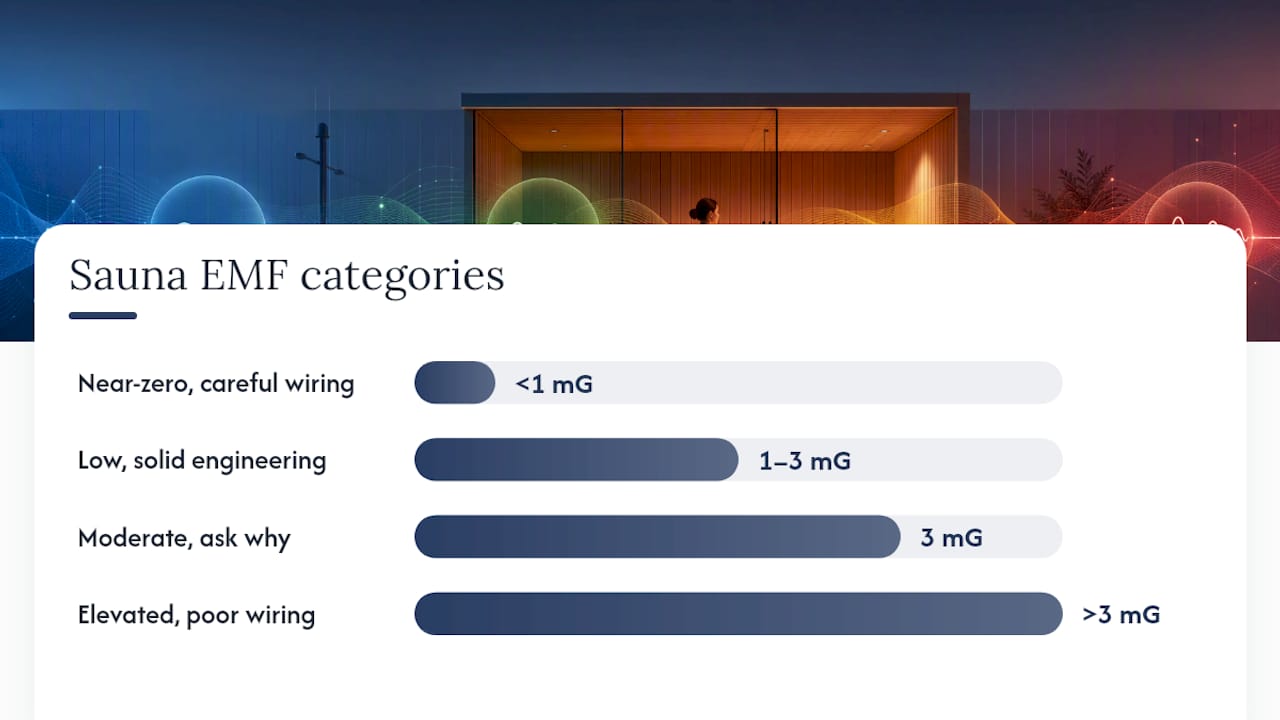
These bins aren’t official categories from any regulatory body. There is no sauna-specific EMF limit set by a government agency. The WHO’s EMF Q&A is explicit that evidence for health effects at low, everyday exposure levels remains limited, which is part of why agencies haven’t issued a sauna-specific cutoff. That absence of a hard regulatory line is exactly why buyer-side verification matters more here than in product categories with strict compliance thresholds.
The number is only meaningful with its measurement condition attached. A 2 mG reading taken cold, at the panel face, tells you almost nothing about what you’ll experience seated and warm. HomeSauna’s measurement guide recommends treating 1 to 3 mG at the seated position as a practical target rather than a guarantee, and that framing holds up: seat height and operating temperature are the two conditions that make a reading comparable at all.
Infrared vs. Traditional Saunas: Which Runs Lower on EMF?
The heating technology label tells you less than you’d think. Both infrared cabins and traditional electric or wood-fired rooms can measure low or high at the seat, and the deciding factor is almost always how the electrical system was engineered, not whether the heat source is infrared or hot air.
Traditional electric heaters draw a larger, more concentrated current through a single unit, which can produce a stronger localized magnetic field near the heater rock bed. Infrared panels distribute current across multiple emitters spread around the cabin walls, which can either help or hurt readings depending on how those panels are wired. Wood-fired units generally have the least electrical EMF exposure of the three, since the only current involved runs the blower and any ambient lighting.
What actually drives the number at your seat:
- Wiring routing — paired-conductor or twisted-pair wiring cancels out much of the magnetic field that single-run wiring produces
- Grounding quality — a dedicated grounded circuit reduces electric field readings measurably
- Controller and panel placement — control units and Bluetooth modules mounted behind the head or backrest sit closer to your body than ones mounted at the base or exterior
Infrared Sauna Lab’s engineering breakdown makes this point directly: most of what shows up at the seat traces back to wiring and controller placement, not the infrared emitter chemistry itself. Two infrared saunas using the same carbon or ceramic emitters can produce very different readings purely based on how the manufacturer routed the wiring.
Reducing EMF Exposure: What You Can Fix Before and After Installation
Some of these fixes belong before you buy. Others apply once the cabin is already in your home.
Before purchase, ask for four things:
- Published seat-height readings, not just panel-face numbers
- The exact distance and body position where those readings were taken
- The meter model used for testing
- Confirmation of grounding status and wiring configuration
During installation, an electrician should:
- Run a dedicated grounded circuit rather than tapping into a shared household line
- Verify chassis grounding on the heater unit itself, not just the outlet
- Route conductors in pairs where the cabin design allows it, since paired routing cancels a meaningful portion of the magnetic field
- Position the controller and any Bluetooth module away from the backrest and headrest zones
After the sauna is running, you can:
- Take your own meter reading at seat height once the cabin reaches temperature
- Switch off Bluetooth and Wi-Fi features you’re not actively using during a session
- Keep your phone off the bench and out of the cabin if you’re not using it for audio
- If readings come back high despite these steps, treat it as grounds to contact the manufacturer or consider rewiring rather than living with it
Sauna Heater Supply’s electrical requirements guide covers the circuit and grounding specifics an installer needs before the first power-on.
Pro Tip: If you already own a sauna and haven’t measured it, do it once before you decide whether mitigation is even necessary. A lot of buyer anxiety about EMF disappears once an actual number replaces the uncertainty.
Buyer Checklist: Questions to Ask Before You Buy
Bring this list into any conversation with a seller, whether you’re shopping in person or reading a product page.
- Ask for seat-height readings with the exact measurement distance stated
- Confirm which meter model produced those numbers
- Ask whether the cabin was warm and Bluetooth-enabled during testing
- Ask where the controller and any wireless module are physically mounted
- Confirm the unit is designed for a dedicated grounded circuit
- Ask about return policy or warranty coverage if your own meter reading doesn’t match published specs
Red flags that should make you pause:
- EMF numbers with no stated measurement distance
- Testing described only at floor level, not seated position
- A controller or Bluetooth module fixed directly behind the headrest
- Cold, unwired demo units used for EMF claims at a showroom
Sauna Heater Supply lists seat-height specifications, grounding details, and wiring configuration on its product pages specifically so buyers can verify before purchase rather than guess after installation.
Why Sauna Heater Supply’s Catalog Reflects Low-EMF Engineering
Sauna Heater Supply specializes in curating high-quality saunas, heaters, and accessories for homeowners, contractors, and wellness professionals, with product specifications built around the engineering factors covered above rather than vague marketing labels.
Three models worth knowing if low-EMF is your priority:
- The Finnmark FD-3 Full Spectrum Infrared Sauna uses full-spectrum emitters with panel wiring designed for consistent seat-height performance.
- The Finnmark FD-4 Trinity Infra-Steam Sauna combines infrared and steam functions, which makes grounding and dedicated-circuit installation especially relevant given the added electrical load.
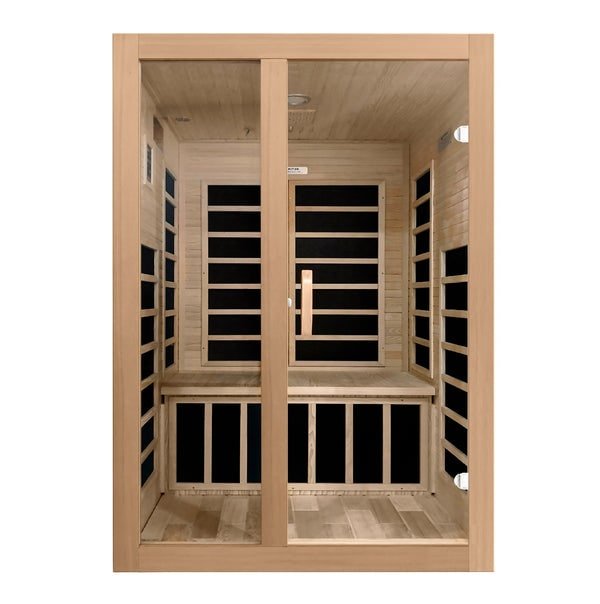
- The Dynamic “Santiago” 2-Person Low EMF Infrared Sauna is built specifically around low-EMF panel placement for smaller households wanting a two-person footprint.
The company backs its catalog with a price match guarantee, fast shipping, and a review base on Trustpilot that reflects repeat buyers, not one-time transactions. Models like the Dynamic “Monaco” 6 Person Ultra Low EMF sauna show the range extends from compact two-person units to full family-sized cabins without sacrificing the wiring discipline that keeps seat-height readings down.
What the Research Actually Says About Sauna EMF and Health
The honest answer is that the science on low-level EMF exposure is unsettled, not alarming. A PubMed-indexed review of ELF magnetic field epidemiology found uncertain causal links between everyday magnetic field exposure and health outcomes, while pointing out that better exposure characterization, meaning better measurement, is part of what’s missing from the existing research base. The National Cancer Institute’s EMF fact sheet states plainly that current evidence does not reliably connect low-level EMF exposure to cancer, even as research continues.
No government agency has issued a sauna-specific exposure limit, which puts sauna EMF in the same category as most household electronics: subject to general non-ionizing radiation guidance rather than a dedicated standard. This is exactly why the WHO frames its position around a precautionary approach for uncertain low-level exposures rather than a strict numeric ban. Precaution here doesn’t mean alarm. It means the practical step of choosing a lower-reading unit costs you nothing and gives you a margin of comfort while the underlying research matures.
For health- and safety-conscious buyers, the practical takeaway isn’t that sauna EMF is dangerous. It’s that spending 20 to 40 minutes several times a week in a specific location makes minimizing avoidable exposure a reasonable, low-cost precaution, not an overreaction. That’s a different posture than fear, and it’s the one worth adopting.
Putting Sauna EMF Numbers in Context
A reading of 2 mG can sound alarming in isolation, so it helps to know where common household exposures land. Standing close to a microwave oven while it’s running can produce readings well above what a well-wired sauna shows at seat height. Hair dryers, electric shavers, and box fans held at close range are all known for producing brief, high magnetic field spikes, often higher than a sauna’s steady-state reading, but for a few seconds rather than a 30-minute session.
The comparison that actually matters is duration times proximity, not the peak number alone. A sauna session puts you close to a field source for a sustained period, which is different from a hair dryer’s 90-second burst. That’s precisely why seat-height, at-temperature testing matters more for saunas than for appliances you use briefly. It’s also why a sauna reading of 1 to 3 mG, sustained for half an hour, deserves more attention from a cautious buyer than a hair dryer’s higher but momentary spike.
Context helps you calibrate, but it shouldn’t replace verification. Knowing that some household appliances spike higher doesn’t make an unverified sauna reading acceptable. It just means panic over a single unverified number is the wrong response. The right response is still the same: get the seat-height reading, know the conditions it was taken under, and compare it against the 1 to 3 mG range that quality low-EMF designs tend to hit.
What “Low-EMF” Marketing Doesn’t Tell You
The phrase “low-EMF” appears on sauna listings with almost no consistency in how it’s earned. A manufacturer can measure at the panel face from 18 inches away, get a flattering number, and market the whole cabin as low-EMF without ever testing where a person actually sits.
The gap between marketing language and engineering reality comes down to three unstated variables: distance, position, and operating condition. A reading taken cold, at the panel, with wireless features off will almost always beat a reading taken warm, at the seat, with Bluetooth paired. Neither number is dishonest on its own, but only one of them tells you what you’ll actually experience.
Verifying a manufacturer’s claim doesn’t require distrust, just a short list of questions. Ask what distance the published number reflects. Ask whether the cabin was at operating temperature. Ask whether wireless features were active. If a seller can answer all three without hesitation, that’s a strong signal the number is real. If they can only produce a single figure with no context, treat that as an incomplete answer rather than a red flag automatically, and ask for a seat-height reading directly before you commit.
The engineering-first approach treats “low-EMF” as a description of wiring and grounding choices, not a chemistry claim about the heating element. That’s the frame that actually helps you compare products instead of comparing marketing copy.
A Buyer’s Take on What “Low-EMF” Really Means
Most of the anxiety around sauna EMF comes from treating it as a mystery when it’s actually an engineering fact you can verify with a $150 meter. The conventional advice tells shoppers to “look for low-EMF saunas,” which is true but incomplete. It skips the part where the same wiring choice, paired-conductor routing with solid grounding, is what separates a 1 mG reading from a 15 mG reading, regardless of whether the box says infrared or traditional.
What gets overrated is the marketing label itself. What gets underrated is the measurement distance printed in fine print, or missing entirely. A seller who publishes seat-height numbers with the meter model and testing conditions has done real engineering work and isn’t afraid to show it. A seller who only lists a single flattering number, tested who knows where, is asking you to trust a claim instead of a fact.
If you take one thing from this guide, take the habit of asking for the seat-height number before you ask about wood type or interior lighting. The measurement should come first. Everything else is preference.
Find a Verified Low-EMF Sauna Through Sauna Heater Supply
Sauna Heater Supply gives you something most sauna retailers don’t: product pages built around the exact verification questions this guide just walked you through, seat-height readings, grounding details, and wiring configuration, instead of a single flattering EMF number with no context.
If you’ve read this far, you already know what to ask a seller and how a Jacuzzi can complement your wellness routine in addition to a sauna. The faster path is buying from a catalog where that information is already published. The Finnmark FD-3 Full Spectrum Infrared Sauna and Finnmark FD-4 Trinity Infra-Steam Sauna both list the specifications that let you verify readings against your own meter, and the Dynamic “Santiago” 2-Person Low EMF Infrared Sauna is a solid entry point if you’re outfitting a smaller space and want low-EMF engineering without a family-sized footprint. Sauna Heater Supply also backs every purchase with a price match guarantee and fast shipping, so you’re not paying a premium for the transparency. Browse the current low-EMF lineup, compare seat-height specs against what you learned here, and reach out to the team with your own meter readings if anything doesn’t match up.
Frequently Asked Questions
What is considered a low EMF level in a sauna? Most reviewers treat under 1 mG as near-zero or ultra-low, and 1 to 3 mG as a solid “low” target, both measured at seat height while the cabin runs at full operating temperature.
Is sauna EMF exposure dangerous? Current evidence, including the National Cancer Institute’s summary, does not reliably link low-level EMF exposure to health harm, though the WHO recommends a precautionary approach given ongoing research.
Do infrared saunas have higher EMF than traditional saunas? Not inherently. Wiring routing, grounding, and controller placement determine seat-height readings far more than whether the unit uses infrared panels or a traditional heater.
How do I measure EMF in my sauna at home? Use a TriField TF2 or comparable three-axis meter, warm the cabin to operating temperature, turn on any Bluetooth features, and take readings at seat height, head height, and near the control panel.
Can I trust a manufacturer’s low-EMF claim without testing it myself? Only if they publish the measurement distance, meter model, and testing conditions. A single number with no context isn’t enough to verify the claim on its own.
This article is general information, not a substitute for advice from a qualified doctor. Consult a qualified healthcare professional about your own circumstances before acting on anything here.
Sources
Recommended
- Maxxus 4-Person FAR Infrared Sauna - Low EMF — Sauna Heater Supply
- Maxxus 3-Person FAR Infrared Sauna Low EMF with Red Cedar — Sauna Heater Supply
- Dynamic “Monaco” 6 Person Ultra Low EMF Far IR Sauna (DYN-6996-01 Elit — Sauna Heater Supply
- Dynamic “Versailles” 2-Person Low EMF FAR Infrared Sauna — Sauna Heater Supply